

Were you one of the millions impacted by yesterday’s AWS US-EAST-1 outage? Did the thought of getting off work earlier cross your mind when services went down?
While the initial relief may have been short-lived, the reality for enterprise security leaders is that this massive downtime—caused by a technical DNS resolution issue with the DynamoDB service—is the starkest possible reminder of the fragility of modern infrastructure. It was not a cyberattack, but it was the ultimate real-world stress test for your Zero Trust Architecture (ZTA).
For CISOs and security architects, this isn’t just a cloud operations failure; it’s a security warning. The cascade of disruption exposed the single greatest weakness in our digital ecosystem: implicit trust in centralized cloud dependencies.
The Core Flaw: The Uncontained East-West Problem
The AWS outage was primarily an East-West traffic failure—a breakdown in service-to-service communication within the US-EAST-1 region. This highlights a critical lesson: the ZT principle of Microsegmentation is essential not just for security, but for resilience. The core principle that failed was the need to Assume Failure (an architectural counterpart to Assume Breach).
Microsegmentation and the Blast Radius
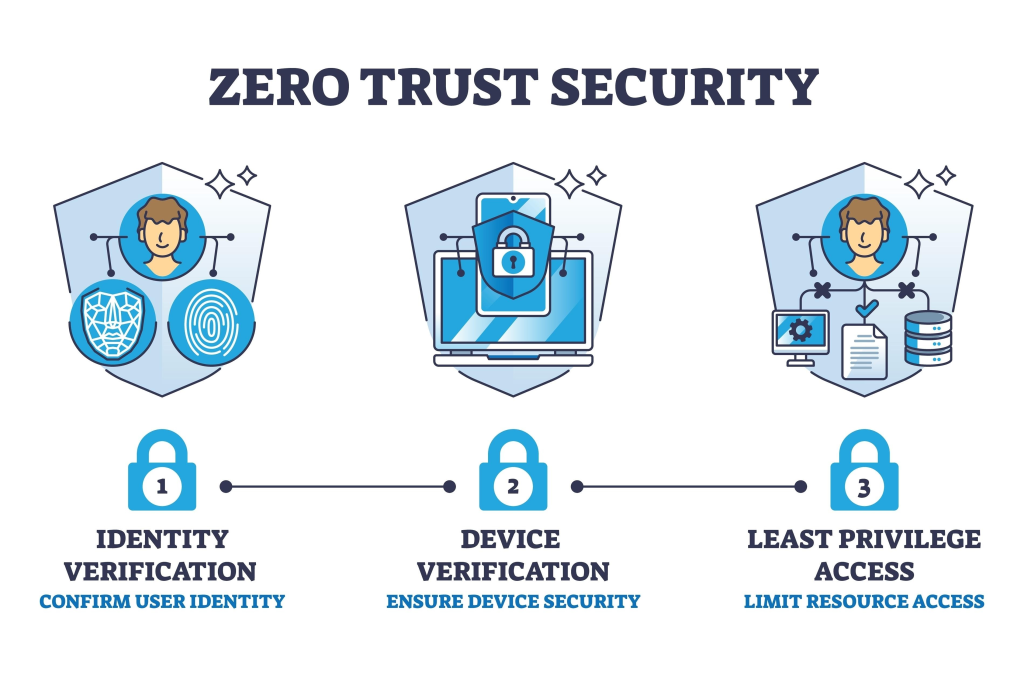
The core problem was the lack of independent verification between cloud workloads. By strictly enforcing the Least Privilege principle on traffic between services (e.g., between a Lambda function and a database):
- Your security architecture ensures one workload only communicates with the exact dependency it needs.
- You prevent a single DNS failure from globally paralyzing all internal communication and business logic across your infrastructure (including platforms like Google Cloud or Asana).
ZTNA’s Role: North-South Resilience
Zero Trust Network Access (ZTNA) primarily secures the North-South path (user access into an application). While ZTNA would not fix the internal DynamoDB dependency, a global ZTNA fabric is critical for user resilience. It allows you to:
- Route users securely and reliably to a working application endpoint in an alternate region.
- Ensure that access remains Explicitly Verified regardless of the user’s location or the underlying cloud instability.
Securing the Pipeline: Zero Trust in DevOps
In the modern cloud world, configuration changes are the most common source of system failure and security breaches. The internal DNS issue itself likely originated from a flawed deployment or change management process. Therefore, securing the DevOps workflow (CI/CD pipeline) is a non-negotiable ZT mandate.
- Pipeline Verification: The entire software delivery pipeline must be treated as a high-privilege access request. Every stage—from code commit to deployment—must be authenticated and authorized. The pipeline should run on Workload Identities with the strictest Least Privilege policies.
- Impact Radius Analysis (AI/Automation): We can leverage AI-powered automation within the pipeline to continuously measure the potential impact radius (or blast radius) of every configuration change before it’s deployed. If an update touches a core, widely-used service endpoint, the system should flag its potential impact radius, halting the deployment until independent approval is secured.
The Mandate for a Secured Recovery Phase
When a failure like this occurs, the recovery phase is often the most vulnerable to security lapses. The urgency to restore service can lead to shortcuts, making it critical to secure the backup and restoration process.
- Recovery Validation: Your recovery plan must prioritize backup and restore speed to minimize downtime. However, speed cannot compromise security. Once a downtime event is detected, an automated recovery arrangement must be initiated to restore a known, previous workable version.
- Workload Integrity Check: Your Cloud Workload Protection system is essential here. It must continuously scan and pre-verify all disaster recovery and backup environments. This ensures the version you restore is free of malware or configuration drift, preventing a security incident during the restoration process itself. The recovery process must strictly follow ZT principles to maintain system integrity.
Integrated ZT Capabilities for Resilience
The AWS outage provides a vital data point for every enterprise: single-platform dependency is a strategic risk. Your ZTA is your blueprint for true cloud independence—an architecture resilient to both the attacker and the inevitable technical flaw.
To achieve true ZTA resilience, integrate the following security capabilities:
- Cloud Workload Protection: Deploy advanced security platforms to ensure the integrity and security of your recovery phase. This includes pre-verifying backups and ensuring the rapid restoration of known, safe workloads.
>>> Crowdstrike can help! - Network Edge Control (ZTNA): Adopt modern edge security solutions that provide reliable Zero Trust Network Access (ZTNA). This capability isolates critical applications, verifying every connection request at the edge and ensuring validated user access even when core cloud regions struggle.
>>> Cloudflare can help! - Human Factor Resilience: Security awareness must be elevated. A major outage often leads to a wave of opportunistic phishing and social engineering attempts. Continuous training must prepare employees to question and verify every digital interaction, especially urgent “system recovery” notices.
>>> KnowBe4 can help! - Endpoint Integrity: Ensure your endpoint management systems continuously assess device health. This guarantees that the devices accessing your most critical recovery environments are compliant, patched, and verified, upholding the Explicit Verification principle during the highest-stress moments.
>>> Jamf can help!
Are you building a Zero Trust environment that can survive the next systemic cloud sneeze? The time to architect for true independence is now. Contact us for free consultation!



![[Free Webinar] Road to COP17: Unifying Enterprise Data with Planetary-Scale Geospatial AI](https://masterconcept.ai/wp-content/uploads/2026/09/Webinar-261007-Unifying-Enterprise-Data-with-Planetary-Scale-Geospatial-AI-_1280x720px-scaled.png)