

Reading time: 4 minutes
Most companies deploy an AI-powered customer agent to save money. Fewer tickets. Fewer agents. Lower cost per contact.
IKEA did that too. Then they made HK$10.9 billion from the same AI deployment.
Here’s the difference — and why it matters for every Hong Kong business running AI chatbot customer service in 2026.
Act 1: The Savings Story (Everyone Knows This Part)
In 2021, IKEA’s parent company Ingka Group launched a customer care chatbot called Billie — named after the bestselling Billy bookcase. Billie’s job was simple: handle the flood of repetitive queries. Where’s my order. Is this in stock. How do I return this. What time do you close.
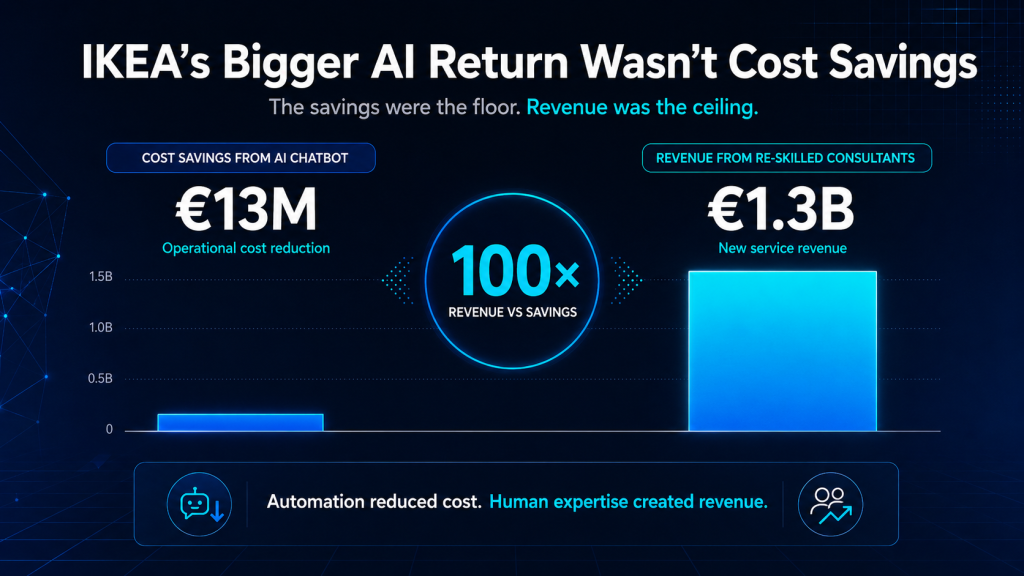
Between 2021 and 2023, Billie resolved 47% of all customer enquiries — over 3.2 million interactions — without a single human agent involved. The group saved more than €13 million in operational costs. (Source: Ingka Group Newsroom, June 2023)
A 47% automation rate. Board-ready headline. Most companies would have celebrated, maybe trimmed headcount, and moved on.
Ingka didn’t.
Act 2: The Revenue Story (Almost Nobody Talks About This)
Ingka asked a question that changes the entire conversation: what are the other 53% of customers actually calling about?
The answer was surprising. Those unresolved conversations weren’t harder versions of the same FAQ. They were something completely different — customers asking for help with space planning, style coordination, furniture selection. These weren’t service issues. They were buying signals. (Source: Reuters, June 2023)
So Ingka made a decision most companies wouldn’t: instead of cutting the 8,500 call centre workers that Billie had freed up, they reskilled them as remote interior design consultants — offering professional home planning advice via video and phone.
In the first year, this new service line generated approximately HK$10.9 billion (€1.3 billion) in revenue. That’s 3.3% of Ingka Group’s total sales from a channel that didn’t exist before the AI chatbot was deployed — and a customer retention and revenue engine that no one predicted.
Let that math sink in:
- Cost savings from AI: €13 million
- Revenue from re-skilled humans: €1.3 billion
- Ratio: 100×
The savings were the floor. The revenue was the ceiling. And nobody found the ceiling until they asked what the AI couldn’t do.
Act 3: The Credibility Proof (This Changes the Calculation)
The IKEA story is inspiring. But you might be thinking: “That’s IKEA. They have global scale. We’re a Hong Kong mid-market business. Different game.”
Fair. So here’s a second data point that applies to any AI chatbot Hong Kong businesses are evaluating — regardless of size.
Anthropic — the company behind Claude, the AI used by 70% of Fortune 100 companies — needed an AI chatbot customer service solution for their own support team. They had every reason to build one themselves. They literally make the AI. They employ some of the best AI researchers on earth.
They chose to buy.
They selected an established platform and had it live in under a week. Within one month: 50.8% resolution rate, 1,700 team hours saved, tens of thousands of queries resolved. (Source: fin.ai)
Their Head of Product Support Operations said it directly: if you’re a fast-growing company in a complex space, the advice is to buy a proven platform — because AI chatbot customer service at scale requires operational expertise that goes far beyond having a good model.
If the people who make the AI say “buy, don’t build,” the calculation changes for everyone else.
What This Means for Hong Kong Businesses
You don’t need IKEA’s scale to apply this. The pattern works at any size:
Step 1: Deploy AI to handle your routine queries — order status, returns, FAQ, opening hours.
Step 2: Look at what the AI can’t handle. What are customers actually asking? What patterns emerge? Are there buying signals hiding in your support queue?
Step 3: Redirect your freed-up human team toward the conversations that drive revenue — consultative selling, customer retention efforts, upsell opportunities, VIP support.
Step 4: Measure both sides — cost reduction from automation AND revenue from upgraded human interactions.
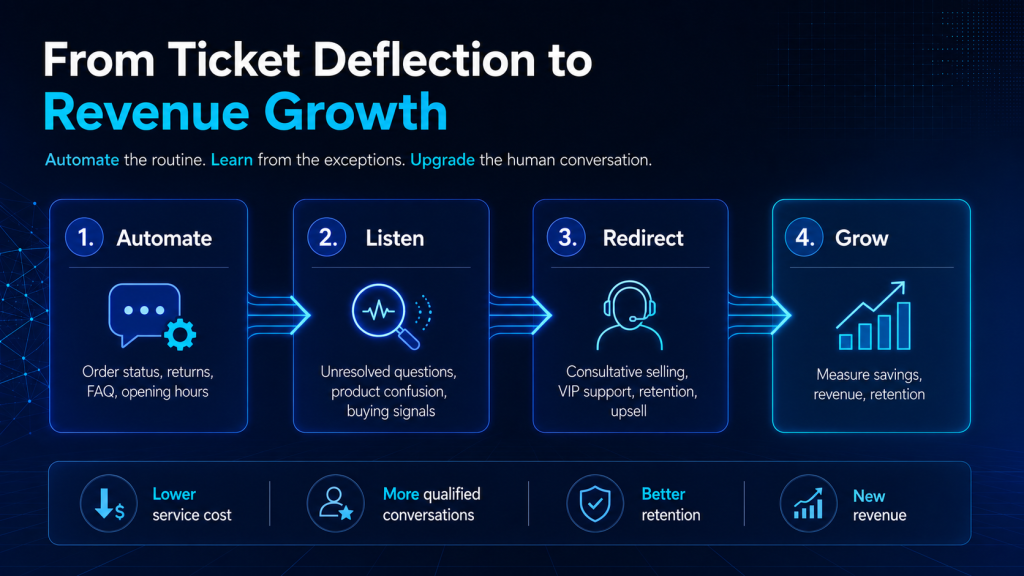
Most HK businesses stop at Step 1. The opportunity — the HK$10.9 billion lesson — is in Steps 2 through 4.
We see a version of this pattern in nearly every Hong Kong business we work with. The support queue is full of signals that nobody’s reading — customers asking questions that reveal what they’d actually buy, what’s confusing them about the product, what would make them stay. Most companies are so focused on reducing ticket volume that they’re throwing away the most honest customer research they’ll ever get.
The Question Worth Asking
Your AI chatbot is handling the easy stuff. Good. That’s table stakes.
The real question is: what is hiding in the conversations your AI can’t handle — that your team could turn into revenue?
Your chatbot should be a listening tool, not just an answering machine. The best chatbot customer care doesn’t just deflect tickets — it captures the most honest, unfiltered voice of your customer. If you’re only using AI to deflect tickets, you’re throwing that intelligence away.
Previously in this series: AI Chatbots in Hong Kong: What’s Actually Changed Since 2019 — And Why It Matters Now →
About DAL — Data & AI Lab: We help Hong Kong businesses design, implement, and optimise AI-powered customer service systems. No vendor lock-in — just the right tools for your needs.
Customer Intelligence. Delivered.
References
- Ingka Group Newsroom. “AI and Remote Selling bring IKEA design expertise to the many.” June 2023.
- Reuters. “IKEA bets on remote interior design as AI changes sales strategy.” June 2023.
- Fin.ai / Intercom. “Build vs. Buy. Why Anthropic chose Fin.” Intercom customer stories.


![[Free Webinar] Road to COP17: Unifying Enterprise Data with Planetary-Scale Geospatial AI](https://masterconcept.ai/wp-content/uploads/2026/09/Webinar-261007-Unifying-Enterprise-Data-with-Planetary-Scale-Geospatial-AI-_1280x720px-scaled.png)