

Reading time: 5 minutes
You’ve tried a chatbot before. It looped through the same five FAQ answers. Your customers left after two minutes. Your team spent more time apologising for the bot than the bot spent helping anyone.
If that’s your experience, you’re not wrong — most AI chatbot Hong Kong deployments between 2018 and 2023 were genuinely bad. Rigid decision trees. Keyword matching. Zero context. The kind of bot that responds to “I want to cancel, but maybe I could change my plan instead” by cheerfully initiating a cancellation.
That era is over. Here’s what’s changed — and why it matters for your business right now.
1. They Respond in Seconds, Around the Clock
Your customers don’t have office hours. They message at 11 PM. They need help during Chinese New Year. They reach out from a different time zone while your team is asleep.
Forrester research found that 53% of customers will abandon an online purchase if they can’t find a quick answer — and 77% say they expect a response in under five minutes. A modern automated service agent eliminates that wait entirely — instant response, any hour, any day.
For Hong Kong businesses serving customers across Greater China, Southeast Asia, or global markets, this isn’t a nice-to-have. It’s the difference between capturing an enquiry and losing it to a competitor who replies faster.
2. They Answer from YOUR Knowledge Base — Not Hallucinations
The number one concern every HK business leader raises: “What if the AI makes something up?”
Fair question. But modern AI-powered platforms use a technique called retrieval-augmented generation (RAG). Instead of generating answers from the AI’s general knowledge (where hallucination happens), RAG retrieves specific information from your own documents — your FAQ, your product specs, your service policies — and grounds every response in verified content.
You control what the AI knows. It won’t invent a refund policy you don’t have or promise a delivery timeline you can’t meet.
3. They Understand Context — Not Just Keywords
This is the biggest leap from the old chatbots.
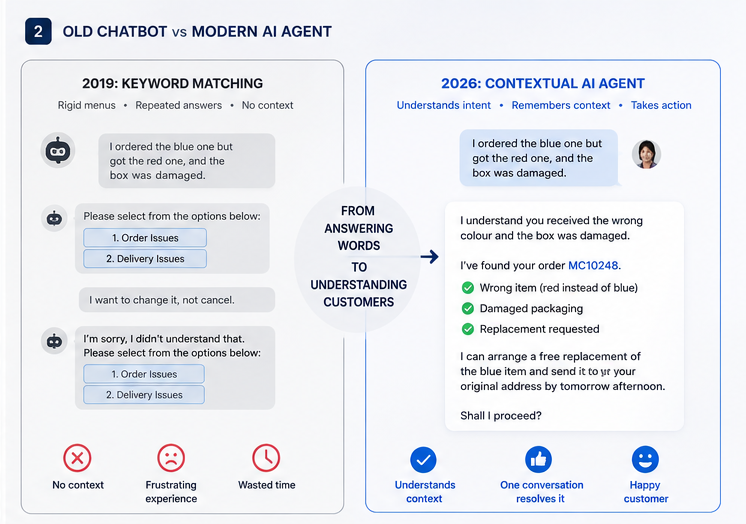
A customer writes: “that issue from last time still isn’t fixed.” A 2019 chatbot sees “issue” and serves a generic troubleshooting menu. A 2026 conversational AI chatbot pulls up the previous conversation, understands the context, and responds to the actual problem.
A customer writes: “I ordered the blue one but got the red one, and the box was damaged.” Old chatbot: routes to two separate queues. New automated service AI: handles both issues in one conversation.
For HK businesses with bilingual customers who switch between English and Chinese mid-message — a daily reality here — this contextual understanding is essential. Modern AI agents handle code-switching natively. The old ones couldn’t even handle a typo.
In our work with Hong Kong businesses, this is the single most common complaint about legacy chatbots: they can’t handle the way HK customers actually write. Mixed-language messages, abbreviated Cantonese, English brand names dropped mid-sentence. When we deploy modern AI agents, the difference in customer satisfaction scores is immediate — because the bot finally understands what people are actually saying.
4. They Know When to Shut Up and Call a Human
The most important capability of a good AI customer service agent isn’t what it can answer. It’s knowing what it shouldn’t answer.
A bereaved customer. A complex billing dispute. A high-value client weighing a major decision. These need a human — empathy, nuance, real judgement.
Modern AI chatbot customer service platforms detect these moments and hand off seamlessly. The human agent gets the full conversation summary and customer profile. No one asks the customer to repeat themselves. No broken handoffs. No “please hold while I transfer you to another department.”
That’s not just efficiency. That’s experience protection.
5. They Work on WhatsApp — Because That’s Where HK Lives
This one is binary. If your customer service AI doesn’t natively integrate with WhatsApp, it’s not built for Hong Kong.
WhatsApp is the dominant customer communication channel in the city. Asking HK customers to leave WhatsApp and visit a chat widget on your website is like asking them to fax you. Some technically can. None will.
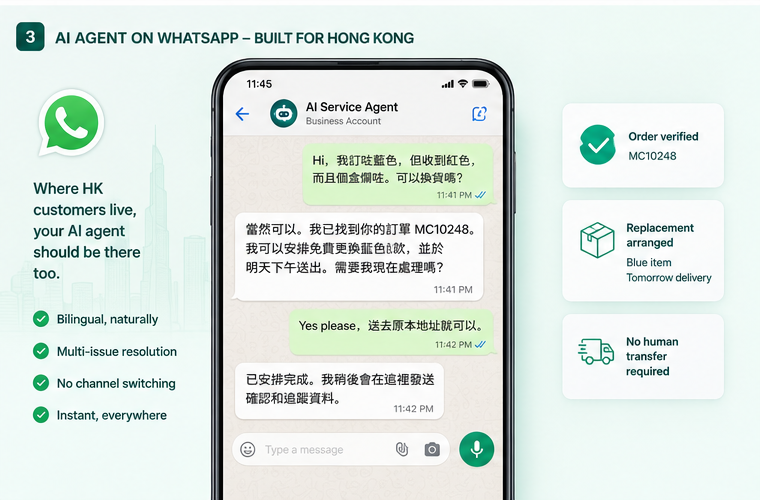
The best customer care chatbot for Hong Kong businesses in 2026 works natively on WhatsApp, web chat, email, social media, and in-app — maintaining the same conversation across all channels. One customer, one thread, no matter where they reach out.
[Image: AI chatbot responding to a bilingual HK customer on WhatsApp — showing seamless English-Chinese conversation with product recommendation. Alt text: “AI chatbot handling a bilingual English-Chinese customer conversation on WhatsApp for a Hong Kong business, demonstrating native code-switching and personalised response.”]
6. They Know Who’s Talking — Not Just What They’re Asking
This is where AI-powered customer agents stop being a search bar and start being useful.
When the AI integrates with your CRM and customer data, it knows who’s asking before they finish typing. Their name. Their purchase history. Their subscription tier. Their last support interaction. Whether they’ve been browsing your pricing page for the last 20 minutes.
A first-time visitor asking about pricing gets a different response than a three-year premium customer asking the same question. The AI doesn’t just know the answer — it knows who’s asking and why it matters.
According to McKinsey, companies that get personalisation right generate 40% more revenue from those activities than average players. That’s not a customer service metric. That’s a business growth metric.
So What Does This Mean for Your Business?
If you tried an AI chatbot in 2019 and it was a disaster — that’s valid. The technology was genuinely not ready.
If you’re still operating on that assumption in 2026 — that’s expensive. The gap between companies deploying a modern customer care chatbot and those still relying on manual support is widening every quarter.
The question isn’t whether AI-powered customer service works. It does — at scale, across industries, with measurable results. For any AI chatbot Hong Kong business leaders are evaluating today, the capability gap compared to 2019 is enormous.
The better question is: what are your customers trying to tell you that your current system can’t hear?
If you’re ready to evaluate, the practical next steps are understanding pricing models, implementation timelines, and which platform fits your scale and channels — we cover all of these in our evaluation checklist.
Next in this series: AI Chatbots Don’t Just Cut Costs — IKEA Used One to Make HK$10.9 Billion →
Ready to evaluate now? Download our AI Chatbot Evaluation Checklist for Hong Kong Businesses →
About DAL — Data & AI Lab: We help Hong Kong businesses design, implement, and optimise AI-powered customer service systems. No vendor lock-in — just the right tools for your needs.
Customer Intelligence. Delivered.


![[Free Webinar] Road to COP17: Unifying Enterprise Data with Planetary-Scale Geospatial AI](https://masterconcept.ai/wp-content/uploads/2026/09/Webinar-261007-Unifying-Enterprise-Data-with-Planetary-Scale-Geospatial-AI-_1280x720px-scaled.png)