


Goal and Objective
A “Goal” is a long-term, broad objective that can be achieved through various means. For example, a brand’s Goal might be to “Reduce new employee onboarding errors by 30% in Q4.”
An “Objective”, on the other hand, is a short-term, measurable action aimed at achieving the Goal.
To illustrate this concept, let’s consider an example:
Goal: “Increase brand awareness”
Objective: “Increase digital marketing reach through setting different digital ads and producing SEO content regularly”
Here are some key points to understand:
1. “Goals” are broad objectives that can be achieved in various ways.
2. “Objectives” are specific, measurable actions aimed at achieving the Goal.
Setting Goals: Common Frameworks and Strategies

Source: Asana
Defining goals is not a simple task
Defining achievable goals is even more challenging. A goal should conform to the SMART or CLEAR principle. SMART represents Specific, Measurable, Achievable, Relevant, and Time-bound, while CLEAR stands for Collaboration, Limitation, Emotional, Applicable, and Refinable. The CLEAR principle is considered more agile than SMART, especially the feature of “Refinable” which makes goals more flexible and not fixed once set.
In business, two common frameworks used to define goals are KPI (Key Performance Indicator) and OKR (Objectives and Key Results).
KPI (Key Performance Indicator)
KPI is a widely used goal-setting strategy that provides quantifiable data to understand the team’s or organization’s progress towards business objectives. It can be applied at various levels, from individual employees to entire organizations.
When selecting and defining KPIs, there are three key points to consider:
“Relevance”: The scope of KPIs is broad, hence the need to ensure that selected metrics are directly aligned with the objectives. For example, evaluating the success of a social media ad campaign and an IT project would involve different KPIs. Likewise, content marketing and physical event marketing within a marketing team would have different KPIs.
“Quantifiability”: Choose KPIs that can be measured in numbers, such as customer satisfaction scores. Avoid non-quantifiable aspects like employee morale.
“Control and tracking”: Select KPIs that can be controlled or trackedandavoid metrics that are uncontrollable. For example, “Out of 10 events, 8 of them are on a sunny day”.
OKR (Objectives and Key Results)
OKR is composed of two parts: objectives and key results. Objectives should be clear and forward-thinking, while key results must be specific and measurable. OKRs ensure that goals and objectives are aligned and can be presented in a simple formula:
“Achieve [key results] to reach [objective].”
Compared to KPIs, OKRs emphasize the relationship between goals and results, making them more macroscopic. They help organizations and teams clearly define action plans, clarify each employee’s and team’s objectives, and even connect individual goals to the overall enterprise goal.
Example: A marketing team aims to “Expand digital marketing reach” through key results like setting different digital ads and producing SEO content on a regular basis, ultimately aiming for the company’s goal of increasing brand awareness.
OKR vs. KPI
A comparison table provided by Asana, can help you quickly understand the differences between OKRs and KPIs:
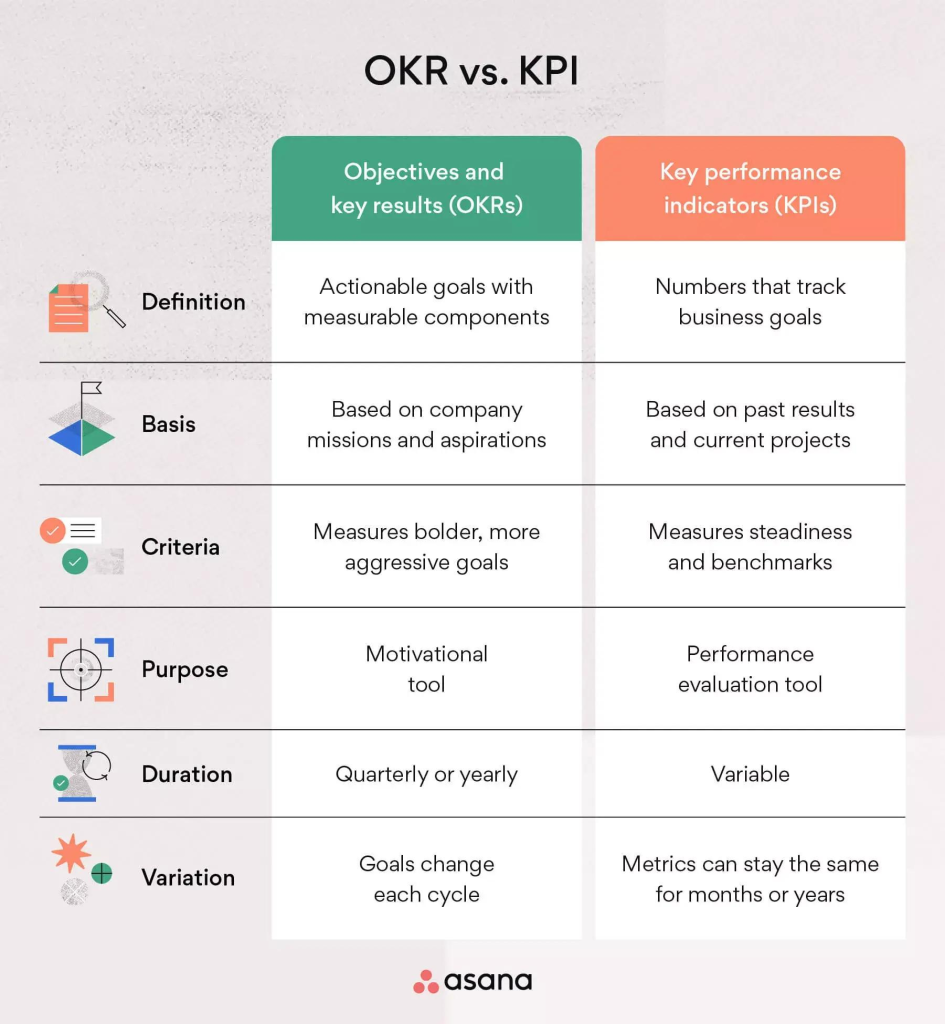
Source: Asana
After setting goals, what’s next?
Management by Objectives (MBO): is a simple, easy-to-understand method for tracking goals after they have been set. It consists of five steps:
- Define organizational objectives: as with KPIs and OKRs, these objectives should follow the SMART or CLEAR principles.
- Communicate the objectives to employees clearly: this step is often overlooked but it’s important to ensure that everyone understands the goals and what is expected of them.
- Track employee performance: regular tracking of employee performance helps identify challenges and opportunities for improvement, rather than just evaluating results at the end.
- Evaluate progress: after a reasonable period of time has passed, evaluate employee progress using key performance indicators or other relevant metrics.
- Provide feedback and rewards: provide constructive feedback and rewards to employees based on their performance, both in terms of tangible rewards like bonuses, and intangible rewards like positive reinforcement.
However, it’s important to note that not all goals can be achieved, so it’s important for organizations to use different tools to manage collaboration and increase the likelihood of goal achievement. For example, Asana’s advanced version includes features specifically designed to help teams collaborate more effectively and achieve their goals.
⚡️ Quick Channel ➤ Explore Asana Goal Tracking Features & Capabilities
Source: Asana
Additionally, Asana also provides templates for OKR planning, allowing users who are new to OKR planning to quickly get started!
⚡️ Quick Channel ➤ Objectives and key results (OKR) template

Source: Asana
Besides the two mentioned features, Asana is an easy-to-use, intuitive project management tool. If you want to learn more, feel free to contact a Master Concept professional consultant!



![[Free Webinar] Road to COP17: Unifying Enterprise Data with Planetary-Scale Geospatial AI](https://masterconcept.ai/wp-content/uploads/2026/09/Webinar-261007-Unifying-Enterprise-Data-with-Planetary-Scale-Geospatial-AI-_1280x720px-scaled.png)