


If you manage vehicles for a living, understanding fleet telematics is the first step toward transforming your operations. Unlike basic GPS devices that simply pinpoint a location, commercial telematics aggregate every data point your vehicles generate—location, speed, fuel consumption, driver behavior, and engine diagnostics—into a clear, actionable dashboard.
In short, telematics isn’t just about knowing where your vehicles are; it’s about understanding how your fleet is performing.
Today, companies across logistics, construction, public transport, retail, and field service rely on an integrated fleet telematics system to curb costs and boost overall operational efficiency. In this article, we’ll explore what telematics is, compare telematics vs. GPS, unpack its core capabilities, and look at how top fleets across various industries are putting telematics to work.
What Is Telematics? (And How It Evolved)
Fleet telematics—often referred to simply as telematics—combines telecommunications and informatics. By plugging a compact device into a vehicle, the hardware continuously collects and encrypts critical vehicle data—such as speed, engine diagnostic codes, fuel levels, and driving habits—and transmits it securely to the cloud. It goes far beyond static navigation, serving as the essential data engine for modern fleet tracking, preventive maintenance, and carbon accounting.
When managers first hear about telematics, a common question often pops up: “Isn’t this GPS tracking?” Not quite. While GPS tells you where a vehicle is, telematics tells you everything else happening under the hood.
Telematics vs. GPS: What’s the Real Difference?
Understanding the difference between telematics and GPS comes down to data depth and actionable management:
- Traditional GPS Tracking: Focuses purely on location and speed. It tells you Vehicle A is on Main Street traveling at 60 km/h. Essentially, you are watching a dot move across a map.
- Commercial Telematics: Tracks location, vehicle health, and driver behavior all at once. For example, when Vehicle A is on Main Street, the platform registers that engine coolant temperature is spiking, the driver hard-braked three times in 10 minutes, and the truck has been idling for over 15 minutes.
| Feature Comparison | Basic GPS | Fleet Telematics |
|---|---|---|
| Data Source | Satellite signals only | Satellite signals + vehicle OBD-II / CAN bus engine diagnostics |
| Data Depth | Location, time, speed | Fuel efficiency, driver behavior, engine health, carbon emissions |
| Reporting Mode | Fixed intervals (e.g., every 30s) | Dynamic, event-driven updates (e.g., harsh braking, collision alerts) |
| Business Objective | Vehicle location monitoring | Lower fuel costs, maximized uptime, enhanced driver safety, and reduced operational overhead |
While GPS tracking looks at where a vehicle travels on the outside, fleet telematics reads the vehicle’s internal nervous system. Fleet management platforms like Geotab rely on these deep insights to help enterprises trim fuel costs, automate preventive repairs, and cut carbon emissions.
How Telematics Systems Work
An end-to-end fleet management system relies on three primary components working in sync:
- The Device: The heart of the hardware. Usually a plug-and-play unit plugged into an OBD-II or universal diagnostic port, it reads deep engine and chassis metrics in real time.
- Cellular Network: Once data is collected, high-speed 4G or 5G networks securely stream encrypted data directly to cloud servers.
- Cloud Analytics Platform: Algorithms process, clean, and organize raw telemetry data into intuitive reports and visual dashboards accessed via web or mobile apps.
6 Key Features of Modern Fleet Telematics
Implementing high-ROI fleet management solutions requires more than one-way tracking. True fleet transformation relies on six core functional pillars of telematics that keep operating costs down across safety, fuel, and maintenance:
1. Real-Time Fleet Tracking & Dynamic Route Optimization
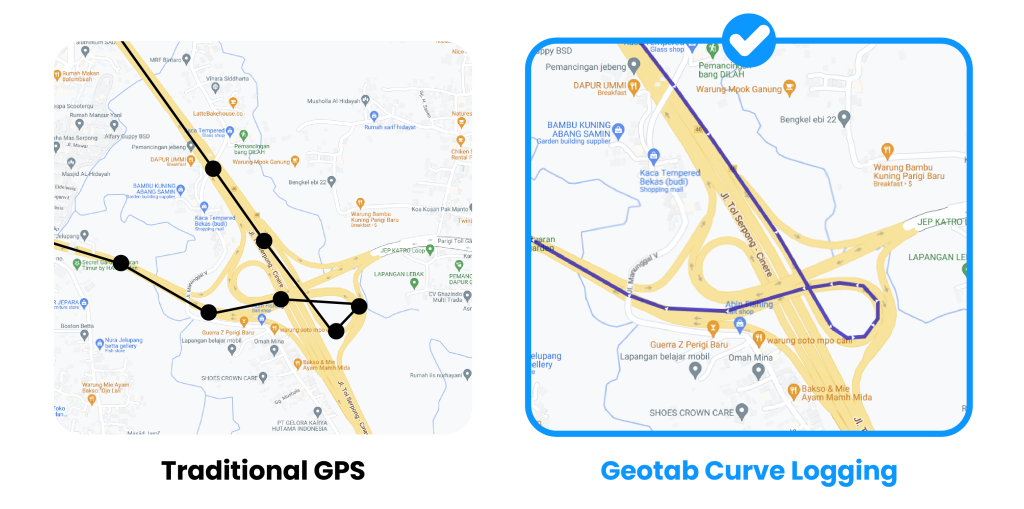
Traditional GPS trackers update at rigid intervals, often losing signals or drawing jagged routes around highway overpasses and urban alleyways.
- Curve Logging Algorithms: Intelligent telematics systems log points based on turns, speed changes, and unexpected events rather than arbitrary 30-second intervals. This creates a map trace that accurately reflects the true route driven.
- Dynamic Rerouting: Beyond precise ETAs, the platform automatically recommends alternate routes to bypass unexpected traffic bottlenecks, keeping deliveries on schedule and cutting wasted driving hours.
2. Driver Behavior Monitoring & Safety Scoring
Managing vehicles is straightforward; managing drivers is where the real work lies. Harsh braking, sudden acceleration, and speeding drive up accident rates and wear down tires and brakes.
Modern commercial telematics acts as an in-cab coach. The system quantifies risky behavior into clear safety scorecards for objective driver reviews. In-vehicle buzzers or voice alerts can prompt drivers the second they exceed speed limits or follow too closely, curbing risky habits instantly.
3. Fuel Monitoring & ESG Carbon Auditing
Fuel often accounts for more than 30% of total operating expenses. By reading vehicle diagnostics directly, a comprehensive fleet management system tracks key fuel metrics:
| Metric | Corporate Pain Points | Telematics Solution |
|---|---|---|
| Excessive Idling | Unmonitored engine idling wastes fuel and budget. | Pinpoints exact idling times and locations to enforce carbon reduction policies. |
| Fuel Anomalies | Relies on receipts; misses leaks or theft. | Reads OBD data/CAN bus for live fuel levels and immediate anomaly alerts. |
| ESG & Carbon Audits | Inaccurate, manual emission estimates. | Automatically converts mileage and fuel burn into audit-ready carbon reports. |
4. Engine Diagnostics & Fault Warnings
Waiting for a truck to break down on a busy delivery route leads to tow trucks, missed deadlines, and high repair bills. Fleet telematics devices read diagnostic trouble codes (DTCs) from the engine controller directly. If battery voltage drops unexpectedly or a check-engine warning triggers, administrators receive an immediate alert. Shifting from reactive maintenance to preventive care keeps vehicles on the road.
5. Remote Dispatching & Job Assignment
Dispatchers often waste time calling drivers to confirm locations or verify deliveries. Advanced fleet telematics systems connect directly with driver mobile apps. Dispatchers push destination details and route schedules straight to the optimal driver in one click, improving vehicle utilization and reducing detour miles.
6. Visualized Dashboards & Automated Reports
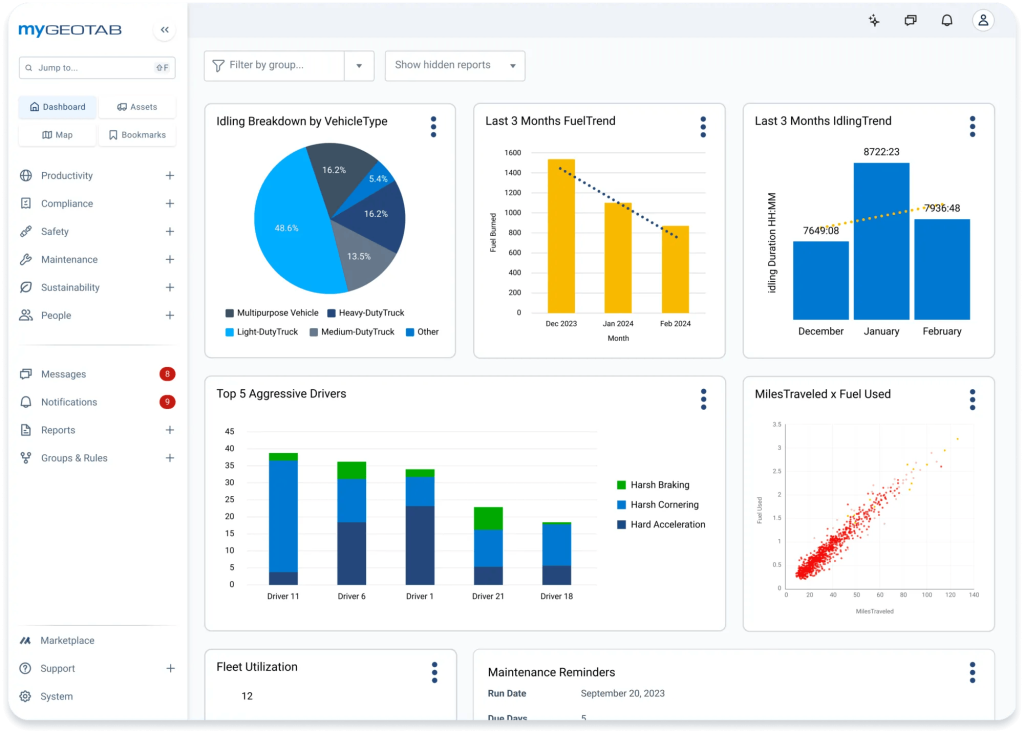
Visualized data helps fleet leaders shift from management by “gut feeling” to data-driven decision-making. Modern telematics platforms synthesize complex, raw data streams into intuitive executive dashboards, weekly efficiency charts, and driver safety scorecards.
5 Industry Examples: Commercial Telematics in Action
Across Southeast Asia and global markets, commercial telematics is creating measurable value across diverse sectors:
Logistics & Transportation
For freight operators where on-time delivery and cold-chain integrity are paramount, maintaining real-time fleet visibility is crucial to protecting brand reputation.
- Automated Geofence Check-Ins: Automatically logs exact arrival and departure times when trucks enter logistics hubs or delivery sites, completely eliminating manual check-ins and tedious paperwork.
- Precision Cold-Chain Monitoring: Integrates directly with cargo temperature sensors to trigger instant dispatch alerts if trailer temperatures spike, preventing high-value perishables or pharmaceuticals from spoiling.
Construction & Heavy Equipment
Heavy trucks and haulers move constantly between active job sites, making equipment tracking and utilization a major operational challenge.
- Site Geofencing & Arrival Logging: Sets virtual perimeters around active job sites to automatically log driver arrival times and track material delivery efficiency in real time.
- Engine-Hour & Idle Tracking: Monitors actual engine runtime to schedule preventive maintenance accurately while eliminating costly fuel waste caused by idle trucks waiting to unload.
Public Transport & Passenger Services
When transporting passengers, safety and regulatory compliance are non-negotiable top priorities.
- Driver Behavior & Fatigue Monitoring: Keeps close tabs on continuous driving hours, speeding, and aggressive maneuvers to ensure full compliance with local labor standards and keep passengers safe.
- Second-by-Second Crash Reconstruction: Captures high-precision telemetry data prior to an incident, allowing safety officers to reconstruct exact speed, braking, and steering inputs with pinpoint accuracy.
Retail & E-Commerce
In last-mile logistics, the customer experience directly impacts repeat business and brand loyalty.
- Dynamic Last-Mile Dispatching: Enables dispatchers to see exact driver locations in real time and instantly assign high-priority returns or express pickups to the nearest available unit.
- Live Customer ETA Tracking: Streams accurate, real-time arrival estimates directly to customer-facing apps, reducing missed deliveries and inbound support calls.
Field Services & Utilities
For telecom, utility providers, and technical field services, managing mobile crews and controlling operating overhead requires transparent fleet data.
- Automated Digital Route Logs: Automatically records business mileage and route histories in real time, streamlining expense reporting and preventing inflated fuel claims.
- Smart Emergency Response Dispatch: Locates the nearest qualified technician when utility outages or service calls occur, slashing emergency response times.
The True Key to Telematics ROI: Breaking Down Data Silos
Understanding telematics is one thing; ensuring your telemetry data flows seamlessly across systems is what determines your long-term success. Too many businesses fall into the trap of proprietary software silos. When your telematics platform can’t talk to your ERP or warehouse software, your operational visibility takes a huge hit.
Modern commercial telematics relies on platform openness. Geotab stands out with an open API architecture, letting enterprises connect vehicle data directly into ERPs, BI analytics tools, or third-party marketplaces. Regardless of your fleet size or vehicle types—gasoline, diesel, hybrid, or EV—an open system gives you a true single pane of glass.
Frequently Asked Questions (FAQ)
GPS trackers passively log basic location and speed, whereas fleet telematics connects directly to a vehicle’s OBD-II port or CAN bus system to capture live engine fault codes, aggressive driving habits, fuel burn, and carbon emissions for complete fleet management.
No. Modern telematics devices (like the Geotab GO device) feature a plug-and-play design that connects straight into standard OBD-II ports—no wire cutting or electrical modifications required. They are 100% safe for leased fleets and will not void original manufacturer warranties.
Yes. Enterprise telematics platforms seamlessly support mixed fleets across gasoline, diesel, hybrid, and electric vehicles. For example, Geotab tracks battery State of Health (SOH), real-time charge status, and EV energy consumption alongside traditional vehicle metrics in a single, unified dashboard.





![[Free Webinar] Road to COP17: Unifying Enterprise Data with Planetary-Scale Geospatial AI](https://masterconcept.ai/wp-content/uploads/2026/09/Webinar-261007-Unifying-Enterprise-Data-with-Planetary-Scale-Geospatial-AI-_1280x720px-scaled.png)