

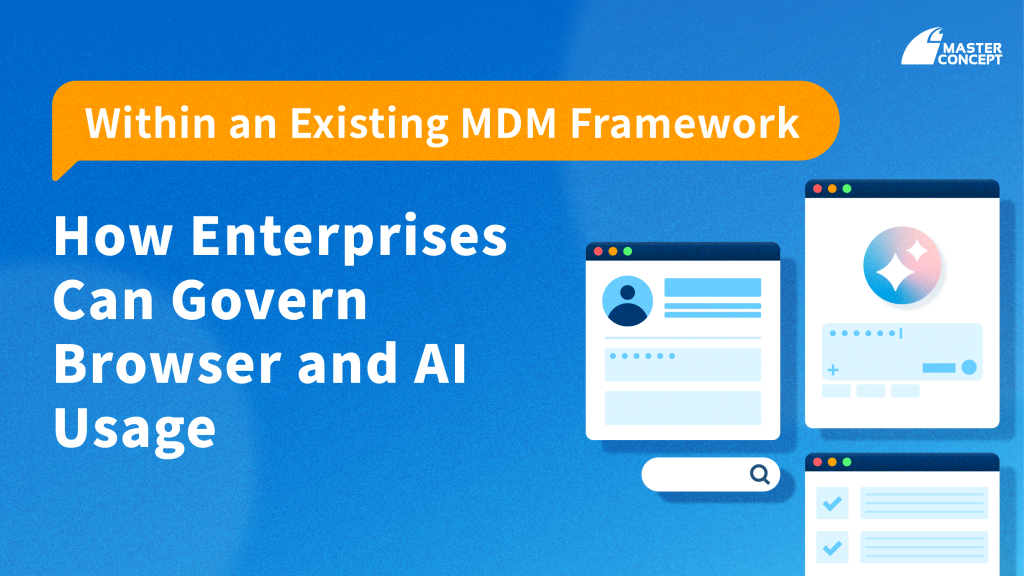
Generative AI has quickly become part of everyday enterprise work. From drafting emails and presentations to summarising information and accelerating research, tools like ChatGPT are now used across marketing, sales, product, and engineering teams.
At the same time, many organisations are facing a growing governance challenge: they have limited visibility into how AI is actually being used in daily work.
Not because policies are missing, but because existing controls were never designed for this kind of behaviour.
Most enterprises already run a mature Mobile Device Management (MDM) environment. In Apple-centric organisations, Jamf plays a critical role in enforcing device compliance, access conditions, and baseline security controls. Yet despite this, AI-related risk continues to surface.
This gap is not a failure of MDM. It reflects a shift in where risk now lives.
Why MDM Alone Is No Longer Enough for AI Governance?
MDM frameworks are built around devices. They answer questions such as:
Is this device managed? Is it compliant? Is the user authorised?
These remain essential foundations of enterprise security. However, generative AI introduces a different category of risk—one that is behaviour-driven and highly contextual.
An employee can be working on a fully compliant, company-managed device and still paste internal content into a public AI service through a browser. From an MDM perspective, nothing is technically wrong. From a governance perspective, visibility is missing.
This is why many IT and security teams find that even with Jamf in place, AI usage remains difficult to control in practice.
AI Risk Has Shifted to the Browser Layer
When enterprises examine how AI tools are actually accessed, a clear pattern emerges: the browser is the primary interface.
Whether users access ChatGPT directly or interact with AI features embedded in SaaS platforms, the browser mediates authentication, content input, file uploads, downloads, and copy-paste actions. These interactions happen continuously and often outside the scope of traditional device-centric controls.
As a result, effective AI governance increasingly depends on understanding how users behave in the browser, not just which device they are using.
Browser Governance Complements. Not Replaces MDM
Leading organisations are not choosing between MDM and browser security. Instead, they are combining them.
In environments where Jamf manages device posture and identity context, browser-level governance—such as that provided by Chrome Enterprise Premium—extends control to actual usage behaviour.
MDM establishes trust in the device and user. The browser layer adds the ability to apply policies based on what is happening during a session. Together, they form a more complete governance model for AI-driven workflows.
This layered approach allows enterprises to address AI risk without dismantling existing MDM investments.
The Practical Limits of Managing ChatGPT with Jamf Alone
It is common for IT teams to ask whether ChatGPT can be managed directly through Jamf. To a degree, it can. Access can be restricted by browser choice, device policy, or network controls.
However, these mechanisms operate at a coarse level. They can decide whether access is allowed, but not how AI tools are used once accessed. AI risk rarely comes from simple access—it comes from interactions with content during active work.
This is where many organisations recognise the need for additional controls that sit closer to user behaviour rather than infrastructure boundaries.
From Blocking AI to Governing Its Use
Importantly, most enterprises are not trying to eliminate AI usage. In markets like Hong Kong and Singapore, AI adoption is often encouraged as a productivity lever.
The real objective is governance, not prohibition. That means allowing AI where it makes sense, while ensuring usage aligns with corporate risk tolerance and data protection expectations.
By incorporating browser-level governance into an existing MDM framework, organisations can move away from binary “allow or block” decisions and toward more nuanced, context-aware policies that reflect how people actually work.
Rethinking Governance for the AI-Driven Workplace
As AI becomes embedded in daily workflows, enterprise security models must evolve accordingly. Device management remains foundational, but it no longer provides sufficient coverage on its own.
By recognising the browser as a governance control point—and aligning it with existing MDM platforms—organisations can better adapt to AI-driven work patterns without disrupting productivity.
For enterprises already running Jamf, this represents an incremental, architectural step forward rather than a disruptive overhaul. It is a shift from device-centric thinking to usage-aware governance, better suited for the realities of modern work. Contact us today to learn more!


![[Free Webinar] Road to COP17: Unifying Enterprise Data with Planetary-Scale Geospatial AI](https://masterconcept.ai/wp-content/uploads/2026/09/Webinar-261007-Unifying-Enterprise-Data-with-Planetary-Scale-Geospatial-AI-_1280x720px-scaled.png)