

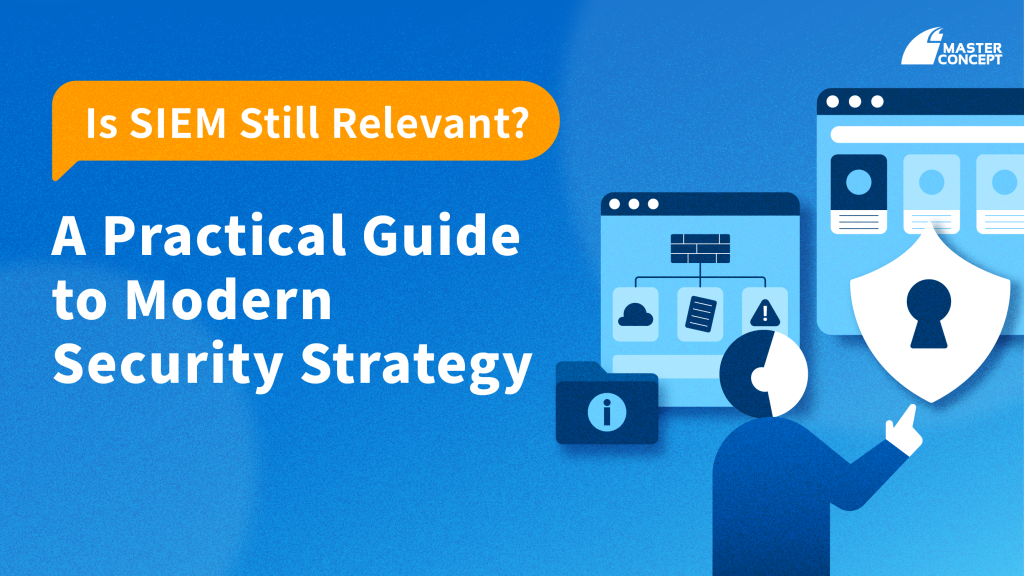
Cloud adoption, remote work, SaaS applications, and hybrid infrastructure have expanded the attack surface dramatically. At the same time, security teams are overwhelmed by alerts from firewalls, endpoint tools, identity platforms, and cloud services—often without enough context to determine what truly matters.
This is where SIEM (Security Information and Event Management) still plays a critical role.
But not in the way it used to.
This article explains what SIEM means today, how modern SIEM architecture works, and why SIEM still matters as part of an enterprise security strategy—especially in an era dominated by cloud, XDR, and AI-driven security.
What is SIEM? Why Do Enterprises Need It?
SIEM (Security Information and Event Management) is a centralized security analysis platform whose primary role is to “collect, analyze, and correlate security events and logs scattered across various systems, helping enterprises discover risks and respond immediately”. It combines Security Information Management (SIM) for centralized log collection and preservation (e.g., from firewalls, servers, cloud platforms, and applications) and Security Event Management (SEM) for real-time monitoring and correlation analysis to find anomalies and generate alerts
It combines two core concepts:
- SIM (Security Information Management) is responsible for centrally collecting and preserving logs (Logs), such as event records from firewalls, servers, cloud platforms, and applications.
- SEM (Security Event Management) performs real-time monitoring and correlation analysis on this data, identifies anomalous behavior, and generates alerts.
Therefore, SIEM is not merely a “log management tool,” but an analysis platform that enables enterprises to truly understand their overall security posture/status.
How Modern SIEM Architecture Works
While implementations vary, most SIEM architectures follow the same conceptual flow:
1. Data Ingestion
SIEM collects logs and events from across the environment, including:
- Network devices (firewalls, IDS/IPS)
- Endpoints and servers
- Cloud platforms and SaaS applications
- Identity and access systems
The goal is comprehensive visibility, not just perimeter monitoring.
2. Normalization and Enrichment
Because each system produces data in a different format, SIEM first normalizes logs into a consistent structure.
It then enriches events with additional context such as user identity, asset criticality, and threat intelligence.
This step is what enables cross-platform correlation.
3. Correlation and Analytics
Correlation is the core value of SIEM.
By connecting events that appear harmless in isolation, SIEM can detect:
Lateral movement
Credential abuse
Privilege escalation
Multi-stage attack behavior
Modern platforms increasingly apply behavioral analytics and machine learning to reduce false positives and surface high-risk activity.
4. Alerting and Prioritization
Effective SIEM platforms focus on risk-based prioritization, not alert volume.
Instead of flooding analysts with noise, SIEM helps security teams focus on:
Alerts with meaningful context
Incidents that require immediate action
Patterns indicating systemic risk
This directly addresses alert fatigue, one of the biggest challenges in security operations.
5. Visualization and Reporting
Dashboards and reports support different stakeholders:
- Security teams monitor real-time threats
- Management understands overall risk posture
- Organizations meet compliance and audit requirements
SIEM vs. XDR vs. SOAR: How They Work Together
A common misconception is that SIEM competes with newer security platforms.
In reality, they serve complementary roles:
SIEM provides centralized visibility, correlation, and security context
XDR focuses on detection and response across specific domains (endpoint, network, email, identity)
SOAR automates response workflows and remediation actions
When SIEM Makes Sense—and When It Doesn’t
SIEM delivers the most value when organizations:
Operate across hybrid or multi-cloud environments
Use multiple security tools that require correlation
Have compliance, audit, or reporting requirements
Need better visibility with limited security manpower
However, SIEM is not a silver bullet.
Without clearly defined use cases, operational ownership, and ongoing tuning, SIEM can become noisy and underutilized.
Successful adoption requires strategy—not just technology.
The Four Practical Application Scenarios of SIEM
Detecting Advanced Persistent Threats (APT)
APT attacks often proceed in phases, where a single event is inconspicuous but the risk is extremely high after correlation. SIEM can connect subtle yet continuous anomalous behaviors to expose latent attacks early.
Identifying Insider Threats (Insider Threat)
Through User and Entity Behavior Analytics (UEBA), SIEM establishes a “normal behavior baseline” for users, issuing alerts when anomalous operations (such as mass downloads or unauthorized access) occur.
Ransomware and Malicious Connection Detection
SIEM can integrate threat intelligence to identify connection behaviors with malicious IPs and C2 Servers, discovering risks before ransomware is activated.
Automated Incident Response (Paired with SOAR)
When SIEM is integrated with SOAR, it can automatically execute processes such as blocking IPs, disabling accounts, and isolating hosts, thereby reducing manual response pressure.
SIEM Development Trends: AI, XDR, and Cloud-Native
SIEM Development Trends: AI, XDR, and Cloud-Native
- AI and Machine Learning: Reducing False Positives and Addressing Alert Fatigue
- Integration with XDR: Supplementing attack context across endpoint, network, and identity layers.
- Cloud-Native SIEM: such as Microsoft Sentinel, offers advantages like elastic scalability and cloud integration.
SIEM is no longer just about “collecting data,” but is evolving toward an intelligent decision-making platform.
Conclusion: SIEM is the Critical Foundation for Enterprise Security Maturity
SIEM is not a silver bullet, but a core platform that truly implements security strategy. It helps enterprises move from “passively responding to incidents” to “actively understanding risks”. For enterprises facing hybrid cloud, remote work, and limited security manpower, choosing the appropriate SIEM architecture and strategy is a crucial step in building long-term security resilience.Welcome to contact masterconcept professional consultants.
SIEM Frequently Asked Questions (FAQ)
Q1: What is SIEM? What major security problems does it solve for enterprises?
SIEM (Security Information and Event Management) is a centralized security analysis platform used to collect, analyze, and correlate security events and logs across an enterprise’s various systems. It primarily addresses the problem of enterprises “not having clear visibility into overall security risks” and “having fragmented events that are difficult to prioritize,” serving as the core foundation for an enterprise’s overall SIEM security strategy.
Q2: How is SIEM architecture typically designed? Is it necessarily complex?
A typical SIEM architecture includes modules for data collection, normalization, event correlation analysis, alerting, and reporting. The actual complexity depends on the enterprise size and IT environment; most enterprises start with key system logs and core use cases and expand gradually, rather than attempting a complete implementation all at once.
Q3: What is the difference between SIEM and firewalls, EDR, and XDR?
These tools have different roles:
- Firewalls, EDR, XDR: are responsible for detection and defense.
- SIEM: is responsible for centralized analysis and understanding of the attack context.
In other words, SIEM does not replace security tools, but “connects them,” allowing enterprises to truly understand the risks behind the events.
Q4: Is a SOC required for SIEM implementation?
Not necessarily.
Although SIEM is often used in a SOC (Security Operations Center), many enterprises first implement SIEM as a centralized monitoring platform, and then decide whether to establish an internal SOC or adopt a managed SOC service, depending on their security maturity.
Q5: What is the difference between Cloud SIEM and traditional SIEM? How should enterprises choose?
Cloud SIEM typically offers the advantages of elastic scalability, consumption-based pricing, and native cloud integration, which often lowers the barrier to adoption and operation for enterprises with multi-cloud or hybrid environments.
Q6: What are the most common reasons for SIEM implementation failure in enterprises?
The most common problems are not the tool itself, but:
- Lack of clear use cases
- Collecting too many logs without an analysis strategy
- Excessive alerts, leading to alert fatigue
Therefore, the key to successful SIEM adoption lies in strategy and processes, not just technology selection.

![[Free Webinar] Road to COP17: Unifying Enterprise Data with Planetary-Scale Geospatial AI](https://masterconcept.ai/wp-content/uploads/2026/09/Webinar-261007-Unifying-Enterprise-Data-with-Planetary-Scale-Geospatial-AI-_1280x720px-scaled.png)