


When daily orders surge from a few dozen to several thousand, online brands quickly realize that shipping products is far more complex than it looks. Relying on traditional logistics and old-school warehouse methods simply won’t cut it. Manual dispatch leads to overlapping routes, missed drop-offs, and late deliveries that frustrate customers. Managing high-volume e-commerce fulfillment requires an entirely new operational blueprint.
In this article, we’ll break down what modern e-commerce fulfillment actually looks like, compare e-commerce and traditional logistics, examine major delivery bottlenecks, and show you how dynamic route planning helps online businesses scale profitably.
What Is E-Commerce Logistics? (Beyond Basic Shipping)
In traditional retail, customers visit a physical store, buy an item, and carry it home. In online shopping, convenience is just a click away—but that convenience raises customer expectations. Today’s buyers expect fast, accurate, and cheap delivery right to their door.
At its core, e-commerce logistics is the end-to-end management of goods from supplier inventory straight to the customer. It covers every step of storing, packing, and delivering products sold online from the moment a buyer clicks “place order” until the package arrives—plus handling any returns.
A modern e-commerce fulfillment chain consists of five main steps:
- Inbound & Warehousing: Receiving stock, storing items, and tracking inventory levels in real time.
- Picking & Packing: Receiving order alerts, locating items in the warehouse, double-checking contents, and packing them securely.
- Outbound & Line Haul: Sorting packed orders by region and transporting them to local distribution hubs.
- Last-Mile Delivery: Drivers or couriers delivering packages to homes, offices, or pickup lockers.
- Reverse Logistics: Managing returns and exchanges when customers send items back.
In short, e-commerce logistics is never just about “sending a package.” It’s an integrated ecosystem linking data, payments, and physical transportation.
Why Logistics Is the Hidden Engine of Online Retail
Early-stage merchants often focus heavily on brand marketing and product design, assuming shipping can easily be outsourced to any standard courier. But as order volumes increase, logistics becomes a make-or-break factor for three big reasons:
1. Drives Customer Experience and Loyalty
Delivery is the only physical touchpoint customers have with your online brand. Damaged boxes, late packages, or lack of tracking spark complaints and destroy repeat sales.
2. Protects Your Net Profit Margins
Shipping and delivery costs often make up 15% or more of total operating expenses. In thin-margin retail environments, inefficient routing eats away your bottom line.
3. Builds a Competitive Advantage
In today’s crowded e-commerce market, fast and reliable delivery creates a real edge over competitors who are slow to ship.
E-Commerce Logistics vs. Traditional Logistics
To understand modern supply chain friction, we need to compare ecommerce logistics and traditional logistics. While both handle freight, their underlying mechanics are worlds apart:
1. Order Profile: Bulk Shipments vs. Small Orders
Traditional logistics focuses on “low variety, large volume” shipments. Whether delivering to big-box retailers or business clients, orders move in large batches on pallets or full cartons. Plans are set weeks in advance.
E-commerce deals with high-volume, unpredictable orders. A single order might consist of just one or two small items. Handling thousands of small, unique orders dramatically increases warehouse picking complexity and shipping frequency.
2. Speed & Frequency: Scheduled Deliveries vs. Instant Fulfillment
Traditional logistics relies on fixed, predictable schedules (e.g., shipping to Vendor A every Tuesday). Schedules are locked in weeks or months ahead of time.
Online shopping is unpredictable. Flash sales or holiday surges (like Black Friday or Double 11) cause order spikes overnight. Customers expect fast delivery to their doorsteps within 24 to 48 hours.
3. Final Drop-Off Points: Standard Spots vs. Front Doors
Traditional trucks deliver to commercial loading docks, distribution centers, or retail stores with clear entrances and designated loading areas.
E-commerce couriers usually deliver to residential addresses, high-rise apartments, or office buildings. Finding parking, navigating apartment gates, and locating specific units make last-mile delivery the most time-consuming and expensive part of the journey.
4. Data Visibility: Periodic Updates vs. Real-Time Tracking
In traditional shipping, buyers typically only get a broad delivery window and paper proof of delivery. In e-commerce, both shoppers and back-office teams expect live updates—allowing customers to track their package’s real-time movement and view exact arrival ETAs down to the minute.
Comparison at a Glance
| Comparison | Traditional Logistics | E-commerce Logistics |
|---|---|---|
| Orders | Low variety, bulk volume, low frequency | High variety, small units, high frequency |
| Destinations | Fixed warehouses, retail stores, loading docks | Homes, offices, pickup lockers |
| Fulfillment Speed | Scheduled; ranges from days to weeks | 24-hour or same-day fulfillment |
| Data Visibility | Periodic status updates | Real-time tracking and ETAs |
| Core Challenges | Maximizing truck loads & warehouse space | Optimizing delivery routes & last-mile accuracy |
4 Delivery Bottlenecks Holding Back E-Commerce Fleets
When order volumes scale into hundreds or thousands of packages a day, manual dispatch fails. Fleets run straight into four major operational bottlenecks:
1. Out-of-Control Fuel and Mileage Costs
When drop-off locations are scattered across a city, dispatchers assigning routes manually often assign overlapping areas to different drivers. Drivers crisscross the same districts, sit in traffic jams, and waste fuel, driving up cost-per-mile metrics.
2. Schedule Disruptions from Emergency Orders & Returns
Handling last mile delivery in ecommerce requires handling volatility. Same-day rush orders, last-minute address changes, or customer returns require couriers to alter schedules mid-route. Without a real-time and dynamic dispatch system, sudden schedule changes easily lead to missed delivery windows and wasted miles.
3. High Rates of Failed Drop-Offs
The final drop-off is often the trickiest step. Unclear addresses, hidden building entrances, or absent recipients lead to failed delivery attempts. Returning packages back to the hub for a second attempt doubles your labor and fuel expenses.
4. Lack of Back-Office Data Visibility
Without live visual tracking, fleet managers can’t see where vehicles are or how drivers are progressing. Operations teams rely on drivers for manual updates, making it impossible to identify bottlenecks or optimize operations.
How AI Route Planning Solves Logistics Challenges
Solving delivery issues requires upgrading dispatching from manual guesswork to AI automation. Modern e-commerce fleets rely on smart algorithms to keep operations running smoothly.
Why Manual Dispatching Fails at Scale?
Experienced dispatchers know local streets well, but manual planning hits a wall when handling complex variables. For example, calculating optimal routes for 30 trucks delivering 500 orders—while factoring in delivery windows, vehicle load limits, and live traffic—is humanly impossible to solve quickly.
How AI Route Optimization Changes the Game
Smart route optimization replaces guesswork with algorithmic precision. Tools like Master Planner powered by Google Maps Route Optimization API (GMPRO) to process thousands of stops in under a minute to give you:
- Real-Time Traffic and Weather Adjustments: Uses historical and live traffic data to bypass peak congestion and update ETAs automatically during bad weather.
- Multi-Constraint Planning: Automatically factors in vehicle capacities, driver shift hours, and special handling (like cold-chain requirements).
- Guaranteed Delivery Windows: Aligns routes to meet precise delivery time windows requested by customers.

💡 Expert Take: An efficient dispatching system builds “golden routes”—paths that minimize total mileage, reduce the number of vehicles required, and meet every customer promise (delivery windows, exact drop-off points, etc.)
What’s More? Dynamic Re-Routing & Continuous Improvement
Static delivery plans lack flexibility. Modern dispatching platforms use dynamic route planning to adjust in real time. When unexpected traffic builds up or an urgent return request comes in, the system recalculates routes instantly, reassigning jobs to nearby drivers with available truck space.
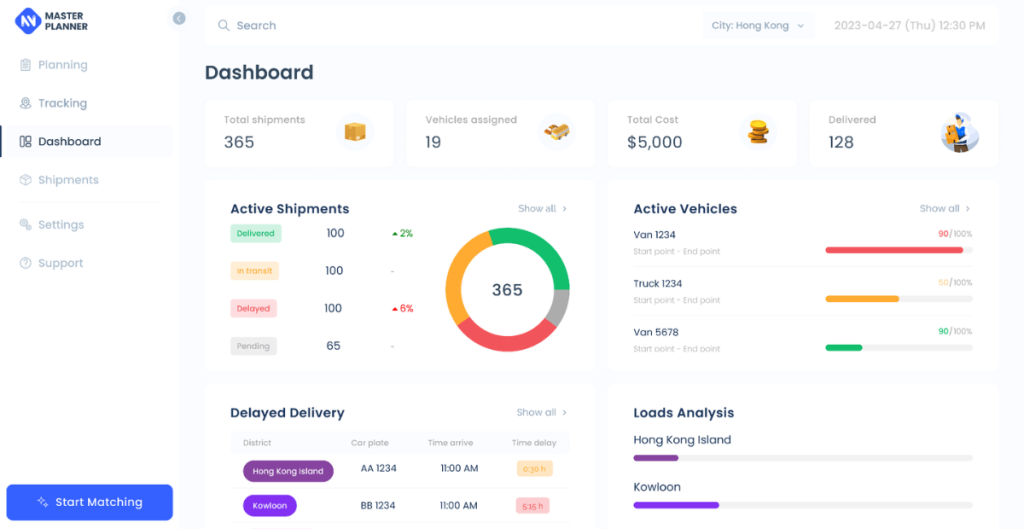
Even better, AI optimization turns daily operations into actionable analytics. Managers track drop-off times, fuel burn, and route efficiency through clear dashboard visuals—making it easy to continuously refine operations.
Scale Your E-Commerce Fleet with Master Concept
Understanding the mechanics of e-commerce logistics is a great first step, but real ROI happens when you replace manual dispatching with a smart automated system.
At Master Concept, we help online brands and fleet operators turn daily shipping chaos into a streamlined, profitable process. Our solution combines AI route optimization with live fleet tracking—allowing you to generate the fastest delivery paths automatically, adapt to last-minute changes on the fly, and monitor every trip from a single dashboard.
Ready to optimize your e-commerce deliveries? Reach out to our team today for a free consultation and personalized demo!
Frequently Asked Questions (FAQs)
1. What is ecommerce logistics and how does it work?
E-commerce logistics is the entire process of getting an online order from the warehouse to a customer’s doorstep. It includes inventory storage, picking and packing items, shipping packages through distribution hubs, managing last-mile delivery, and handling product returns.
2. What is the difference between traditional logistics and e-commerce logistics?
Traditional logistics focuses on shipping large bulk batches (like pallets or full truckloads) on fixed schedules to retail stores or commercial warehouses. E-commerce logistics handles thousands of small, individual orders shipped directly to residential addresses with much faster turnaround times—often within 24 to 48 hours to meet customer demand.
3. How can I improve my e-commerce delivery efficiency?
The fastest way to improve delivery speed and lower costs is to automate your dispatching. Using AI route optimization software like Master Planner eliminates manual planning errors, maps out complex multi-stop routes efficiently, and helps drivers avoid traffic jams—allowing your fleet to complete more orders in less time.
4. What is last-mile delivery?
Last-mile delivery is the final step of the supply chain, where a package moves from a local hub directly to the customer’s hands. It is typically the most expensive and time-consuming part of logistics due to unexpected traffic, parking challenges, and unclear drop-off locations.
5. How do I reduce high shipping and delivery costs for my online store?
You can significantly lower mileage and fuel expenses by replacing manual dispatch with AI route planning. Take Master Planner as an example:
- Calculates the shortest, most efficient paths across thousands of scattered drop-off points in minutes.
- Maximizes cargo space and weight limits so you use fewer trucks on the road.
- Bypasses heavy traffic and handles last-minute address changes on the fly to avoid wasted miles.
Reference:
- Ti Whitepaper – Global e-commerce Logistics costs, e-fulfilment and last mile



![[Free Webinar] Road to COP17: Unifying Enterprise Data with Planetary-Scale Geospatial AI](https://masterconcept.ai/wp-content/uploads/2026/09/Webinar-261007-Unifying-Enterprise-Data-with-Planetary-Scale-Geospatial-AI-_1280x720px-scaled.png)