

Why WAF Migration Has Become a Priority for Enterprises Handling Sensitive Data
In Singapore, enterprises in sectors such as financial services and insurance operate platforms that must handle high volumes of concurrent users and sensitive data. These environments require not only strong security protection, but also strict uptime guarantees and regulatory alignment.
As threat landscapes evolve, especially with the rise of zero day attacks and automated threats, traditional on premises WAF deployments are increasingly unable to keep pace. This has led many organizations to evaluate cloud based WAF as part of a broader security transformation strategy.
Migrating Without Disruption or Risk
For one regional enterprise managing high-traffic applications, the primary concern was not whether to migrate, but how to migrate safely. Key challenges included:
- Zero tolerance for downtime during migration
- Need to detect and mitigate zero-day threats
- Maintaining consistent security policies across environments
- Avoiding false positives that could impact user experience
In practice, a direct cutover from on-premises WAF to cloud WAF was not feasible. A more controlled and measurable approach was required.
Coexistence-Driven WAF Migration
Instead of replacing the existing infrastructure immediately, a coexistence model was introduced. This approach allows both environments to operate simultaneously while performance and security behavior are validated.
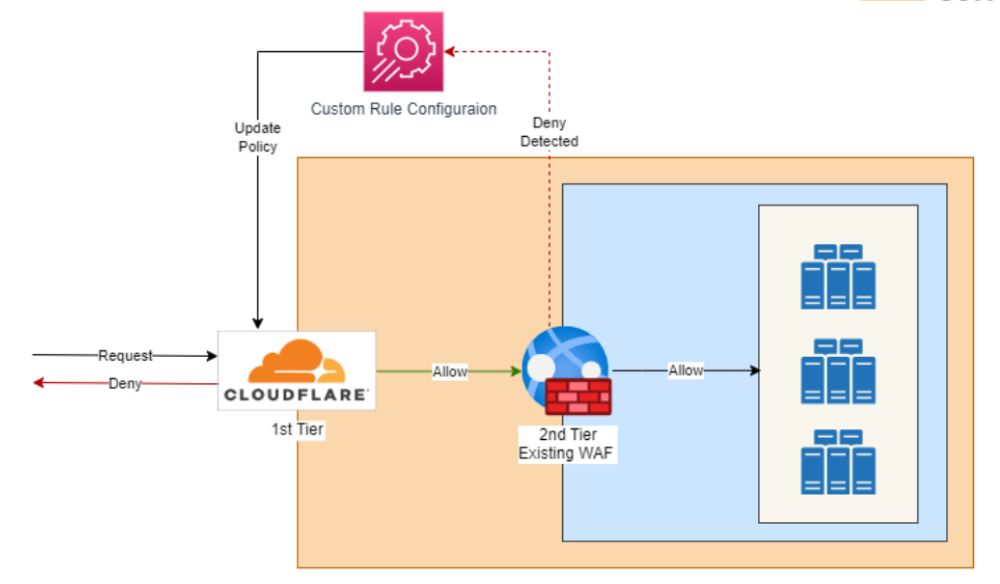
The design includes:
- Cloudflare DNS, CDN, and WAF forming a cloud protection layer
- Existing on premises WAF retained during transition
- Traffic routed across both environments for validation
- Continuous monitoring of application behavior and security events
How Coexistence Migration Works in Practice
This model is not only about architecture, but also about execution.A structured migration workflow is critical to ensure accuracy and stability.
Step 1: Parallel Deployment
Both WAF systems are deployed in parallel, allowing the cloud WAF to observe live traffic without immediately enforcing full blocking policies.
Step 2: Detailed Log Analysis
Traffic logs from both environments are continuously analyzed. This enables teams to:
- Identify discrepancies in threat detection
- Detect false positives from new rule sets
- Understand user behavior across applications
This step is essential to ensure that security improvements do not negatively impact legitimate users.
Step 3: Policy Tuning and Optimization
Based on log insights, WAF rules are fine-tuned. This ensures:
- Accurate threat detection
- Minimal disruption to application functionality
- Alignment with existing security standards
Step 4: Controlled Traffic Shift
Traffic is gradually shifted from the on-premises WAF to the cloud WAF. This controlled rollout allows teams to monitor:
- Application performance
- Security effectiveness
- User experience
Step 5: Full Cutover with Confidence
Only after validation is completed does the organization proceed with full migration. This eliminates the risks associated with abrupt transitions.
Security Enhancement Beyond Traditional WAF
Migrating to Cloudflare WAF introduces capabilities that go beyond traditional deployments.
The platform operates at the network edge, leveraging global threat intelligence and AI-driven detection to mitigate attacks in real-time.
This includes protection against:
- Zero-day vulnerabilities
- Automated bot attacks
- Application layer exploits such as SQL injection and cross-site scripting
Key Benefits of a Coexistence-Based Migration Model
| Area | Traditional Migration Risk | Coexistence Migration Approach |
| Downtime | High risk during cutover | Near-zero disruption |
| Accuracy | Limited validation | Continuous verification via logs |
| Security | Reactive tuning | Proactive optimization |
| User Impact | Potential service issues | Controlled and monitored rollout |
| Confidence | Uncertain outcomes | Data-driven decision-making |
Aligning with Security and Compliance Requirements in Singapore
Enterprises in Singapore must comply with data protection and cybersecurity standards. A cloud-based WAF architecture supports this by:
- Providing centralized visibility across environments
- Enabling consistent policy enforcement
- Supporting secure handling of sensitive data
This is particularly relevant for organizations operating across multiple regions with varying regulatory requirements.
From Migration Project to Security Transformation
WAF migration is no longer a simple infrastructure upgrade. It is a shift toward a more adaptive and intelligence driven security model. By adopting a coexistence driven migration approach, enterprises can:
- Minimize operational risk
- Improve protection against modern threats
- Maintain service continuity
- Build a scalable security foundation
For many organizations in Singapore, this approach has become the preferred path toward modern application security.
Organizations evaluating WAF migration typically begin by assessing current risk exposure, traffic patterns, and application dependencies. A structured migration approach, including coexistence validation and traffic analysis, can significantly reduce uncertainty and accelerate decision-making. For teams exploring how to implement this model in practice, a technical walkthrough tailored to their environment can help clarify the migration path and expected outcomes. Contact us today!
FAQ
How long does WAF migration to cloud typically take?
The timeline depends on application complexity and traffic volume. With a coexistence approach, most enterprises complete validation and migration within several weeks to a few months.
How can organizations ensure zero downtime during WAF migration?
By running both WAF environments in parallel and gradually shifting traffic after validation, organizations can avoid service disruption.
How to evaluate whether WAF migration is successful?
Success is measured by stable application performance, reduced false positives, improved threat detection, and no user disruption during transition.
What is coexistence mode in WAF migration?
Coexistence mode refers to running both legacy and cloud WAF simultaneously to validate security behavior before full migration.
Why move from on-prem WAF to cloud WAF?
Cloud WAF provides better scalability, faster threat response, and lower operational overhead compared to on-premises solutions.

![[Free Webinar] Road to COP17: Unifying Enterprise Data with Planetary-Scale Geospatial AI](https://masterconcept.ai/wp-content/uploads/2026/09/Webinar-261007-Unifying-Enterprise-Data-with-Planetary-Scale-Geospatial-AI-_1280x720px-scaled.png)