

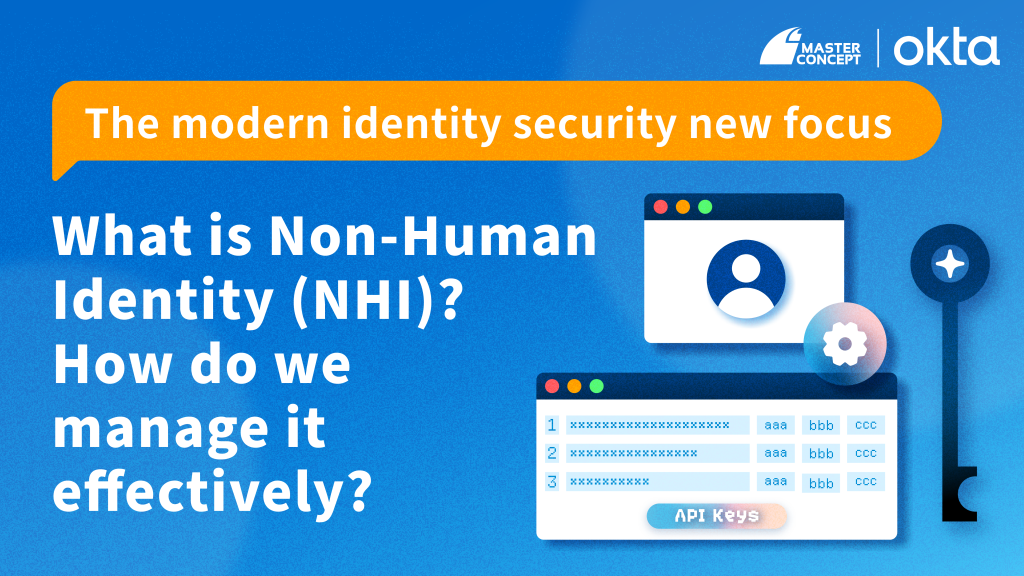
While we design the identity and Access Management (IAM) framework, most of the resources are usually dedicated to managing human user identities through SSO and MFA. However, according to the threat intelligence and market research of IBM, the identities driving high-frequency access to sensitive data in modern cloud environments are actually Non-Human Identities (NHIs). These kinds of machine credentials have become a primary attack surface that modern organizations can’t ignore.
What is Non-Human Identity (NHI)?
Non-Human Identity (NHI) refers to the digital credentials and accounts that are utilized by any software, source code, or automated processes to access digital resources and execute system commands without human intervention.
Within standard IT and development environments, the three most common types of NHIs include:
- API Keys: Digital passports that allow different software applications to communicate and exchange data with one another.
- Service Accounts: Specialized accounts dedicated to specific software applications or operating system services, used to execute background infrastructure tasks like automated data backups.
- Secrets and Tokens: Cryptographic keys, SSH keys, or temporary access tokens used for authentication within automated deployment pipelines (such as CI/CD workflows).
Why Do NHIs Outnumber Human Employees?
The proliferation of microservices architectures and enterprise automation has caused machine-to-machine interactions to grow exponentially. Every time an organization adapts to a new SaaS application, deploys cloud infrastructure, or establishes an automation workflow, there will be multiple API keys and service accounts being generated.
Cybersecurity data has indicated that in a typical enterprise IT ecosystem, the number of NHIs outnumbers human employees by 45 to over 92 times. It means that an organization with 500 employees may have tens of thousands of active non-human identities possessing data access privileges in the background.
What Are the Core Risks of Unmanaged NHIs?
The over-rising numbers of NHIs are already outside the traditional scope of IT oversight, which has presented substantial security risks. According to the IBM X-Force Threat Intelligence Index, credentials abuse has become one of the main pathways of data leaking.
Unmanaged NHIs typically suffer from the following technical vulnerabilities:
- Inherent Lack of MFA Capabilities: Machine credentials cannot perform biometric checks or input one-time passcodes. They rely almost exclusively on static secrets, making them highly vulnerable if intercepted by adversaries.
- Privilege Creep and Perpetual Validity: During deployment, developers frequently grant service accounts full Administrative privileges for operational convenience without enforcing expiration dates. This creates a high volume of over-privileged, stagnant credentials.
- Hardcoded Credentials: A frequent compliance oversight involves hardcoding API keys directly into application source code. If this code is inadvertently exposed to public repositories (such as GitHub), critical entry points become publicly accessible within seconds.
How to Manage NHIs?
To deal with the management challenges of NHIs, we have to move beyond human-centric IAM practices. Enterprises should integrate non-human identities into a unified identity governance strategy via three actionable steps:
- Continuous Discovery: Implement automated scanning across cloud and infrastructure environments to catalog all active and dormant APIs, service accounts, and their respective permissions.
- Enforce Least Privilege: Restrict the access scope of each NHI to the bare minimum required for its function, and mandate regular secrets rotation.
- Leverage Modern Identity Platforms: Utilize modern security platforms like Okta to consolidate the management of both human and machine identities into a single control plane.
To address the challenges of machine credential governance, many vendors have also been actively promoting ISPM (Identity Security Posture Management) capabilities.
What is ISPM?
Identity Security Posture Management is a continuous, automated security framework. It proactively detects over-privileged, misconfigured, or abandoned Non-Human Identities (NHIs) across diverse cloud infrastructures and diverse SaaS platforms which enable IT teams to remediate structural vulnerabilities before they can be exploited.
Conclusion
Automation and cloud technologies have improved the business efficiency, but also create blind spots on NHIs management. To build a resilient identity infrastructure is a continuous process. By identifying potential vulnerabilities in advance and implementing proactive governance solutions, enterprises can ensure their automated workflows remain secure and compliant. To evaluate your organization’s current identity security posture, please contact the advisory team at Master Concept.
FAQ
Is Non-Human Identity (NHI) the same as “Machine Identity,” a term frequently used in the cybersecurity industry?
NHI is the broadest overarching term, while Machine Identity represents the core physical component within the NHI ecosystem.
【 Non-Human Identity (NHI) 】
- Machine Identity (Servers, Virtual Machines, IoT devices, Containers)
- Software Identity (API Keys, OAuth Tokens, CI/CD scripts)
- Intelligent Identity (AI Agents, RPA automation bots)
How does ISPM (Identity Security Posture Management) differ from an enterprise’s existing CSPM (Cloud Security Posture Management) or PAM (Privileged Access Management)?
This is the most common classification confusion organizations encounter during procurement evaluation. These three architectures serve distinct operational purposes:
- CSPM (Cloud Security Posture Management): Focuses on infrastructure-level “misconfigurations” within cloud environments (e.g., whether an S3 bucket is exposed to the public, or if network firewalls have open backdoors).
- PAM (Privileged Access Management): Focuses on securing and auditing the credentials of “highly privileged human users (such as IT network administrators)” through password vaults, session recordings, and temporary authorization.
- ISPM (Identity Security Posture Management): Explicitly designed to manage the dynamic relationship between “identities and their actual permissions.” It continuously analyzes across multiple cloud providers (AWS/Azure) and SaaS platforms (Salesforce/Microsoft 365) to flag anomalous, dormant, or over-privileged human accounts and Non-Human Identities (NHIs). It effectively bridges the visibility gap left by CSPM (which lacks deep SaaS identity visibility) and PAM (which cannot scale to manage millions of automated APIs).
Will enforcing strict NHI secrets rotation and the principle of least privilege affect our existing CI/CD pipelines or automation workflows?
This is the single greatest point of friction and resistance for IT and DevOps teams. If an organization lacks centralized visibility, blindly changing the credentials of a legacy service account can easily cause the entire automation pipeline to crash.
To mitigate this risk, modern identity governance advocates a structured approach: “Discover First, Analyze Dependencies Second, and Remediate Dynamically Last.” By leveraging Okta ISPM, IT teams can passively monitor the real-time API calls of an NHI over a 90-day window. Once they verify that stripping redundant permissions or rotating tokens will not trigger a system-wide domino effect, they can execute automated credential rotations.
Do I still need IGA if I already have ISPM?
Yes. When a company exceeds a certain user size and operates in a hybrid environment, ISPM can only help you detect and assess risks across on-premises and cloud infrastructures. In contrast, IGA serves as the core for automatically executing user provisioning, lifecycle management, and compliance reviews. The two complement each other and are mutually irreplaceable.

![[Free Webinar] Road to COP17: Unifying Enterprise Data with Planetary-Scale Geospatial AI](https://masterconcept.ai/wp-content/uploads/2026/09/Webinar-261007-Unifying-Enterprise-Data-with-Planetary-Scale-Geospatial-AI-_1280x720px-scaled.png)