


Cisco found only 13% of enterprises globally are AI-ready. Here’s what that means for Hong Kong — and how to find out where you stand.
How AI-Ready Are Hong Kong Enterprises? The Data Is Sobering
Cisco’s AI Readiness Index delivered a sobering finding: only 13% of organisations globally have the data infrastructure, governance, and security foundations required for effective AI deployment. The remaining 87% are not ready — and most do not know it.
For Hong Kong enterprises, this gap carries specific consequences. The city’s businesses are investing in AI tools at an accelerating pace — from CRM automation to customer service chatbots to the 養龍蝦 (OpenClaw) trend that swept through tech circles in early 2026. But tools without foundations produce expensive disappointment.
Gartner reinforces the point: more than 40% of agentic AI projects will be cancelled by 2027 due to escalating costs, unclear business value, or insufficient data governance.
The question for Hong Kong’s C-suite is no longer “should we invest in AI?” It is “are we in the 13% that will succeed, or the 87% that will waste the investment?”
What “Not Ready” Looks Like in Hong Kong
The 87% problem is not abstract. It shows up in recognisable patterns across Hong Kong’s mid-market and enterprise landscape.
The spreadsheet layer.
Despite investing in CRM systems, many Hong Kong businesses still run critical customer decisions through Excel spreadsheets maintained by individual team members. When a key employee leaves, institutional knowledge walks out the door. No AI agent can access intelligence that lives in someone’s personal spreadsheet.
The WhatsApp gap.
WhatsApp is the dominant business communication tool in Hong Kong. Sales conversations, customer complaints, appointment confirmations, and relationship management all happen in WhatsApp threads — none of which feeds into the company’s CRM, analytics, or customer records. An AI agent deployed on top of this has no visibility into the most valuable customer interactions.
The bilingual data problem.
Hong Kong enterprises operate in English and Chinese simultaneously. Customer records, product catalogues, support tickets, and internal communications exist in both languages — often inconsistently. “John Chan,” “陳大文,” and “Chan Tai Man” may all be the same customer across different systems. AI agents cannot resolve these identity conflicts without a unified data layer.
The compliance blind spot.
The HKMA requires financial institutions to maintain audit trails on customer communications. The PDPO governs how personal data is collected, used, and stored. When customer data is scattered across WhatsApp, WeChat, email, CRM, and spreadsheets — with no centralised governance — AI agents do not just create efficiency. They create compliance exposure.
The cross-border complexity.
Hong Kong businesses that work with mainland China partners and customers face an additional challenge: data flows across WeChat, enterprise systems, and regulatory jurisdictions. AI agents operating across these boundaries need governed data pipelines that most enterprises have not built.
What AI-Ready Enterprises Do Differently — the 13% Playbook
Cisco calls the AI-ready 13% “Pacesetters.” Their advantage is not better AI tools — it is better data foundations. Specifically:
They have a single source of truth for customer data.
Not five dashboards pulling from five systems. A genuinely unified customer profile that combines behavioural data, transaction history, support interactions, and marketing engagement. This is typically built using a Customer Data Platform (CDP) such as Segment or mParticle, connected to analytics (Amplitude) and CRM (HubSpot).
They act on signals in real time.
When a high-value customer shows signs of churn, the team knows today — not in next month’s report. Real-time data pipelines feed AI agents with current information, enabling timely and relevant responses.
They govern data access proactively.
Clear rules about what data can be accessed, by whom, and for what purpose. This is not just a compliance requirement — it is the guardrail that prevents AI agents from confidently making wrong decisions with data they should not have accessed.
They invest in infrastructure before applications.
The 13% did not start with AI agents. They started with the data foundation that makes AI agents effective. The AI layer came last, not first.
The World Economic Forum confirms this priority: 72% of business leaders now say data foundations and pipelines will be their fastest-growing area of AI investment over the next 12 months.
How to Turn Scattered Data into Business Decisions
Introducing Customer Intelligence
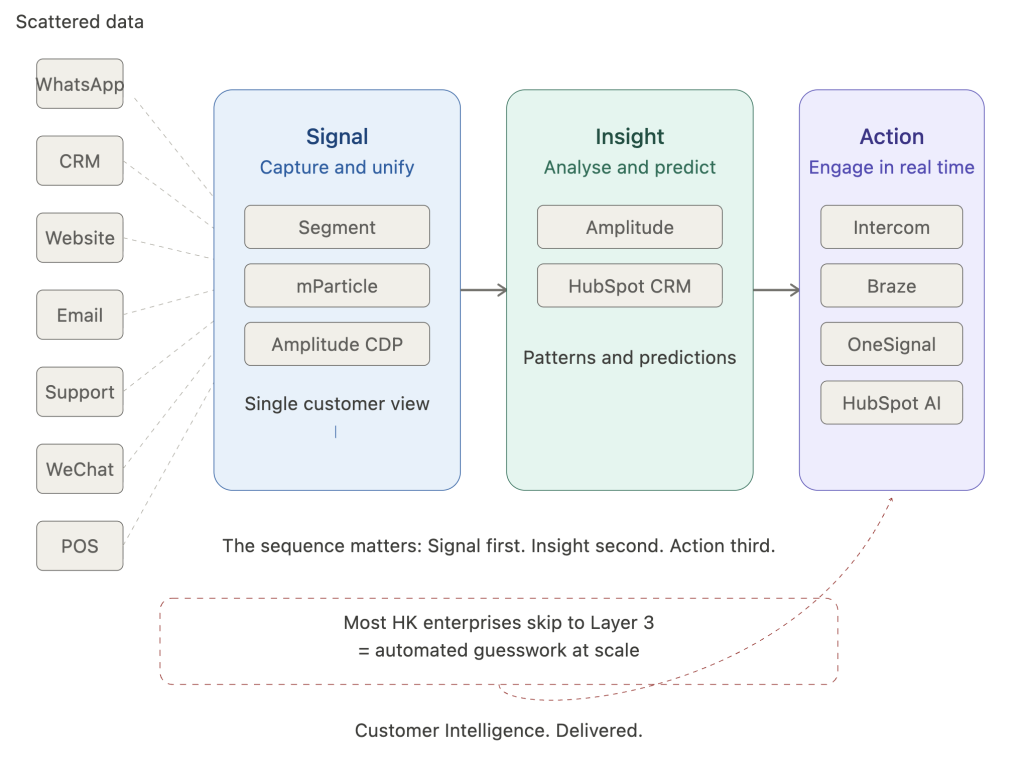
Customer Intelligence is the discipline that turns scattered data into business decisions. It is built in three layers: “turns scattered data into business decisions”
SIGNAL:
Capture and unify customer data from every touchpoint into a single source of truth. This is the CDP layer — technologies like Segment and mParticle that connect WhatsApp conversations, CRM records, website behaviour, support tickets, and transaction data into one unified customer profile.
INSIGHT:
Analyse behaviour, identify patterns, predict outcomes, and measure what matters. Analytics platforms like Amplitude reveal not just what customers are doing, but why — and what they are likely to do next. CRM systems like HubSpot provide the operational layer for sales and marketing teams to act on those insights.
ACTION:
Deliver personalised experiences, automate engagement, and optimise in real time. This is where AI agents become powerful — platforms like Intercom for customer service, Braze and OneSignal for cross-channel messaging, and HubSpot AI for CRM automation. But they only work when Layers 1 and 2 are in place.
Most Hong Kong enterprises try to jump straight to Layer 3. They deploy AI-powered customer service, automated email campaigns, or personalisation engines — without first unifying their data (Layer 1) or understanding what it means (Layer 2). The result: automated guesswork at scale.
Learn more about how this applies to Hong Kong enterprises →
The Business Cost of Poor Data Readiness in Hong Kong
The cost of not being AI-ready is not simply “missing out on AI.” It is measurable in concrete business terms:
Customer acquisition cost stays high because marketing cannot identify which channels and messages actually drive conversion. Every campaign is a partially informed guess.
Customer retention is reactive because churn signals — declining engagement, support complaints, competitive browsing — are spread across systems that do not talk to each other. By the time a human notices, the customer has already left.
Revenue attribution is unreliable because the customer journey spans touchpoints that no single system tracks. Leadership makes investment decisions based on incomplete data.
Compliance risk accumulates silently because customer data governance is manual, fragmented, and dependent on individual employees remembering to follow process.
AI investments underperform because every AI tool deployed on top of fragmented data produces fragmented results — and leadership loses confidence in the entire AI investment thesis.
The 13% avoid all of this — not because they have bigger budgets, but because they invested in the right sequence: data foundation first, AI applications second.
Talk to our team to be the successful 13%
How to Find Out Where You Stand
The path from the 87% to the 13% begins with honest assessment. Three questions determine your starting point:
1. Can you answer “who is our most valuable customer segment, and why?” using data from a single system? If the answer requires pulling from multiple systems and reconciling conflicting numbers, your data is not unified.
2. If a high-value customer showed signs of leaving today, would anyone in your organisation know today? If churn signals take days or weeks to surface, your data is not real-time.
3. Could you demonstrate to a regulator exactly what customer data you hold, where it is stored, and who has accessed it? If this would require a multi-week audit across multiple systems, your data governance is not adequate for AI deployment.
These are not technology questions. They are business capability questions. The answers determine whether AI agents will amplify your competitive advantage or amplify your existing problems.
DAL (Data & AI Lab) helps Hong Kong enterprises turn scattered data into business decisions. Our Customer Intelligence Assessment identifies where your organisation stands on the readiness spectrum — and maps the fastest path to the 13%.
Frequently Asked Questions
Why does Hong Kong rank so low in AI readiness compared to other markets?
Cisco’s AI Readiness Index found that only 2% of Hong Kong organisations qualify as “pacesetters” — compared to 13% globally. The South China Morning Post reported that 68% of HK organisations struggle to centralise data, and only 14% have robust computing capacity. The issue isn’t lack of ambition — 71% plan to deploy AI agents within a year. The gap is infrastructure: fragmented data across legacy systems, WhatsApp, WeChat, and multiple CRM tools that were never designed to work together. Emerging economies like Indonesia and Thailand are leapfrogging because they’re building on modern, unified stacks from scratch rather than retrofitting decades of disconnected systems.
What is the difference between AI-ready data and normal business data?
Normal business data sits in databases and spreadsheets and is adequate for human reporting — someone pulls a report, interprets it, and makes a decision. AI-ready data is fundamentally different: it must be unified across systems (not siloed), continuously quality-assured (not cleaned once a year), governed at the asset level (not by department policy), and contextually enriched with metadata that AI models need to understand what the data means, not just what it says. Gartner predicts that through 2026, organisations will abandon 60% of AI projects that lack AI-ready data. The gap between “we have data” and “our data is AI-ready” is where most enterprise AI investments die.
How long does it take to become AI-ready?
Faster than most enterprises expect. The foundation work — unifying customer data across CRM, messaging, support, and website touchpoints — typically takes 8-16 weeks with the right platform and implementation partner. The misconception is that AI readiness requires a multi-year, multi-million-dollar transformation programme. In practice, it requires choosing the right sequence: unify data first (CDP), build analytics second (behavioural analytics), deploy AI applications third (agents and automation). Organisations that try to skip steps or do everything simultaneously are the ones that stall. MasterAI solutions go live in 1-4 weeks for operational AI use cases.
Can SMEs in Hong Kong benefit from AI, or is this only for large enterprises?
SMEs can benefit — but they need a different approach. Large enterprises typically have fragmented data across many systems and need unification. SMEs often have simpler data landscapes but lack any structured data management at all. The HKPC’s AI Readiness Survey found that 88% of employees in surveyed firms already use AI tools, but SME cybersecurity readiness (48.4 points out of 100) lags significantly behind corporates (73.1 points). For SMEs, the starting point is often a single platform that handles CRM, analytics, and automation together (like HubSpot) rather than assembling a multi-vendor stack. The key principle is the same: get the data foundation right before deploying AI on top of it.
What should a Hong Kong enterprise do first to improve AI readiness?
Start with an honest assessment of where your data actually lives and how connected it is. The three questions in this article are a good starting point. Then prioritise based on your weakest zone. If customer data is scattered — start with a Customer Data Platform (Segment, mParticle). If internal knowledge is buried — start with an AI-powered knowledge base (KnowledgeAI). If manual processes consume your team — start with workflow automation (ProcessAI). The most common mistake is buying an AI tool before fixing the data it will run on. That’s why Gartner, Cisco, and MIT all point to the same root cause: the data foundation, not the AI model, determines whether your investment succeeds or fails.
DAL (Data & AI Lab) helps Hong Kong enterprises turn scattered data into business decisions. Our Customer Intelligence Assessment identifies where your organisation stands on the readiness spectrum — and maps the fastest path to the 13%. Book an assessment →



![[Free Webinar] Road to COP17: Unifying Enterprise Data with Planetary-Scale Geospatial AI](https://masterconcept.ai/wp-content/uploads/2026/09/Webinar-261007-Unifying-Enterprise-Data-with-Planetary-Scale-Geospatial-AI-_1280x720px-scaled.png)