

AI has been popular for a while, and some features are very helpful for work, but many people are starting to feel the limitations of several AI models. When will we have an AI assistant like F.R.I.D.A.Y in the Iron Man Marvel movie? When will we be having the same intelligent service?
In December last year, Google announced Gemini, the most powerful AI multimodal not only breaking the restrictions of only writing instructions but also obtaining superior understanding through a large amount of data training with a price more affordable than OpenAI.
What is Multimodality?
Traditionally, AI models have focused on single data source formats. For instance, Google Vision AI primarily deals with images, while Google Speech-to-Text AI focuses on audio. In contrast, multimodal models seek to integrate vast amounts of data, enhancing the accuracy and effectiveness of their models. This progression mirrors human development. As embryos, we first develop the sense of touch, followed by smell, taste, hearing, and finally, sight. As our senses mature, embryos or infants respond increasingly to environmental stimuli in various ways. In elementary school, most subjects initially focus on foundational skills in a single direction. Language studies emphasize character recognition, writing, and vocabulary explanation, while mathematics concentrates on basic arithmetic. However, as we progress to middle school, high school, and university, we rely on all previously accumulated skills to make comprehensive judgments. This enables us to write articles with correct word usage, appropriate vocabulary, personal experiences, and historical context, or to solve problems using geographical knowledge and calculation skills based on maps provided in exam questions. These examples demonstrate that multimodal models’ learning approach closely resembles that of humans, and their capabilities are becoming increasingly similar to those of the human brain.
Multimodal models have a more diverse and extensive range of applications compared to conventional AI models. In the past, when shopping online, we typically relied on website categories or keyword searches to find desired products. However, sometimes we might struggle to locate an item due to uncertainty about its official name. With the integration of image input sources, consumers can now simply upload a photo of the product they wish to purchase, quickly finding identical items. E-commerce platforms can even recommend similar styles, enabling consumers to compare prices and make selections more efficiently. This advancement in AI technology not only streamlines the shopping experience but also bridges the gap between visual recognition and text-based search, offering a more intuitive and user-friendly approach to online retail. Such multimodal capabilities demonstrate the potential for AI to revolutionize various aspects of e-commerce and digital interactions, making processes more intuitive and aligned with natural human behavior.
Google’s Most Powerful Multimodal Model -Gemini Partially Launched
Gemini is a multimodal model built from the ground up by Google. Through internal cross-departmental collaboration, Gemini can be applied to diverse scenarios, accurately and fluently understanding and responding to various forms of data input including text, images, video, audio, and code. It’s highly flexible and can operate on different platforms such as data centers, computers, or mobile devices.
Currently, Gemini comes in three versions: Ultra, Pro, and Nano:
- Ultra: The highest-level and largest model, suitable for highly complex tasks.
- Pro: Already integrated with Google services like Bard and Vertex AI, offering the highest versatility.
- Nano: The most efficient version, easily usable on small devices like smartphones.
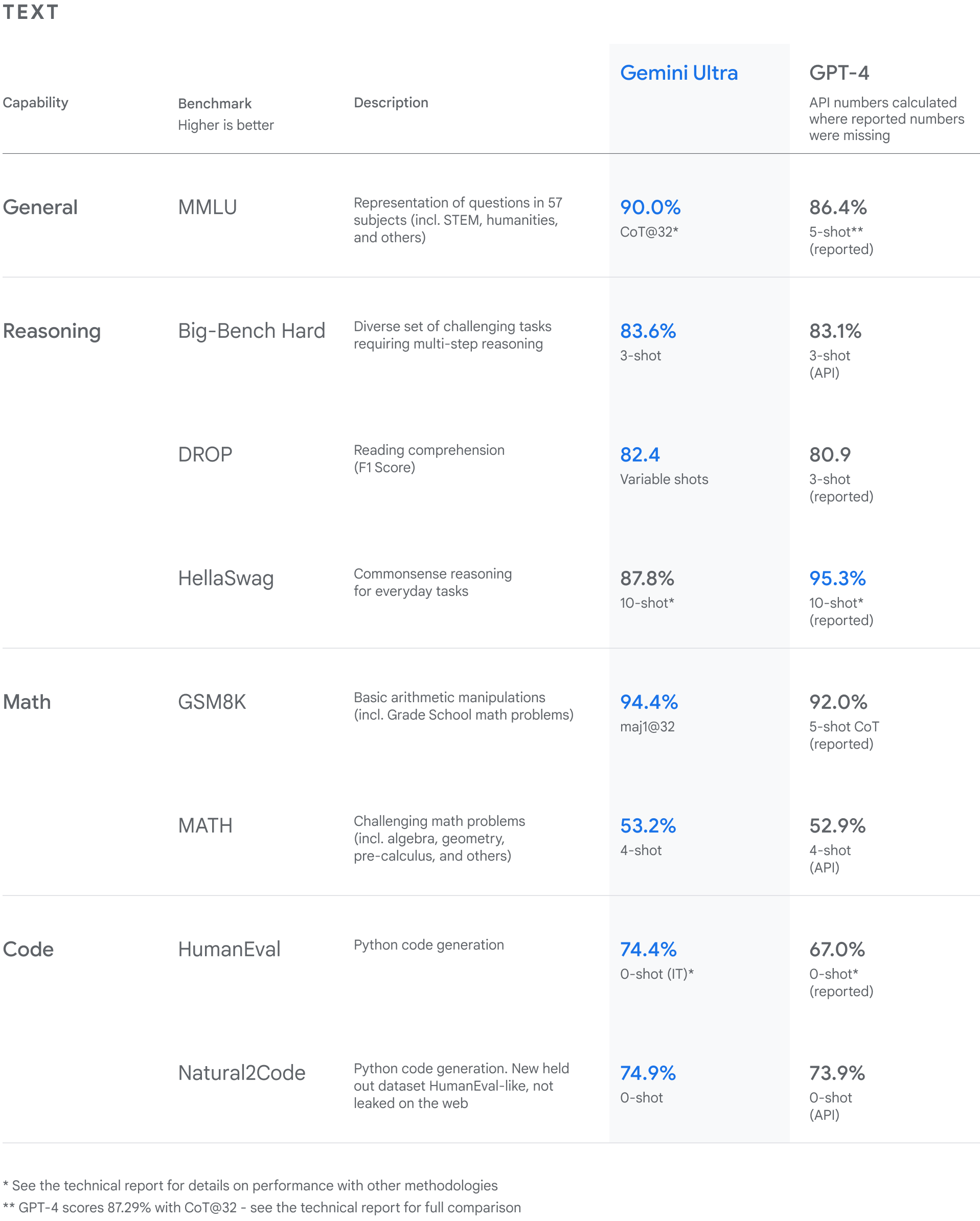
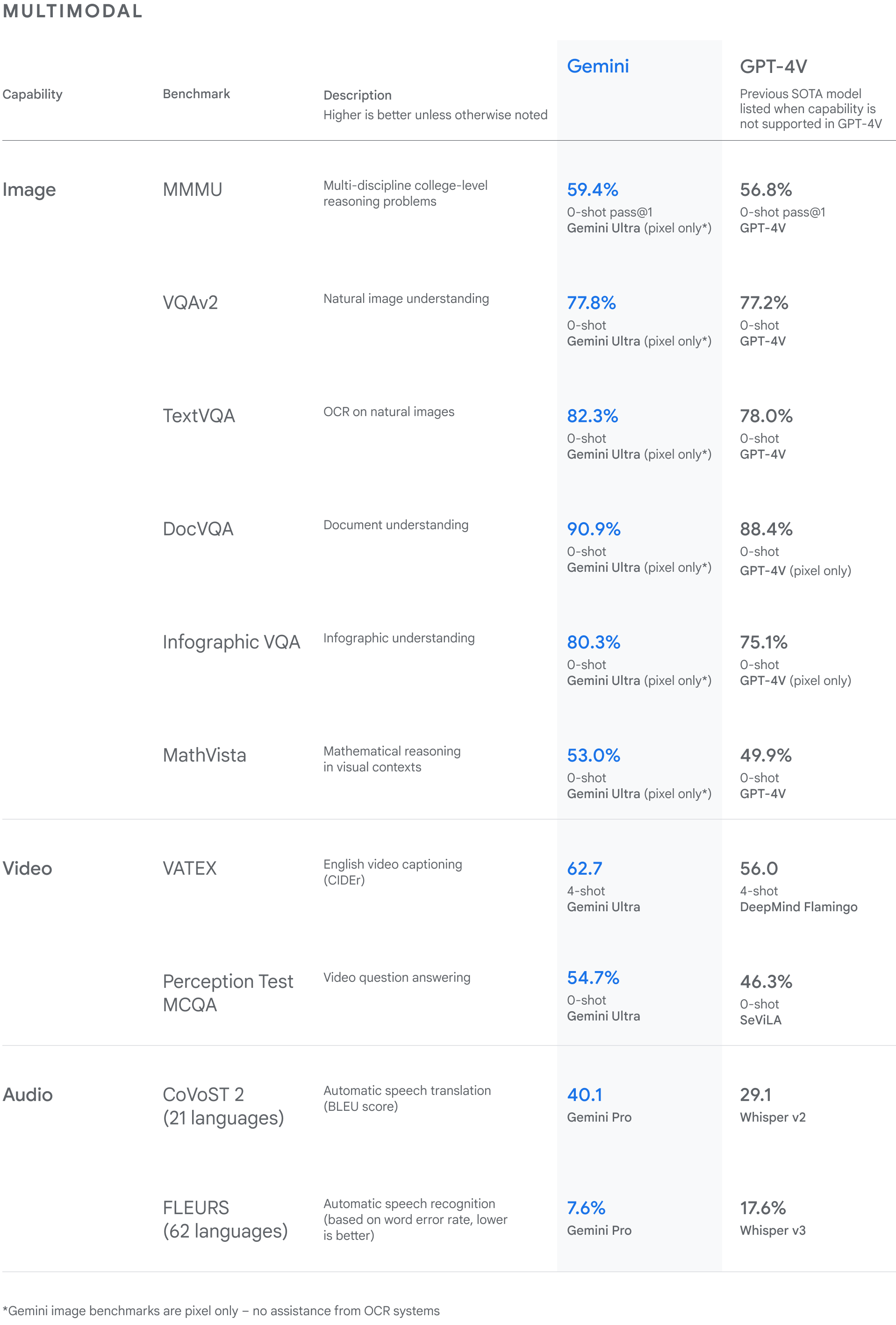
According to Google’s tests, Gemini’s performance surpasses GPT models in almost all aspects.
Potential Enterprise Applications In The Future
New Employee Onboarding Guideline
We’ve previously mentioned that Google Vertex AI Search can help enterprises build a dedicated search engine. If companies input their internal regulations and SOP procedures, it can greatly assist in new employee training and internal information retrieval. With Gemini’s powerful performance, we can have more concrete use cases for this system: New employee A receives a document from their boss without a title and doesn’t know how to handle it. They can upload a photo of the document to the internal retrieval system, which uses text recognition to understand the content and purpose, find relevant procedures, and even check if any manager or department signatures are missing.
Marketing Strategy
Marketing Department B has a full schedule of events this year, but due to an unexpected company award, B must plan a celebration party in two weeks that aligns with the supervisor’s preferences and the award theme. B knows nothing about this award and has no time for slow planning. In this case, they can ask Gemini for suggestions and gradually complete the plan through dialogue while obtaining necessary event information.
Data Analysis
Data scientist C must produce a year-end website traffic analysis report. Their manager wants not just an annual summary but also an analysis of historical data, company trajectory, and future trend predictions. C can use Gemini to find necessary numbers and charts (yes, including charts) from extensive historical data.
Code Generation
Engineer D designed a webpage in Figma but only has a preliminary concept with many unplanned details. Writing a front-end from scratch would be time-consuming and inefficient for D. In this situation, Gemini can generate complete front-end code from a simple webpage design image.
Support Sales Initiatives
Salesperson E recently received a Qualified Lead from abroad with a large purchase amount that could secure their annual sales target. Unfortunately, E’s foreign language skills are weak, and the client’s company comprises members from different countries with diverse accents. The diligent E records meetings and transcribes them afterward, which is time-consuming. Soon, Gemini can help E improve this process! Gemini can directly receive audio, help E create summaries, and provide more detailed prompts based on tonal changes.
These cases demonstrate that the high comprehension ability of the multimodal model Gemini will bring another wave of transformation to our lives and work! Now, you can immediately experience the Gemini model through Bard and Vertex AI. Feel free to contact Master Concept to learn more!
Related articles:
What is AI, ML, and DL? Custom generative AI models with Vertex AI!
Reference
Gemini: Our most powerful AI model