

- TL;DR: Legacy Places, Directions, and Distance Matrix APIs are in Legacy status. As of October 2026, these Legacy APIs can no longer be enabled for new Google Cloud projects by default, though exceptions can be requested. Existing projects remain fully supported. While migration is not required, upgrading to Places API (New) and Routes API is encouraged for improved performance, cost controls, and new features.
Google Maps Platform has announced an important update regarding its legacy services. As of October 5th, 2026, Legacy Places APIs, Legacy Directions, and Legacy Distance Matrix APIs are officially in legacy status.
If your applications currently use these services, here is a clear breakdown of what is changing, how your current setup is affected, and what you need to do next.
What Is Changing with Google Maps Platform APIs?
Google is transitioning developers from older, legacy services to modern, performant Places (New) and Routes APIs. These upgraded services offer better speed, refined cost management, and rich geospatial data.
Key Policy Highlights:
- Legacy Status Effective Date: As of October 2026.
- New Cloud Projects: Newly created projects can no longer enable Legacy APIs by default and will be directed to Places API (New) and Routes API.
- Existing Cloud Projects: Existing projects currently using Legacy APIs remain fully supported and are not affected.
- Exception Requests Available: If you have a specific requirement to activate Legacy APIs on a new Project ID, you can request exceptions.
- Migration to New APIs: While your existing projects remain fully supported, migrating to Places API (New) is encouraged for new features and improved performance.
Why Upgrade? Performance, Control, and Next-Gen Features
Migrating to the new Places and Routes APIs unlocks significantly higher capability for your location-based products.
Legacy vs. New API Comparison
| Feature | Legacy APIs (Directions / Distance Matrix / Places) | New APIs (Places & Routes) |
|---|---|---|
| Network Protocols | Standard HTTP REST | HTTP REST & gRPC (Supports fast streaming) |
| Billing & Payloads | Returns fixed, bulky data objects automatically | Strict Field Masking (Only request and pay for what you need) |
| Specialized Vehicles | Standard driving profiles only | Heavy Trucks (Weight/Height/Size) & Two-Wheelers |
| Contextual Details | Basic coordinates, address, and generic business hours | EV Charging status, Accessibility markers, and AI Summaries |
What’s New in Places (New) & Routes APIs?
The redesigned APIs introduce rich features that go far beyond basic address lookups:
1. Smart Place Search & AI Insights
Places API (New) makes finding location info easier and faster:
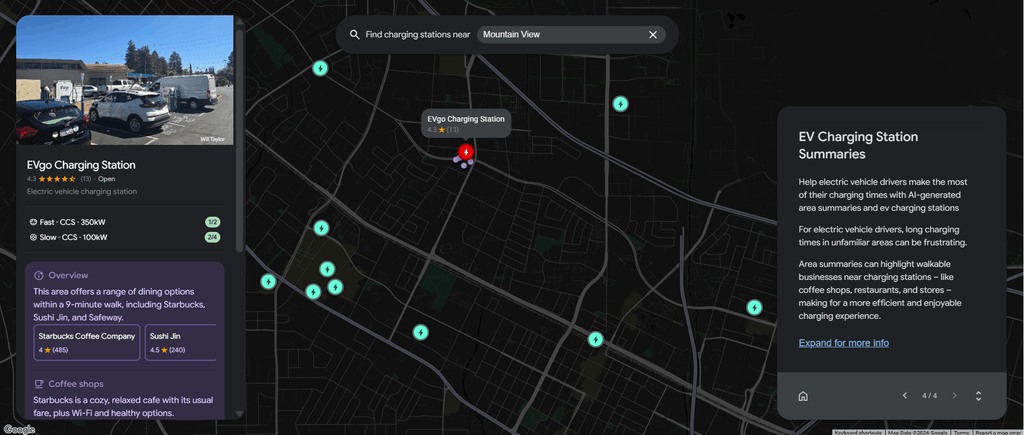
- AI-Powered Summaries: Fetch concise, AI-driven overviews directly into your app to give users an instant snapshot of POIs, user sentiment, and nearby highlights.
- Natural Search Queries: Users can search using conversational phrases (e.g., “quiet cafes with fast Wi-Fi”) through Text Search (New) and Nearby Search (New).
- Efficient Autocomplete: Faster real-time query predictions with session token support for optimized billing.
2. Richer Location Context & Accessibility
Access detailed attributes covering nearly 200 place types:
- EV Charging & Fuel Options: Real-time status for EV charging stations and current fuel prices.
- Detailed Parking: Separate data for free street parking, valet, garage options, and paid parking lots.
- Accessibility: Wheelchair access details across entrances, seating, and parking.
- Sub-Destinations: Identify specific airport terminals, complex entrances, or navigation drop-off points.
3. Smarter Vehicle Routing & Traffic Intelligence
The new Routes API replaces legacy Directions and Distance Matrix with navigation tools built for modern logistics:
- Specialized Vehicle Profiles: Set custom height, weight, and load constraints for heavy trucks, or use localized profiles for two-wheelers like scooters and motorcycles.
- Eco-Friendly Paths & Tolls: Calculate energy-efficient routes matched to vehicle engine types (EV vs. fuel), alongside precise toll estimations.
- Smart Waypoints & Live Traffic: Distinguish between actual pickup/drop-off stopovers and simple pass-through points on a map, complete with color-coded traffic details mapped onto individual route segments.
Recommended Migration Steps
Migration is encouraged to take advantage of advanced features and granular cost controls. Here is how to get started:
- Audit Existing Projects: Check which Google Cloud projects are making calls to legacy maps/api/place, directions, or distancematrix endpoints.
- Configure Field Masking: Update your API request headers to request only essential data fields before pointing calls to the new endpoints.
- Consult a Google Maps Partner: Transitioning enterprise applications can be complex. As an official Google Maps Premier Partner in APAC, Master Concept can evaluate your architecture, optimize field masks to reduce API spend, and guide you through a zero-downtime migration — completely free of charge. Reach out directly via email at [email protected] or contact us to get help.
Frequently asked questions
1. What is changing for legacy Places, Directions, and Distance Matrix APIs as of October 2026?
Legacy Places, Directions, and Distance Matrix APIs are in legacy status. Legacy APIs can no longer be enabled for newly created Google Cloud projects by default, directing developers to Places API (New) and Routes API instead.
2. How does this impact existing projects? Can I still create a new Project ID using legacy services?
Existing projects remain fully supported and will continue functioning normally. However, if you need to activate legacy APIs on a newly created Project ID, you can request exceptions or access through Google Support. You can also contact Master Concept for assistance.
3. Is migration required for existing customers?
Migration is not required, but it is strongly encouraged. Migrating to Places API (New) and Routes API unlocks new features, enhanced cost controls, and improved performance for your applications.
4. Who should we contact for questions or technical support?
For questions or technical support, you can reach out to Google Support or contact Master Concept (email: [email protected]) as an official Google Premier Partner for faster resolution at no additional cost.
References:


![[Free Webinar] Road to COP17: Unifying Enterprise Data with Planetary-Scale Geospatial AI](https://masterconcept.ai/wp-content/uploads/2026/09/Webinar-261007-Unifying-Enterprise-Data-with-Planetary-Scale-Geospatial-AI-_1280x720px-scaled.png)