
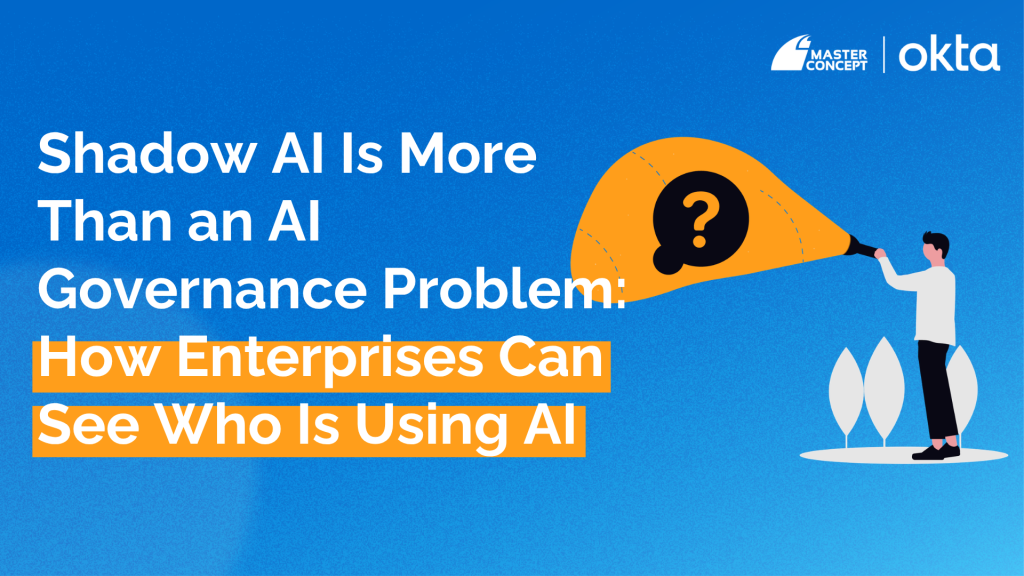
Generative AI is quickly becoming part of everyday enterprise work. ChatGPT, Gemini, Claude, Microsoft Copilot, and other AI services are now widely used, while many organizations are introducing formal policies that define which platforms employees may use, what information can be shared, and which AI applications require IT approval.
But having a policy does not necessarily mean the organization has visibility into how AI is actually being used.
A marketing team may sign up for a new AI service because it helps them work faster. A developer may authorize an AI tool to access GitHub. A salesperson may connect an AI assistant to Google Drive. These decisions are not necessarily malicious. In many cases, business demand simply moves faster than the formal IT approval process.
Once AI usage spreads across different accounts, applications, and connections, however, the question is no longer just, “Which AI tools are our employees using?”
Enterprises also need to know:
Who is using them? Which identity are they using? What has the AI been authorized to access? And is that access still appropriate?
This is where Shadow AI begins to move beyond AI Governance and become an Identity Security problem.
The Real Blind Spot in Shadow AI Is Not the Tool, It Is Who Has Access to What
Shadow AI is often associated with employees quietly using AI services that have not been approved by IT. The natural response is therefore to create an approved AI list or block applications that have not passed security review.
Those controls still matter, but they answer only the first question: Which AI applications are allowed?
Governance also needs to answer a second question: Who should be able to use them, and what should that use allow them to access?
Consider an employee who signs in to an AI service with a corporate Google account and then connects the service to Google Drive. From the employee’s perspective, clicking “Allow” simply lets the AI help find documents. From a security perspective, a new access relationship has just been created.
The organization now needs to understand who that user is, which corporate identity was used, what permissions were granted, which data can be reached, and how long that access should remain valid. If the employee later changes roles or leaves the company, will the AI-related access be reviewed or removed as well?
If the answer is unclear, the organization is dealing with more than a Shadow AI visibility issue. It has an Identity Governance gap. This is also where Okta becomes particularly relevant in the AI era. Enterprises already use identity platforms to answer the question, “Who should have access to what?” AI does not change that principle. It simply creates many more identity and access relationships that need to be governed.
AI Risk Is Expanding From “What Data Goes Into AI?” to “What Can AI Access?”
The first wave of enterprise generative AI security focused heavily on data leakage.
Could an employee paste customer information, source code, a contract, or another sensitive document into a public AI service?
That remains a significant risk. But the way organizations use AI is changing. AI applications no longer have to wait for users to paste information into a prompt. Increasingly, they can connect directly to Google Drive, GitHub, Salesforce, Slack, CRM platforms, APIs, and other enterprise resources.
Organizations now need to answer two different questions:
What data is going into AI?
and:
What can AI access?
The first is primarily a Data Governance, DLP, and Browser Security problem. The second moves directly into identity, authorization, and access governance.
AI agents push the same issue one step further. When AI can do more than read information, for example, query a system, call an API, or take an action on a user’s behalf. The organization needs to know who is accountable for that AI, which permissions it has, and whether those permissions can be restricted or revoked. AI agents therefore do not need to become a separate storyline in the Shadow AI discussion. They simply make the Identity × Access challenge much more visible.
How Okta Brings AI Access Back Into Enterprise Identity Governance
Rather than building an entirely separate security model for AI, a more practical approach is to bring AI into the Identity Security model the enterprise already uses.
That is an important part of Okta’s current AI identity strategy.
For AI agents, Okta for AI Agents can discover known and unknown agents, register them in a centralized identity directory, and associate them with a clear human owner. Security teams can therefore move beyond simply knowing that an agent exists and understand who is accountable for it and which enterprise resources it is connected to.
The next step is controlling access.
If an AI system only needs access to a specific set of data, technical convenience should not result in unnecessarily broad permissions. If an agent only needs access while performing a task, there is little reason to leave a credential active indefinitely. Okta for AI Agents supports scoped, short-lived credentials in place of higher-risk long-lived tokens and applies least-privilege policies to the resources agents can reach.
Access then needs to enter a governance process.
Okta Identity Governance combines Lifecycle Management, Workflows, and Access Governance. Access Governance includes Access Requests, Access Certifications, governance-focused reporting, and Entitlement Management. This means organizations can govern not only whether access is granted, but also who requested it, who approved it, which permissions were granted, and whether those permissions should still be retained later.
Okta is also extending Identity Governance further into AI agents and their linked applications, allowing AI access to follow an organization’s established governance model rather than becoming a completely separate permissions environment.
Lifecycle is the final piece.
Mature access governance is not only about granting permissions. It is equally about taking them away when they are no longer justified. If an agent is retired, its owner leaves, its purpose changes, or its behavior becomes suspicious, the organization needs a clear way to stop further access.
Okta’s role in this architecture is therefore more specific than simply “protecting AI.”
It brings AI back to the same Identity Security questions enterprises already understand:
Who owns it? What can it access? Why does it have that access? How long should it keep it? And when should that access be revoked?
Those have always been Identity Governance questions. AI simply makes them more urgent.
Shadow AI Governance Should Not Stop at Blocking — Access Must Be Visible, Governable, and Revocable
None of this means an identity platform can solve every Shadow AI problem by itself.
If an organization needs to understand whether employees are using public AI from unmanaged devices, or whether sensitive information is being pasted into generative AI, Browser Security, DLP, CASB, and other Data Security controls still have important roles to play.
It is also important to be precise about Okta’s current Shadow AI capabilities. Okta’s explicit product focus is on discovering and governing Shadow AI agent identities, not on claiming visibility into every employee’s use of every public AI application from every device.
That distinction actually makes the broader AI Governance architecture clearer.
Browser and Data Security answer: How is data reaching AI?
Identity Security answers: Who is creating access? What can AI reach? And who is accountable for those permissions?
Organizations need these control layers to work together rather than expecting one product to solve the entire problem.
5 Core Questions for AI Access Governance:
- Connection Visibility: Do we know which AI systems and AI agents are connecting to corporate resources?
- Accountability & Ownership: Do we know who created or owns them?
- Access Scope: Do we know what data and systems they can access?
- Least Privilege: Does that access strictly follow Least Privilege principles?
- Lifecycle Revocation: Can we quickly review or revoke access when roles, business needs, or risk levels change?
If several of those questions cannot be answered, the organization may be facing something broader than Shadow AI. It may have an Identity Visibility and Access Governance gap.
The Next Step in AI Governance Is to Put Identity Back at the Center
When enterprises first began governing generative AI, the primary concern was what employees might put into AI.
Now, another question is becoming just as important: What is AI allowed to access?
As AI creates more connections with enterprise applications, data, and workflows, governance naturally expands beyond managing individual tools and toward managing Identity and Access.
That is the deeper reason Shadow AI matters in the enterprise.
The problem is not simply how many unapproved AI services exist. It is whether the organization can identify the identity, owner, permissions, and lifecycle behind each AI access relationship.
AI Governance should not create another security silo. The deeper AI becomes embedded in enterprise workflows, the more governance needs to return to Identity: who can access what, under which conditions, and when that access should end.
Can your organization actually see the identities and access relationships behind its AI? Contact the advisory team at Master Concept to assess your current AI Identity and Access Governance architecture and identify potential gaps in Shadow AI visibility, access control, and Identity Governance.
FAQ
What is Shadow AI?
Shadow AI is the use of AI tools or agents that an organization has not formally approved, governed, or fully identified.
What are the risks of Shadow AI?
The risk goes beyond data leakage. Organizations may not know who is using AI, what the AI can access, or whether that access is still appropriate.
How can companies manage Shadow AI?
Blocking alone is not enough. Organizations need visibility into AI usage, protection for sensitive data, and governance over the identities and access behind AI.
Can Okta help manage Shadow AI?
Yes. Okta can help discover and govern Shadow AI agents, establish ownership, control access, and bring AI agents into existing Identity Governance processes.
Why is Shadow AI an Identity Security issue?
Once AI connects to systems such as Google Drive, GitHub, or CRM platforms, the key question becomes who authorized the AI to access what.

![[Free Webinar] Road to COP17: Unifying Enterprise Data with Planetary-Scale Geospatial AI](https://masterconcept.ai/wp-content/uploads/2026/09/Webinar-261007-Unifying-Enterprise-Data-with-Planetary-Scale-Geospatial-AI-_1280x720px-scaled.png)