

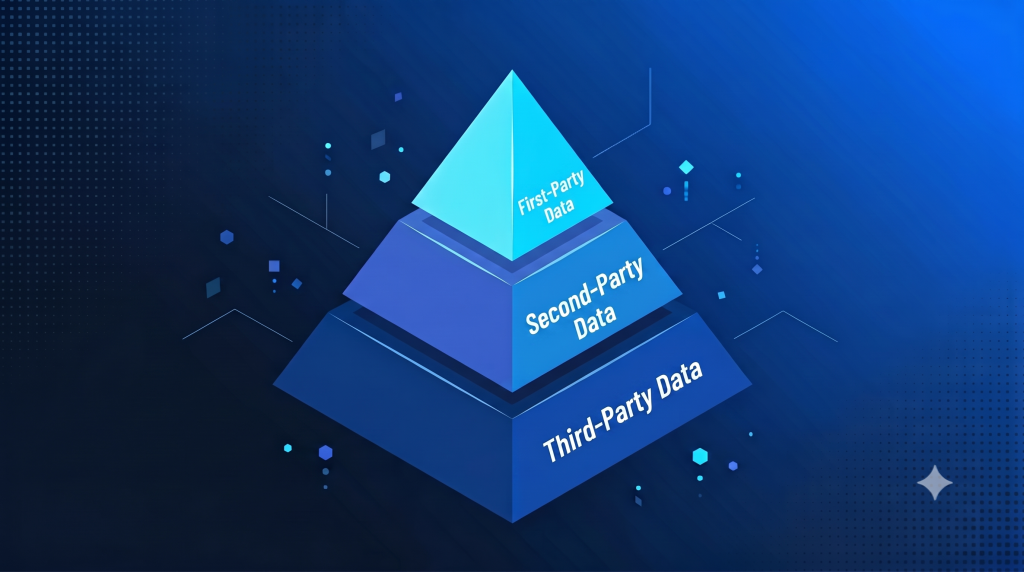
Third-party data used to make digital marketing feel easy. Buy an audience, launch the campaign, chase the click.
That playbook is cracking. Safari’s tracking prevention already limits cross-site tracking, and Chrome’s third-party cookie model now depends more on user choice and privacy controls. The message for marketers is clear: brands need customer data they own, understand, and can use responsibly.
First-party data helps enterprises build that foundation. It gives marketing, CRM, analytics, and customer experience teams a cleaner view of customers, without depending only on rented audiences or opaque third-party segments.
- What Is First-Party Data?
- How Is First-Party Data Different From Second-Party and Third-Party Data?
- How Do First-Party, Second-Party, and Third-Party Data Compare?
- Why Does First-Party Data Matter More Now?
- How Should Enterprises Collect First-Party Data?
- Why Is a CDP Important for First-Party Data Strategy?
- How Should Businesses Start Building a First-Party Data Strategy?
- Frequently Asked Questions
- Ready to Build a First-Party Data Strategy?
- Take Action Now
What Is First-Party Data?
First-party data is customer data that a business collects directly through its own channels.
These channels can include a website, app, CRM, membership programme, POS system, email platform, customer service tool, webinar registration form, or offline event.
Common examples include:
- Website visits and product page views;
- App clicks and feature usage;
- CRM records and contact details;
- Purchase history and loyalty status;
- POS transactions;
- Email engagement;
- Customer service conversations;
- WhatsApp or chatbot interactions;
- Event registrations and survey responses.
First-party data is valuable because the brand owns the relationship and controls the collection process. When collected with clear consent and good governance, it gives businesses a more accurate and privacy-conscious way to understand customers.
It is not just “more data.” It is data with context.
How Is First-Party Data Different From Second-Party and Third-Party Data?
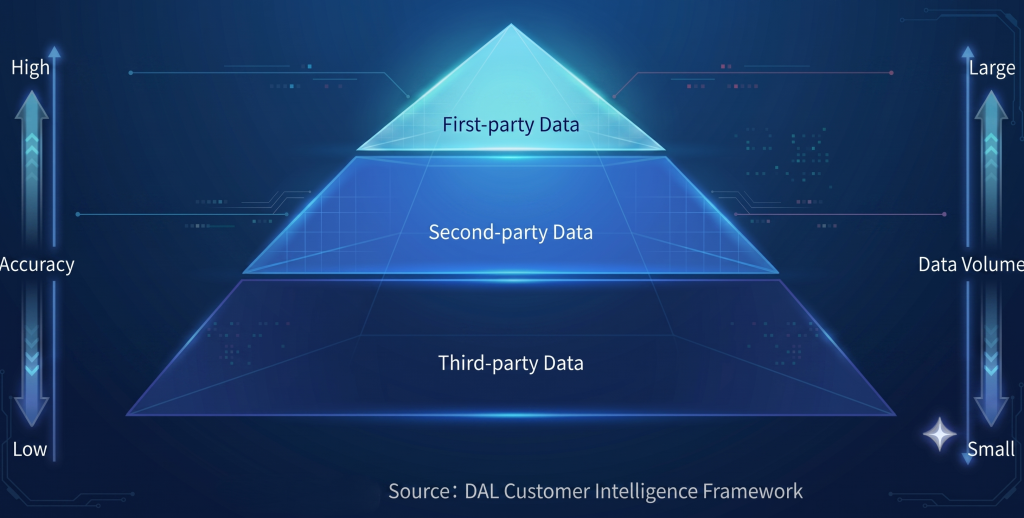
First-party, second-party, and third-party data differ by source, ownership, accuracy, cost, and privacy risk.
A simple way to think about it: the closer the data is to your direct customer relationship, the more useful it becomes for Customer Intelligence.
What Is First-Party Data?
First-party data comes from your own customer touchpoints.
You collect it when customers interact with your website, app, CRM, store, support team, or loyalty programme. It usually has the highest relevance because it reflects real engagement with your brand.
For example, a customer views a product page three times, adds an item to cart, opens a member email, and later buys in-store. These signals help the business understand intent, interest, and lifecycle stage.
What Is Second-Party Data?
Second-party data is another company’s first-party data shared through a direct partnership.
This usually happens between brands with overlapping but non-competing audiences. For example, an airline and a hotel group may collaborate on member campaigns. An e-commerce platform may share aggregated or consented audience insight with merchants.
Second-party data can be useful for cross-promotion, partner campaigns, and audience expansion. However, teams need clear agreements, privacy controls, and data usage rules.
What Is Third-Party Data?
Third-party data is collected and packaged by external data providers from many websites, platforms, and sources.
It is often used for advertising audience targeting, such as “people interested in baby products” or “users searching for sports shoes.” The scale can be large, but the accuracy and transparency are weaker.
Third-party data also carries higher privacy and compliance risk because the original source and consent path can be harder to verify.
How Do First-Party, Second-Party, and Third-Party Data Compare?
| Comparison Factor | First-Party Data | Second-Party Data | Third-Party Data |
|---|---|---|---|
| Source | Owned channels such as website, app, CRM, POS | Direct partner data | External data aggregators |
| Accuracy | High, based on real customer interaction | Medium to high, depending on partner quality | Medium to low, often based on inferred labels |
| Scale | Limited to your own audience | Depends on partner reach | Large audience scale |
| Cost | Lower over time because it becomes an owned asset | Medium, often based on partnership value exchange | Higher, often paid through media or data buying |
| Privacy Risk | Lower when collected with clear consent | Medium, depending on governance and contract terms | Higher due to source complexity |
| Best Use | Personalization, retention, CRM, CDP, analytics | Partner campaigns and audience expansion | Broad awareness and upper-funnel advertising |
The trade-off is simple.
Third-party data gives reach. First-party data gives relevance.
Why Does First-Party Data Matter More Now?
First-party data matters more because customers expect privacy, regulators expect accountability, and marketing teams need better signals.
How Does First-Party Data Build Direct Customer Relationships?
First-party data helps brands stop “renting” customer access from ad platforms.
If a business only reaches customers through paid media, it loses that relationship once the campaign ends. First-party data changes that. It helps the brand communicate through owned channels such as email, app push, WhatsApp, CRM workflows, loyalty journeys, and customer service.
For example, a B2B prospect reads three articles about AI automation, downloads a guide, and attends a webinar. A data-driven team can use those signals to trigger a relevant case study or sales follow-up.
That is stronger than sending the same newsletter to everyone.
How Does First-Party Data Create a Competitive Advantage?
First-party data becomes a business asset that competitors cannot buy.
A company’s customer behaviour history, purchase patterns, product preferences, engagement habits, and churn signals are unique. Competitors may copy the campaign. They cannot copy the customer intelligence behind it.
This matters for personalization, forecasting, retention, and AI.
AI models need reliable inputs. If the customer data is messy, the output will be weak. First-party data gives enterprises a cleaner foundation for predictive analytics, next-best-action models, and marketing automation.
How Does First-Party Data Support Privacy-First Marketing?
First-party data supports privacy-first marketing because it comes from direct customer relationships.
That does not mean businesses can collect anything they want. Consent, purpose, access control, retention policy, and data governance still matter.
The advantage is transparency. Customers can understand why they share data and what value they receive in return. This value exchange may include faster checkout, better recommendations, loyalty benefits, personal offers, or more relevant support.
Trust grows when customers see the benefit.
How Should Enterprises Collect First-Party Data?
Enterprises should collect first-party data through multiple customer touchpoints and connect those signals into one usable view.
The goal is not to collect everything. The goal is to collect the signals that support better decisions.
Which Online Channels Should Collect First-Party Data?
Online first-party data can come from:
- Website registration;
- Product page views;
- Search behaviour;
- Content downloads;
- Newsletter subscriptions;
- Webinar sign-ups;
- App events;
- E-commerce cart activity;
- Live chat conversations;
- Email engagement.
Interactive content can also help. Buying guides, calculators, quizzes, assessments, and preference centres can collect intent data while giving customers something useful.
Which Offline Channels Should Collect First-Party Data?
Offline data matters for retail, hospitality, finance, education, healthcare, and event-led B2B businesses.
Useful offline signals include:
- POS transaction records;
- Store membership sign-ups;
- Event attendance;
- Sales consultations;
- QR code registration;
- Customer service records;
- Loyalty programme activity.
The key is connecting offline identities with digital profiles. For example, a store QR code can help customers bind their in-store purchase history to an online member account.
That turns offline behaviour into usable Customer Intelligence.
What Value Should Brands Offer in Exchange for Data?
Customers share data when the value is clear.
Strong value exchanges include:
- Useful reports or whitepapers;
- Exclusive member benefits;
- Personalized recommendations;
- Faster checkout;
- Early access;
- Loyalty points;
- Relevant offers;
- Better support.
Do not ask for data just because your form has empty fields. Ask because the answer improves the customer experience.
Why Is a CDP Important for First-Party Data Strategy?
A CDP is important because first-party data often lives across disconnected systems.
A customer may browse anonymously on the website, open emails through a marketing platform, buy through POS, speak to support on WhatsApp, and sit in CRM as a sales contact. Without integration, every system sees a different person.
A Customer Data Platform helps connect those signals into one customer profile. Segment, for example, positions its platform around collecting first-party data from multiple touchpoints and activating it across warehouses and hundreds of destinations.
How Does a CDP Break Data Silos?
A CDP connects data from tools such as Segment, HubSpot, Amplitude, POS, CRM, app analytics, e-commerce platforms, and customer service systems.
Through identity resolution, it can match anonymous and known behaviour. For example, the same person may first browse anonymously, later register with an email, and then buy in-store as a member.
The CDP connects those fragments into a single customer view.
How Does a CDP Turn First-Party Data Into Insight?
Once the data is unified, teams can analyse behaviour with more context.
They can identify:
- Highest-value customer groups;
- Common behaviours before purchase;
- Churn-risk signals;
- Product interests;
- Member lifecycle stages;
- High-intent leads;
- Campaign performance by segment.
This helps marketing teams move from campaign reporting to customer intelligence.
How Does a CDP Turn Insight Into Action?
A CDP becomes valuable when teams activate the data.
For example, if a high-intent customer views a product several times but does not purchase, the CDP can trigger an email, WhatsApp message, app push, ad audience update, or CRM sales task.
This is where DAL’s Signal → Decide → Act → Learn model becomes practical.
Signal: collect first-party data from online and offline touchpoints.
Decide: connect identities, build segments, and identify customer intent.
Act: activate journeys across CRM, marketing automation, ads, WhatsApp, email, and app push.
Learn: measure results, improve data quality, and optimize the next customer journey.
First-party data is the signal. CDP makes it usable.
How Should Businesses Start Building a First-Party Data Strategy?
Businesses should start with a clear use case, not a giant data project.
A practical roadmap looks like this:
- Choose one business goal. Focus on retention, repeat purchase, lead quality, abandoned cart recovery, churn reduction, or member engagement.
- Identify the data needed. List the customer signals required to support that goal.
- Audit current systems. Review CRM, website analytics, POS, app, email, and support data.
- Fix consent and governance. Define what data you collect, why you collect it, and who can use it.
- Connect key sources first. Start with high-value data, not every possible field.
- Build one customer segment. Create a segment that supports the chosen use case.
- Activate one journey. Launch one campaign or workflow.
- Measure and improve. Review results, clean data, and expand.
The strongest first-party data strategies grow step by step.
Do not wait for perfect data. Start with the signals that matter.
Frequently Asked Questions
What is first-party data?
First-party data is customer data that a business collects directly through its own channels, such as websites, apps, CRM, POS systems, email, membership programmes, and customer service tools. It is usually more accurate and useful than third-party data because it comes from real customer interactions with the brand.
What is the difference between first-party data and zero-party data?
Zero-party data is information that customers actively and intentionally share, such as preferences, interests, survey answers, or purchase intentions. First-party data is broader. It includes zero-party data, but also covers behavioural data such as website visits, app clicks, purchases, and email engagement.
Why is first-party data important for marketing?
First-party data helps marketing teams create more relevant segmentation, personalization, automation, and customer journeys. It also reduces reliance on third-party data, which can be less accurate and harder to govern. For enterprises, first-party data becomes a long-term Customer Intelligence asset.
Is third-party data still useful?
Yes, third-party data can still support broad awareness and audience expansion. However, it works best as a supplement, not the foundation. Businesses should use first-party data for customer intelligence, personalization, retention, and lifecycle marketing because it is more relevant to their own customers.
How does a CDP help with first-party data?
A CDP helps collect, unify, and activate first-party data across systems such as CRM, website analytics, POS, app, email, ads, and customer service platforms. It creates a single customer view and helps teams use customer data for segmentation, personalization, automation, and measurement.
Ready to Build a First-Party Data Strategy?
DAL helps enterprises turn customer signals into Customer Intelligence through CDP, analytics, CRM, automation, and experimentation.
GET IN TOUCH


![[Free Webinar] Road to COP17: Unifying Enterprise Data with Planetary-Scale Geospatial AI](https://masterconcept.ai/wp-content/uploads/2026/09/Webinar-261007-Unifying-Enterprise-Data-with-Planetary-Scale-Geospatial-AI-_1280x720px-scaled.png)