
RFM analysis helps marketing teams stop treating every customer the same.
A customer who bought last week, buys often, and spends heavily deserves a different journey from someone who bought once three years ago. Same campaign? Wasted budget. Same discount? Lazy segmentation. Same message? Your high-value customers can feel invisible.
For Hong Kong and APAC enterprises, the challenge is no longer “Do we have customer data?” The challenge is turning that data into usable customer segmentation, marketing automation, and measurable growth.
That is where the RFM model works best. It gives teams a simple way to identify who is active, who is loyal, who spends, who is slipping away, and who deserves the next best action.
- What Is RFM Analysis?
- How Do Recency, Frequency, and Monetary Value Work?
- How Do You Score Customers with the RFM Model?
- What Should Teams Watch When Building RFM Scores?
- Which Customer Segments Can RFM Analysis Create?
- What Marketing Strategies Work for Each RFM Segment?
- How Can a CDP Automate RFM Analysis?
- How Should Hong Kong Enterprises Start with RFM Analysis?
- Why Does RFM Analysis Matter for Customer Intelligence?
- Frequently Asked Questions
- Take Action Now
What Is RFM Analysis?
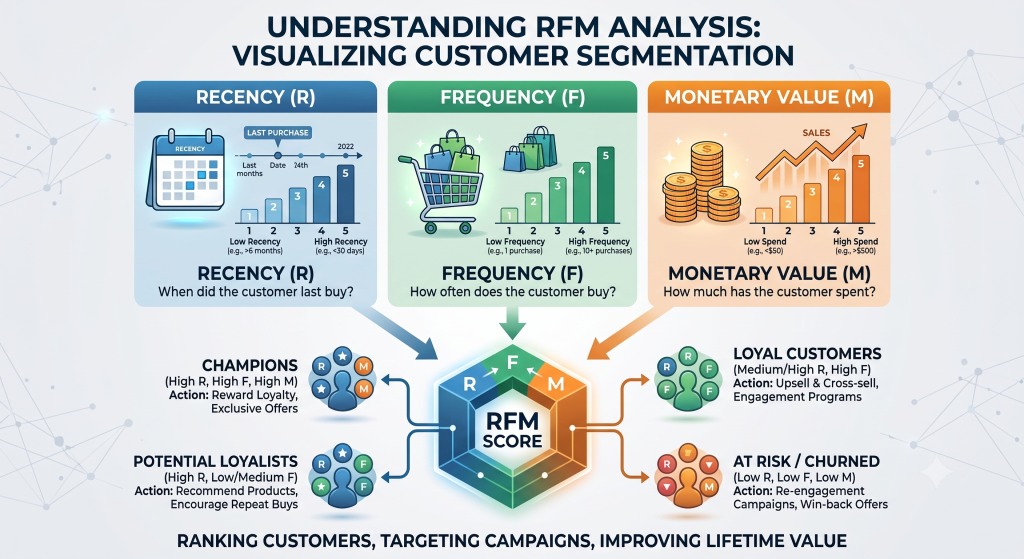
RFM analysis is a customer segmentation method that scores customers based on three behaviours: Recency, Frequency, and Monetary value.
- Recency: When did the customer last buy?
- Frequency: How often does the customer buy?
- Monetary value: How much has the customer spent?
Together, these three signals help companies understand customer value without building a complex machine learning model from day one. A retailer, e-commerce brand, membership business, or B2B subscription company can use existing transaction data to rank customers, design targeted campaigns, and improve customer lifetime value.
RFM analysis works because customer behaviour carries intent. A recent buyer still remembers your brand. A frequent buyer has formed a habit. A high-spend buyer contributes more revenue. When those signals come together, marketing teams can stop guessing and start acting.
For a broader market definition, Investopedia also describes RFM as a marketing analysis tool that ranks customers by how recently they purchased, how often they purchase, and how much they spend.
How Do Recency, Frequency, and Monetary Value Work?
The RFM model works because each metric answers a different commercial question.
What Does Recency Measure?
Recency measures how much time has passed since a customer’s last purchase or meaningful transaction.
A customer who bought in the last 7 or 30 days usually has stronger brand memory than someone who has been inactive for 180 days. This makes recent customers easier to re-engage, upsell, or guide into the next step.
Recency helps teams identify:
- Active customers: Customers who purchased recently and may be ready to buy again.
- Sleeping customers: Customers who have not purchased for 90, 180, or more days.
- At-risk customers: Customers whose purchase interval is getting longer than their usual pattern.
Recency is often the most time-sensitive RFM signal. It tells marketers when to act.
What Does Frequency Measure?
Frequency measures how many times a customer buys within a defined period.
High-frequency customers show habit, trust, and loyalty. They have already built a relationship with the brand. They are also more likely to respond to loyalty rewards, cross-sell offers, and exclusive experiences.
Frequency helps teams identify:
- Brand loyalists: Customers who purchase repeatedly within a year.
- Potential loyalists: Customers whose purchase frequency is increasing.
- One-time buyers: Customers who need a stronger reason to return.
Frequency is one of the strongest practical signals for future engagement. A customer who buys often has already done the hard part: they came back.
What Does Monetary Value Measure?
Monetary value measures how much revenue a customer contributes within a defined period.
High-spend customers often deserve special treatment, but Monetary value should never be read alone. A customer who spends a large amount once is not the same as a customer who buys every month at a lower average order value.
Monetary value helps teams identify:
- High-value customers: Customers in the top spending tier.
- High-ticket customers: Customers with above-average order value.
- Growth-potential customers: Customers whose spending is increasing over time.
The Pareto Principle, often known as the 80/20 rule, is useful here as a planning lens: a smaller share of customers often contributes a larger share of revenue. However, treat it as a prioritization guide, not a fixed law.
How Do You Score Customers with the RFM Model?
The simplest RFM scoring method gives each customer a score from 1 to 5 for Recency, Frequency, and Monetary value.
A score of 5 means the customer performs strongly in that dimension. A score of 1 means the customer needs attention or may be lower priority.
| Score | Recency: Last Purchase | Frequency: Annual Purchases | Monetary Value: Total Spend |
|---|---|---|---|
| 5 | Within 7 days | 12+ times | Top 10% |
| 4 | 8 to 30 days | 6 to 11 times | Top 10% to 25% |
| 3 | 31 to 90 days | 3 to 5 times | Top 25% to 50% |
| 2 | 91 to 180 days | 2 times | Top 50% to 75% |
| 1 | More than 180 days | 1 time | Bottom 25% |
After scoring, each customer receives a three-digit RFM score.
For example:
- 555: A top-tier customer. Recent, frequent, and high-spending.
- 511: A new customer. Recent purchase, but low frequency and low total spend.
- 255: A formerly valuable customer. High frequency and spending, but no recent activity.
- 111: A low-engagement customer. Inactive, infrequent, and low-spending.
This scoring method gives marketing, sales, and customer experience teams a shared language. Instead of debating “good customers,” teams can define the segment, the risk, and the action.
What Should Teams Watch When Building RFM Scores?
RFM scoring only works when the model reflects real business behaviour.
A fashion e-commerce brand and a luxury jewellery retailer should not use the same frequency benchmark. A customer who buys skincare every month may be loyal. A customer who buys enterprise software once every three years may also be loyal.
When building an RFM model, teams should watch three things.
Adjust the Model by Industry
Different industries have different purchase cycles. E-commerce, retail, luxury, hospitality, insurance, and B2B services all need different thresholds.
A 90-day gap may signal churn for groceries. It may be normal for luxury watches.
Refresh the Scoring Rules
RFM scoring should not sit untouched forever. As the business grows, old thresholds can lose meaning.
Review the scoring logic every six to twelve months. If too many customers fall into the same tier, the model needs sharper bands.
Clean the Data First
RFM analysis depends on transaction quality.
Before launching RFM campaigns, check for duplicate customer records, incorrect purchase dates, missing refunds, offline transactions that never synced, and loyalty IDs that do not match digital profiles.
Bad data does not become strategy. It becomes expensive noise.
Which Customer Segments Can RFM Analysis Create?
RFM analysis can create many customer groups, but most teams should start with four practical segments: high-value customers, potential loyalists, new customers, and at-risk customers.
| Customer Segment | RFM Score Pattern | Description | Marketing Focus |
|---|---|---|---|
| High-Value Customers | High R, F, and M, such as 555, 544, 454 | Recent buyers who purchase often and spend heavily | Retain, reward, and deepen the relationship |
| Potential Loyalists | High F and M, low R, such as 255 or 244 | Customers who used to buy often and spend well, but have not returned recently | Reactivate with relevant reminders and personal offers |
| New Customers | High R, low F and M, such as 511 or 411 | Customers who recently completed their first or early purchases | Build trust and drive the second purchase |
| At-Risk Customers | Low R, F, and M, such as 122, 112, 111 | Customers who have not purchased recently and show weak historical value | Decide whether the win-back cost is worth it |
This is where RFM analysis becomes useful. The model does not just label customers. It tells teams what to do next.
What Marketing Strategies Work for Each RFM Segment?
Different customer segments need different marketing strategies. One-size-fits-all marketing lowers conversion, wastes incentives, and weakens customer relationships.
How Should Teams Treat High-Value Customers?
High-value customers are your VIP group. The goal is not to discount them into action. The goal is to make them feel recognized.
Strong tactics include:
- VIP customer service channels
- Priority support and faster issue handling
- Early access to new products or services
- Birthday gifts or personal recognition
- Private events or exclusive community access
- Thank-you messages based on actual purchase history
High-value customers do not always need cheaper prices. They often need better treatment.
How Should Teams Reactivate Potential Loyalists?
Potential loyalists have proven value, but they have gone quiet. The goal is to remind them why they bought from you before.
Strong tactics include:
- Personalized product recommendations based on past purchases
- Limited-time coupons linked to categories they prefer
- Loyalty points reminders
- Member upgrade offers
- “Back in stock” or new arrival alerts
- Replenishment reminders if the product has a known usage cycle
This segment is worth more than generic dormant users because they already showed buying power and trust.
How Should Teams Grow New Customers?
New customers are in the brand-forming stage. The goal is to drive the second purchase and build habit.
Strong tactics include:
- First-purchase thank-you emails
- Product usage guides
- Brand story content
- New-customer welcome journeys
- Second-purchase incentives
- Membership program onboarding
- Review requests after delivery or service completion
The second purchase matters. Once a customer returns, the relationship becomes easier to grow.
How Should Teams Handle At-Risk Customers?
At-risk customers need careful handling. Not every customer is worth winning back at any cost.
Strong tactics include:
- Win-back messages with a clear reason to return
- Product update announcements
- “We miss you” messaging, used sparingly
- Return offers or bundles
- Short surveys asking why they stopped buying
- Suppression rules if the customer keeps ignoring campaigns
For this segment, the real question is commercial: will the expected return justify the incentive, media cost, and attention?
How Can a CDP Automate RFM Analysis?
RFM analysis becomes more valuable when a Customer Data Platform, or CDP, turns customer scores into live segments and automated journeys.
A spreadsheet can calculate RFM scores. A CDP can keep them updated, connect them to real customer identities, and activate them across channels.
That is the difference between knowing and doing.
How Does a CDP Connect Customer Data?
Modern customer data lives across too many systems: websites, apps, POS systems, CRM tools, customer service platforms, email platforms, paid media, and offline stores.
A CDP helps by:
- Connecting online and offline customer data sources
- Building unified customer profiles
- Resolving customer identity across channels
- Cleaning and standardizing event and transaction data
- Making RFM scores available to activation tools
This is why a CDP matters for RFM. The model needs complete and current customer data, not one system’s partial view.
For example, Segment Unify describes unified customer profiles and identity resolution as ways to track interactions across the customer journey.
How Does a CDP Keep RFM Segments Dynamic?
Traditional RFM analysis often works as a monthly or quarterly report. That is too slow for modern customer journeys.
A CDP can update RFM scores when new transactions, events, or customer behaviours come in. When a customer moves from “new customer” to “potential loyalist,” the segment can update automatically.
Dynamic tagging helps teams:
- Monitor customer movement between segments
- Trigger alerts when valuable customers become inactive
- Suppress irrelevant campaigns
- Send offers based on current customer state
- Avoid waiting for the next manual report
Customer behaviour changes daily. Your segmentation should not be stuck in last month’s spreadsheet.
How Does RFM Trigger Automated Marketing Journeys?
The final goal of RFM analysis is action.
A CDP can connect RFM segments to tools such as HubSpot, Braze, Intercom, OneSignal, Infobip, VWO, AppsFlyer, and Amplitude. Once connected, teams can trigger automated journeys based on segment changes.
Examples include:
- Dormant customer journey: When a customer moves into a sleeping segment, trigger a personalized email or push notification.
- New customer journey: After a first purchase, launch a 30-day onboarding flow.
- VIP journey: When a customer enters the high-value segment, assign them to a premium treatment track.
- At-risk alert: When a high-value customer has not purchased within the expected window, notify the CRM or account team.
- Experimentation flow: Use VWO or Amplitude to test which offer, message, or journey performs best for each segment.
This is where DAL’s Signal → Decide → Act → Learn methodology fits naturally.
- Signal: Collect transaction, behavioural, CRM, and engagement data.
- Decide: Score customers using RFM and predictive rules.
- Act: Trigger campaigns, journeys, offers, and service workflows.
- Learn: Measure response, conversion, retention, and lifetime value.
RFM gives the segmentation logic. CDP marketing automation turns that logic into revenue movement.
How Should Hong Kong Enterprises Start with RFM Analysis?
Start simple. Then automate.
A practical RFM roadmap for Hong Kong enterprises looks like this:
- Define the business goal. Decide whether the priority is retention, repeat purchase, VIP growth, churn prevention, or customer lifetime value.
- Collect the right data. Start with transaction date, transaction count, customer ID, and total spend.
- Create the scoring model. Use a 1 to 5 scale for Recency, Frequency, and Monetary value.
- Validate the customer segments. Ask sales, marketing, and operations whether the segments match real customer behaviour.
- Design one journey per segment. Do not launch ten workflows at once. Start with high-value retention or dormant customer reactivation.
- Connect the stack. Use a CDP to connect data sources, update audiences, and sync segments into CRM and marketing automation tools.
- Measure the outcome. Track conversion, repeat purchase, average order value, retention, and CLV.
The first version does not need to be perfect. It needs to be usable.
Why Does RFM Analysis Matter for Customer Intelligence?
RFM analysis helps teams move from broad campaigns to customer intelligence.
It gives marketers a sharper view of who customers are, what they are worth, and how the relationship is changing. It also gives sales and CX teams a shared framework for prioritizing attention.
However, RFM only creates business value when teams act on it. Scores sitting in a dashboard do not grow revenue. Segments connected to journeys, offers, service workflows, and experiments do.
That is why DAL builds Customer Intelligence Systems, not just reports. We help enterprises connect scattered signals, decide what matters, act across channels, and learn from every result.
DAL | Data & AI Lab helps enterprises implement customer data platforms, analytics, CRM, automation, attribution, and experimentation tools across modern marketing stacks. Our core solutions include Amplitude, Segment, mParticle, HubSpot, VWO, AppsFlyer, Intercom, Braze, OneSignal, Infobip, and Fivetran.
Ready to turn RFM analysis into automated customer journeys?
Book a 30-minute Customer Intelligence Assessment and explore how DAL can help you connect customer data, segment by value, and activate smarter marketing.
Frequently Asked Questions
What is RFM analysis?
RFM analysis is a customer segmentation method that scores customers by Recency, Frequency, and Monetary value. Recency measures when a customer last purchased. Frequency measures how often they purchase. Monetary value measures how much they spend. Together, these signals help businesses identify high-value customers, new customers, potential loyalists, dormant customers, and at-risk customers. Marketing teams use RFM analysis to prioritize campaigns, personalize offers, improve retention, and increase customer lifetime value.
What is the difference between RFM analysis and customer segmentation?
Customer segmentation is the broader practice of grouping customers based on shared characteristics or behaviours. RFM analysis is one specific segmentation method based on purchase behaviour. It uses three measurable signals: how recently a customer bought, how often they buy, and how much they spend. RFM is useful because it is simple, fast to implement, and easy for marketing, CRM, and customer experience teams to understand. More advanced segmentation may add browsing behaviour, engagement data, product preferences, lifecycle stage, or predictive AI models.
How do you calculate an RFM score?
To calculate an RFM score, rank each customer on Recency, Frequency, and Monetary value, usually from 1 to 5. A score of 5 means strong performance in that dimension, while 1 means weaker performance. For example, a customer with an RFM score of 555 purchased recently, buys often, and spends heavily. A customer with 511 purchased recently but has low frequency and low spend. The scoring rules should match the company’s industry, purchase cycle, and revenue model.
Why should companies connect RFM analysis with a CDP?
Companies should connect RFM analysis with a CDP because customer behaviour changes continuously. A spreadsheet can calculate scores, but a CDP can update scores dynamically, unify customer identities, and sync segments into marketing automation, CRM, analytics, and advertising tools. This allows teams to trigger journeys when customers become dormant, enter VIP status, complete a first purchase, or show churn risk. With a CDP, RFM analysis moves from static reporting to automated action.
Which businesses benefit most from RFM analysis?
RFM analysis works best for businesses with repeat purchases, membership activity, subscriptions, loyalty programs, or identifiable customer transactions. Examples include retail, e-commerce, hospitality, financial services, beauty, education, apps, and B2B service businesses. Companies with long sales cycles can also use RFM logic by replacing “purchase” with meaningful commercial events, such as contract renewal, product usage, service engagement, or account expansion.
GET IN TOUCH


![[Free Webinar] Road to COP17: Unifying Enterprise Data with Planetary-Scale Geospatial AI](https://masterconcept.ai/wp-content/uploads/2026/09/Webinar-261007-Unifying-Enterprise-Data-with-Planetary-Scale-Geospatial-AI-_1280x720px-scaled.png)