

Programmatic advertising can buy impressions fast. But speed alone does not create better marketing.
The real question is this: does your advertising system know which customer is worth reaching, what message they should see, and how much you should pay for that moment?
For Hong Kong and APAC enterprises, this matters because digital media is no longer bought only through manual negotiations, fixed packages, and broad audience assumptions. Programmatic buying has become a dominant way to transact digital display media. eMarketer expects programmatic to account for nearly 9 in 10 digital display ad dollars worldwide in 2025.
That makes programmatic advertising essential. However, the winners will not be the teams that simply buy more impressions. The winners will be the teams that connect customer data, bidding logic, creative, and measurement into one operating system.
- What Is Programmatic Advertising?
- How Does Programmatic Advertising Work?
- What Are DSPs, SSPs, Ad Exchanges, and DMPs?
- What Is Real-Time Bidding in Programmatic Advertising?
- How Does Programmatic Advertising Work in Mobile Games?
- How Can Enterprises Improve Programmatic Advertising Performance?
- Why Does Programmatic Advertising Need a CDP?
- How Should Hong Kong and APAC Enterprises Start with Programmatic Advertising?
- How Does DAL Help Turn Programmatic Advertising Into Customer Intelligence?
- Frequently Asked Questions
- Take Action Now
What Is Programmatic Advertising?
Programmatic advertising is the automated buying and selling of digital ad inventory. Instead of manually contacting publishers, negotiating rates, signing insertion orders, and waiting for placements, advertisers use technology platforms to buy ad impressions in real time.
IAB UK describes programmatic advertising as the automated process of buying and selling digital inventory, connecting advertisers to publishers so ads can be delivered to relevant audiences.
The basic idea is simple: when a user opens a website, app, video, or digital content environment with available ad space, an auction can happen almost instantly. Advertisers compete for that impression based on audience data, campaign goals, bid strategy, and expected value. The winning ad appears to the user.
Traditional media buying asks, “Which publication should we buy?”
Programmatic advertising asks, “Which user, context, and moment are worth paying for?”
That difference changes everything. It moves digital advertising from bulk buying to decision-based buying. Every impression becomes a data-driven choice.
How Does Programmatic Advertising Work?
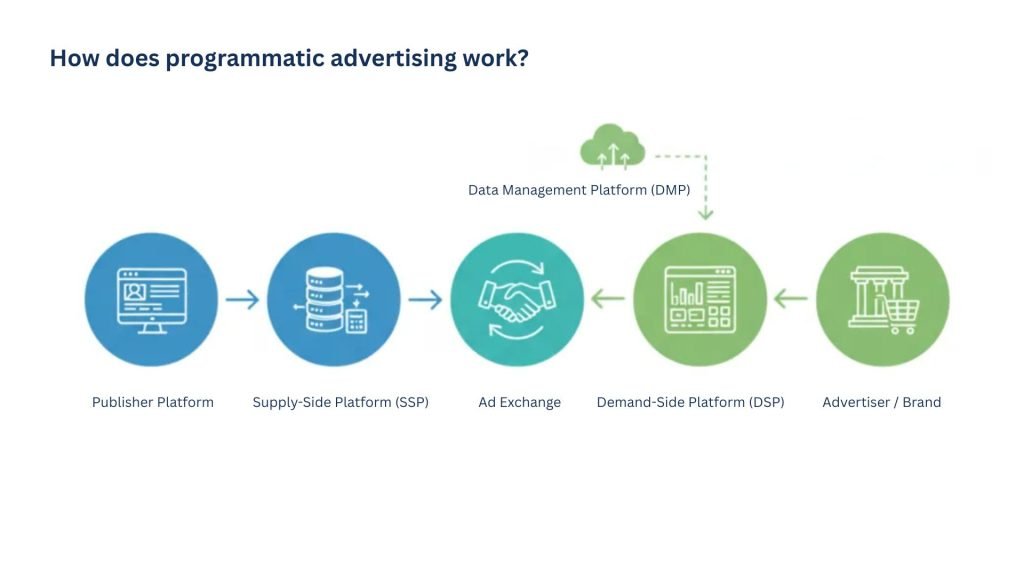
Programmatic advertising works through a connected ecosystem of buying platforms, selling platforms, data platforms, and ad exchanges.
When a user loads a page or opens an app, the publisher makes an ad impression available. The supply-side platform sends that opportunity into the market. The ad exchange invites demand-side platforms to bid. Advertisers use their audience rules, campaign goals, and data signals to decide whether to bid and how much to bid.
The winning advertiser’s creative then appears in the ad slot.
This process happens in fractions of a second. Google’s Authorized Buyers documentation explains that real-time bidding allows digital advertising inventory to be bought and sold in less than a second.
Here is the simplified flow:
- A user visits a website or app with available ad space.
- The publisher’s SSP identifies the impression opportunity.
- The ad exchange sends a bid request to connected DSPs.
- Each DSP evaluates the user, context, and campaign rules.
- The DSPs submit bids.
- The ad exchange selects the winning bid.
- The winning creative appears to the user.
To the user, the page simply loads. Behind the scenes, a live auction just happened.
What Are DSPs, SSPs, Ad Exchanges, and DMPs?
Programmatic advertising has four core roles: DSPs, SSPs, ad exchanges, and DMPs. Each role serves a different side of the market.
What Is a DSP?
A DSP, or demand-side platform, represents the advertiser.
Marketing teams and agencies use a DSP to set campaign objectives, audience rules, budgets, bidding limits, frequency caps, geographies, and creative rules. The DSP then evaluates ad opportunities across multiple exchanges and decides when to bid.
Think of the DSP as the advertiser’s buying engine. It does not just buy media. It decides whether each impression is worth buying.
What Is an SSP?
An SSP, or supply-side platform, represents the publisher.
Publishers use SSPs to manage their ad inventory, set floor prices, control which types of ads can appear, and maximize yield from available ad space. A publisher may be a news website, streaming platform, mobile app, marketplace, or game developer.
Think of the SSP as the publisher’s revenue engine. It helps publishers sell inventory at the best possible value.
What Is an Ad Exchange?
An ad exchange is the marketplace where buying and selling happen.
It connects DSPs and SSPs, receives bid requests, runs auctions, and selects winning bids. In simple terms, the ad exchange is where demand meets supply.
IAB Europe describes the ad exchange model as a way to make media trading easier and faster by focusing on audience-based buying rather than only pre-packaged inventory.
What Is a DMP?
A DMP, or data management platform, helps advertisers organize anonymous audience data, often from third-party sources.
A DMP may classify users into segments such as “sports enthusiasts,” “frequent travelers,” or “luxury beauty shoppers.” DSPs can then use those segments to decide whether a user fits the campaign’s target audience.
However, DMPs have a limitation. Much of their value historically came from third-party data. As privacy expectations, consent rules, and signal loss reshape digital advertising, enterprises need stronger first-party data strategies. That is where CDPs become critical.
What Is Real-Time Bidding in Programmatic Advertising?
Real-time bidding, or RTB, is the auction mechanism behind many programmatic ad transactions.
RTB lets advertisers bid on individual impressions in real time. Instead of buying a fixed block of inventory upfront, advertisers evaluate each impression as it becomes available.
For example, a retailer may decide to bid higher for a returning customer who viewed a product three times in the past week. A bank may bid more for a user who has shown interest in credit cards and lives in a target district. A gaming company may bid aggressively for a player who looks similar to its highest-value users.
The better the data, the better the bid decision.
That is why programmatic advertising performance depends on more than media buying skills. It depends on data quality, audience design, identity resolution, conversion measurement, and optimization discipline.
How Does Programmatic Advertising Work in Mobile Games?
Mobile gaming offers a clear example of programmatic advertising because ad opportunities appear frequently and user context changes fast.
Imagine a player fails a level and sees an option to watch a rewarded video ad for an extra life. That single moment creates an impression opportunity.
In a mobile gaming environment:
- The game app acts as the supply source.
- The mediation or in-app bidding platform manages the ad opportunity.
- Advertisers bid to show a video ad to that player.
- The winning ad appears inside the game.
AppLovin’s MAX platform supports in-app bidding and network data for bidding networks, making it a useful example of how mobile app monetization connects supply, demand, and real-time bidding.
The logic is the same as web programmatic advertising, but the environment is faster and more behavior-rich. A user’s game category, session depth, purchase behavior, and engagement pattern can all shape the bid decision.
For advertisers, this is powerful. For enterprises, it also creates a warning: if your customer data sits in disconnected systems, your bidding engine will make expensive guesses.
How Can Enterprises Improve Programmatic Advertising Performance?
Enterprises improve programmatic advertising performance by upgrading the quality of audience data, creative decisions, and bidding logic.
Most teams focus too much on media cost. That is only one lever. Better performance usually comes from three moves: sharper first-party segmentation, dynamic creative optimization, and value-based bidding.
How Does First-Party Data Improve Audience Targeting?
First-party data comes from your own customer touchpoints: website behavior, app events, CRM records, purchase history, loyalty status, email engagement, support interactions, and offline transactions.
Compared with broad third-party audience labels, first-party data gives marketing teams a clearer picture of intent and value.
A basic audience segment may say: “People interested in sports.”
A stronger first-party segment says: “Existing members who searched for premium basketball shoes in the past 7 days, visited the product page twice, and have not purchased.”
The second audience is smaller. It is also far more useful.
Programmatic advertising rewards precision. When you know who matters, you can bid smarter, personalize creative, suppress low-value audiences, and protect budget from waste.
How Does Dynamic Creative Optimization (DCO) Improve Relevance?
Dynamic creative optimization, or DCO, lets advertisers change ad creative based on user data.
Instead of showing the same banner to everyone, DCO can adjust the image, headline, product, offer, language, or call to action.
For example:
- A returning shopper sees the exact product they abandoned.
- A high-value customer sees a loyalty upgrade offer.
- A new visitor sees a best-selling product category.
- A user in Hong Kong sees WhatsApp as the conversion path.
- A user in Taiwan sees LINE as the next action.
DCO only works well when the data is clean and connected. Without reliable customer signals, dynamic creative becomes random variation.
Personalization needs memory. Your advertising system needs to know what the customer did before it decides what to show next.
How Does CLV-Based Bidding Improve ROI?
Customer lifetime value, or CLV, helps advertisers decide how much a customer is worth over time.
Not every click deserves the same bid. Not every conversion has the same business value.
A customer who buys once with low margin should not receive the same bid treatment as a loyal customer with high repeat purchase potential. A lead from a target enterprise account may deserve a higher bid than a generic low-fit inquiry.
When enterprises connect CLV to programmatic bidding, they can:
- Bid higher for high-value customers and accounts.
- Reduce bids for low-value audiences.
- Suppress customers who already converted.
- Retarget based on journey stage.
- Optimize toward revenue quality, not just clicks.
This is where programmatic advertising becomes a growth system rather than a media buying tactic.
Why Does Programmatic Advertising Need a CDP?
Programmatic advertising needs a CDP because most enterprises still store customer data across disconnected systems.
Your customer signals may sit in:
- CRM records
- POS systems
- Website analytics
- App events
- Email engagement
- Customer service tools
- Offline transactions
- Loyalty programs
- Advertising platforms
Each tool sees part of the customer. None of them sees the full customer alone.
A CDP, or Customer Data Platform, connects these signals into a unified customer profile. It collects data from multiple systems, resolves identities, creates segments, and activates audiences into downstream platforms such as DSPs, marketing automation tools, analytics platforms, and personalization engines.
The key capability is identity resolution.
Identity resolution connects scattered identifiers, such as email, phone number, member ID, device ID, browser cookie, and app behavior, to the same customer profile. That gives the business a single customer view.
Once a CDP creates that foundation, marketing teams can activate stronger programmatic audiences.
For example:
- The CDP creates a segment of high-CLV customers who visited a product page three times in 30 days.
- The CDP syncs that audience to the DSP.
- The DSP recognizes matching users during real-time bidding.
- The DSP bids higher or triggers a more relevant creative.
- Performance data flows back into the intelligence loop.
Without a CDP, programmatic advertising often relies on rented audience labels. With a CDP, programmatic advertising can act on owned customer intelligence.
How Should Hong Kong and APAC Enterprises Start with Programmatic Advertising?
Hong Kong and APAC enterprises should start with the business problem, not the media platform.
Buying programmatic ads is easy. Building a programmatic growth engine takes discipline.
Start with these five steps.
1. Define the revenue objective
Choose the business outcome before choosing the channel.
Are you trying to acquire new customers, reactivate dormant customers, increase repeat purchases, drive app installs, grow qualified B2B leads, or protect retention?
The answer changes the audience, bid strategy, creative, and measurement model.
2. Audit your customer signals
List the data sources that can improve targeting and bidding.
For example:
- CRM
- GA4
- Website behavior
- Mobile app events
- POS
- Offline sales
- HubSpot lifecycle stage
- Customer support interactions
- Product usage data
- Purchase history
Then ask a harder question: can your team actually activate this data into paid media?
If not, you have a data activation gap.
3. Build first-party audiences
Create audience segments based on real behavior and customer value.
Good segments are specific, actionable, and measurable.
Avoid vague audiences such as “interested users.” Build sharper segments such as “enterprise leads from target industries who downloaded a guide but have not booked a consultation.”
4. Connect creative to customer context
Do not run one message for every audience.
Map creative to journey stage. Awareness audiences need education. Consideration audiences need proof. Returning customers need relevance. High-value accounts need tailored value propositions.
5. Measure beyond clicks
Clicks are easy to buy. Revenue is harder to prove.
Measure programmatic advertising against outcomes such as qualified leads, pipeline contribution, purchase value, repeat purchase rate, customer acquisition cost, and CLV.
If the data cannot prove business impact, the campaign is not finished. It is just reported.
How Does DAL Help Turn Programmatic Advertising Into Customer Intelligence?
DAL helps enterprises turn programmatic advertising from media buying into Customer Intelligence.
That means we do not only help you buy ads. We help you build the system that decides who to reach, what to show, when to act, and how to measure the outcome.
Our methodology follows the DAL loop: Signal → Decide → Act → Learn.
Signal: Connect customer data
We connect first-party signals across CRM, web analytics, app events, marketing automation, transaction records, and customer engagement tools.
This creates the data foundation for smarter advertising.
Decide: Build audiences and bidding logic
We help teams define high-value audiences, propensity segments, CLV groups, and next-best-action rules.
This turns scattered data into decisions.
Act: Activate across channels
We activate audiences into advertising, email, WhatsApp, push notifications, in-app messaging, personalization, and lifecycle automation.
This lets marketing teams coordinate paid media with owned channels.
Learn: Measure and optimize
We connect campaign performance back to customer outcomes. That includes conversion quality, pipeline, revenue, repeat purchase, retention, and experiment results.
This closes the loop.
Programmatic advertising is not just about buying impressions faster. It is about making better customer decisions at scale.
With the right CDP and Customer Intelligence foundation, every bid becomes smarter. Every creative becomes more relevant. Every campaign teaches the next one what to do better.
Frequently Asked Questions
What is programmatic advertising?
Programmatic advertising is the automated buying and selling of digital ad inventory. Instead of manually negotiating every placement, advertisers use platforms such as DSPs, SSPs, and ad exchanges to buy impressions in real time. The system evaluates audience data, campaign rules, and bid strategy before deciding which ad should appear.
What is the difference between programmatic advertising and real-time bidding?
Programmatic advertising is the broader method of automated media buying. Real-time bidding, or RTB, is one auction-based buying mechanism within programmatic advertising. RTB lets advertisers bid on individual impressions as they become available. Not all programmatic buying uses open RTB. Some deals use private marketplaces or programmatic direct buying.
What is a DSP in programmatic advertising?
A DSP, or demand-side platform, is a tool advertisers use to buy digital media programmatically. It lets advertisers set campaign goals, budgets, audience rules, bids, frequency caps, and creative conditions. The DSP then evaluates available impressions and bids on the ones that match the advertiser’s objectives.
Why does programmatic advertising need first-party data?
Programmatic advertising needs first-party data because broad third-party audience segments are often too vague. First-party data shows real customer behavior, purchase history, lifecycle stage, and engagement. This helps advertisers build sharper audiences, bid based on customer value, personalize creative, and reduce wasted media spend.
How does a CDP improve programmatic advertising?
A CDP improves programmatic advertising by unifying customer data across CRM, analytics, POS, app, website, and marketing tools. It resolves identities, builds first-party audience segments, and activates those audiences into DSPs and other channels. This lets advertisers bid and personalize based on real customer intelligence rather than fragmented platform data.
GET IN TOUCH


![[Free Webinar] Road to COP17: Unifying Enterprise Data with Planetary-Scale Geospatial AI](https://masterconcept.ai/wp-content/uploads/2026/09/Webinar-261007-Unifying-Enterprise-Data-with-Planetary-Scale-Geospatial-AI-_1280x720px-scaled.png)