

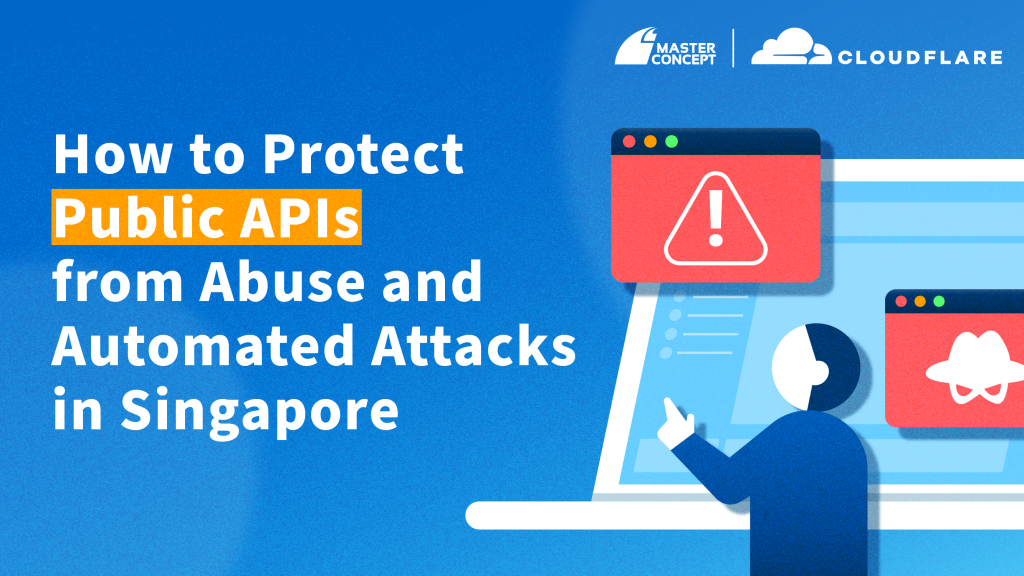
Public APIs are essential for modern digital services. From mobile applications to partner integrations, APIs enable speed, scalability, and innovation. At the same time, they introduce a growing attack surface that many enterprises underestimate.
In Singapore, where fintech platforms, SaaS providers, and digital commerce businesses operate in highly connected environments, API abuse is no longer a theoretical concern. It directly affects service availability, infrastructure cost, and data security.
Why API Abuse Is Becoming a Business Risk
Public APIs are designed to be accessible, but that accessibility also makes them easy targets.
Many organisations initially notice API abuse through indirect signals. Infrastructure costs increase without clear business growth. Login endpoints experience unusual spikes. Data appears to be accessed at a frequency that does not align with normal user behaviour.
In Singapore, where digital services are expected to maintain high availability and comply with data protection expectations under the Personal Data Protection Act, these issues quickly become more than operational concerns. They affect trust, compliance posture, and long-term scalability.
Where Traditional API Protection Falls Short
Many teams assume that basic controls such as IP blocking or fixed rate limits are sufficient. In practice, these approaches are often ineffective against modern automated attacks. Attack traffic today is distributed, adaptive, and designed to mimic legitimate users. This makes it difficult to distinguish between real usage and abuse without deeper analysis.
At the same time, security teams must balance protection with user experience. Overly aggressive controls can impact legitimate users, especially in high-traffic environments such as financial services or e-commerce platforms. As a result, API security becomes not just a technical challenge, but an operational one.
What Effective API Protection Looks Like Today
Modern API protection is no longer about adding isolated controls. The challenge is how to enforce protection consistently across all API traffic without increasing operational complexity.
Leading enterprises are shifting towards an approach where protection is applied before traffic reaches core systems. Instead of relying solely on backend enforcement, controls such as rate limiting, bot detection, and traffic analysis are handled at a unified layer.
In this model, rate limiting becomes more than a simple threshold. It adapts based on identity, session behaviour, and traffic patterns in real time. This allows organisations to control abuse without introducing friction for legitimate users.
At the same time, automated traffic is analysed continuously. Rather than blocking based on static rules, modern systems identify behavioural signals that indicate scraping, credential abuse, or non-human interaction. This significantly improves accuracy while reducing false positives.
For many enterprises, the biggest shift is visibility. When API traffic is analysed in a single layer, teams gain a clearer understanding of how services are being used, where abuse originates, and how controls should evolve over time.
A Practical Scenario: API Abuse in a Singapore Fintech Platform
Consider a Singapore-based fintech platform that exposes APIs for account access and transaction services.
At first, the platform notices an increase in login attempts and API calls. The traffic appears legitimate on the surface, but infrastructure costs begin to rise faster than user growth. Over time, performance starts to degrade during peak periods. Further investigation reveals a combination of credential stuffing and automated scripts attempting to extract financial data.
Without adaptive controls, the platform faces a difficult trade-off. Tightening restrictions risks blocking real users, while leaving systems open increases exposure. By introducing behavioural analysis and dynamic rate limiting, the platform is able to identify abusive patterns and reduce malicious traffic. Importantly, this is achieved without disrupting normal user activity.
Moving Towards a More Unified Approach
One of the most common challenges enterprises face is fragmentation. API protection is often implemented across multiple tools, making it difficult to enforce consistent policies or gain full visibility.
As digital services scale, this model becomes harder to maintain.
In response, many organisations in Singapore are adopting a more consolidated approach. By handling API traffic, application security, and bot mitigation within a single layer, enterprises are able to simplify operations while improving protection.
This approach also enables security teams to respond more quickly. Instead of coordinating across multiple systems, policies can be updated centrally and applied immediately across all API endpoints. For fast-growing platforms, this shift is not just about security. It is about maintaining performance and operational efficiency as traffic increases.
From Awareness to Action
Understanding API abuse is only the first step. The more important question is how to implement protection in a way that is scalable and does not introduce unnecessary complexity.
Many enterprises begin by improving visibility into API traffic, then gradually introduce adaptive controls such as rate limiting and bot detection. Over time, these capabilities are integrated into a broader security architecture.
This phased approach allows teams to strengthen API protection without disrupting existing systems or slowing down development.
Public APIs are a foundation of modern digital services, but they also introduce new risks that cannot be ignored. In Singapore’s digital landscape, where performance, trust, and compliance are closely linked, protecting APIs from abuse and automated attacks is no longer optional. It is a core part of building resilient and scalable systems.
Strengthen API Protection Without Increasing Complexity
Many enterprises recognise the risks of API abuse, but face a common challenge. Implementing multiple layers of protection often introduces additional complexity, operational overhead, and performance impact.
A more effective approach is to integrate rate limiting, bot detection, and API traffic visibility into a unified edge layer. By filtering and analysing traffic before it reaches origin systems, organisations can reduce abuse while maintaining performance and scalability.
This model allows teams to:
- Reduce infrastructure load caused by automated traffic
- Improve detection of scraping and credential-based attacks
- Apply consistent policies across all APIs without fragmentation
For organisations evaluating how to protect public APIs in a scalable way, the key question is no longer whether to implement these controls, but how to do so without slowing down the business.
FAQ
What is API abuse and how is it different from API misuse?
API abuse refers to malicious or excessive use of an API to exploit systems or extract data, while misuse typically involves unintended usage without malicious intent.
How can enterprises prevent API scraping?
By analysing traffic patterns, applying adaptive rate limits, and using bot detection to distinguish automated behaviour.
What is the best API rate-limiting strategy?
A context-aware approach that adjusts limits based on user identity and behaviour.
How to prevent automated API attacks?
Through behavioural analysis, bot management, and real-time traffic classification.


![[Free Webinar] Road to COP17: Unifying Enterprise Data with Planetary-Scale Geospatial AI](https://masterconcept.ai/wp-content/uploads/2026/09/Webinar-261007-Unifying-Enterprise-Data-with-Planetary-Scale-Geospatial-AI-_1280x720px-scaled.png)