

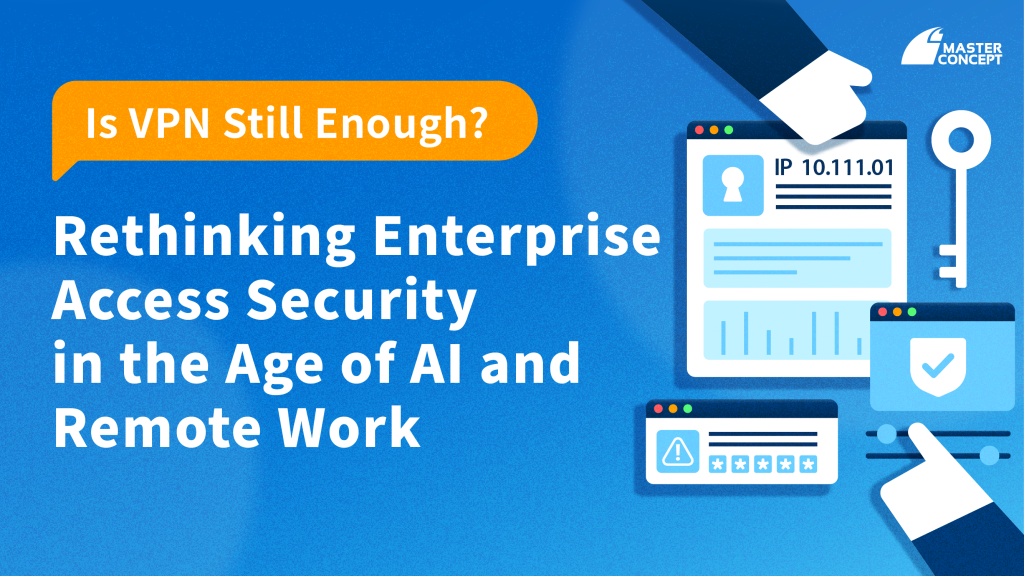
Imagine a scenario that plays out in businesses every day.
A sales manager is working from a café, preparing an important client presentation. At the same time, they need to log into a CRM system, access internal cloud files, and use a generative AI tool to refine their slides. Following company policy, they turn on the VPN—but the connection slows down noticeably. Meanwhile, the IT team has no visibility into whether sensitive customer data is being pasted into external AI platforms.
This is no longer an edge case.
It’s a normal workday in the age of AI and remote work.
And it raises an increasingly common question for enterprises: is VPN still enough to protect modern access and data flows?
Why Enterprises Are Re-evaluating the Role of VPN
For years, VPNs were the default answer to remote access. They were designed for a time when applications lived inside corporate networks and employees worked from predictable locations.
That reality has changed.
Today’s enterprise environment is shaped by:
- SaaS-first architectures instead of on-prem systems
- Remote and hybrid work as the default, not the exception
- BYOD and unmanaged devices
- AI tools embedded directly into everyday workflows
In this context, the challenge is no longer just how users connect, but how access should be evaluated, controlled, and continuously validated.
Where Traditional VPNs Fall Short in Modern Workflows
One of the biggest limitations of VPN lies in its trust model. Once a user successfully connects, they are often treated as if they are “inside” the network, with broad access to internal resources. This model significantly increases the blast radius if credentials are compromised and makes lateral movement much easier for attackers.
Another issue is device visibility. Most VPN implementations focus on identity verification but have limited awareness of device posture. Whether a device is patched, compliant, or even managed is often outside the VPN’s decision-making process—an increasingly dangerous gap in BYOD-heavy environments.
User experience is also a practical concern. Slow connections, unstable tunnels, and performance issues frequently lead employees to bypass VPNs altogether. When security controls disrupt productivity, users find workarounds—using personal accounts, unmanaged devices, or external AI tools without proper oversight.
Finally, VPNs are fundamentally misaligned with SaaS- and browser-centric work. Modern employees don’t “enter the corporate network” before working; they open a browser and start. When the browser is the primary workspace, network-level trust alone is no longer sufficient.
From “Can They Connect?” to “Should This Access Be Allowed?”
As a result, many organizations searching for VPN alternatives are not simply looking for a new tool—they are rethinking their access philosophy.
This shift is rooted in a core Zero Trust principle:
never assume trust, and continuously verify every access request.
Instead of granting broad network access, enterprises are moving toward models that evaluate access dynamically, based on identity, device, and context.
This is where the concept of a Zero Trust Browser enters the conversation.
Why Zero Trust Browsers Fit Modern Enterprise Security
A Zero Trust Browser is not just a “more secure browser.” It represents a shift in where access control happens—directly at the point where work actually occurs.
Each access request can be evaluated based on:
- Who the user is
- The security posture of their device
- What application or data they are trying to access
- What actions are allowed (viewing, downloading, copying, or sharing with AI tools)
Rather than placing users inside a trusted network, access is limited to specific applications and actions. This dramatically reduces exposure while aligning security controls with real user behavior.A simple way to think about it is this:
traditional VPNs resemble a single passport check at the airport entrance, while a Zero Trust Browser verifies identity and authorization at every boarding gate. In a SaaS- and AI-driven environment, that level of granularity matters.
Rethinking Remote Access Security Without VPN Dependency
As browsers become the primary interface for SaaS platforms, internal systems, and AI tools, enterprises are increasingly treating the browser as a strategic control point.
This approach is especially relevant for organizations that:
- Rely heavily on cloud and SaaS applications
Support distributed or hybrid workforces - Need better visibility into AI-driven data usage
- Want secure access without degrading user experience
In many cases, this enables secure connections without VPN, while maintaining stronger and more contextual access controls.
VPN Is Not Disappearing. But It Is No Longer the Center
This shift does not mean VPNs are obsolete. For certain legacy systems or specific internal use cases, VPNs still serve a purpose.
However, they are no longer sufficient as the primary foundation for enterprise access security. Modern organizations are adopting hybrid models that combine VPN where necessary with Zero Trust principles and browser-level enforcement where it makes more sense. Contact us today to learn more!
Frequently Asked Questions About VPN and Modern Access Security
Is VPN still necessary for modern enterprises?
VPNs are not obsolete, but they are no longer sufficient as a standalone solution. While VPNs may still be useful for certain legacy systems or specific internal access scenarios, modern enterprises require more granular and context-aware controls to secure SaaS, cloud, and AI-driven workflows.
What are the main limitations of VPN for remote work?
Traditional VPNs rely on broad network-level trust. Once connected, users often gain access to large portions of the internal network, with limited visibility into device posture and user behavior. This approach does not align well with distributed, SaaS-first environments.
What is a Zero Trust Browser?
A Zero Trust Browser applies Zero Trust principles directly at the browser level, where most modern work takes place. Each access request is evaluated based on identity, device security posture, and context, allowing access only to specific applications and actions rather than entire networks.
Can enterprises enable secure access without VPN?
Yes. Many organizations are reducing or eliminating VPN dependency by enforcing access controls at the browser or application layer. This approach is particularly effective for cloud-first and SaaS-based environments, while also improving user experience.
Is Zero Trust a replacement for VPN?
Zero Trust is not a direct replacement for VPN, but a different security model. In practice, enterprises often combine VPNs for specific use cases with Zero Trust-based controls to better align security with modern work patterns.

![[Free Webinar] Road to COP17: Unifying Enterprise Data with Planetary-Scale Geospatial AI](https://masterconcept.ai/wp-content/uploads/2026/09/Webinar-261007-Unifying-Enterprise-Data-with-Planetary-Scale-Geospatial-AI-_1280x720px-scaled.png)