

Key Takeaway: The fundamental difference between a Customer Data Platform (CDP) and a Customer Relationship Management (CRM) system lies in their core purpose and the type of data they handle. A CDP focuses on data unification, creating a 360-degree view of all customers (including anonymous users) to power personalized marketing. A CRM focuses on relationship management, optimizing interactions with known customers across sales and service. In essence, a CDP sees all the data, while a CRM manages the conversation. Integrating both is the key to a data-driven customer strategy.
For years, the Customer Relationship Management (CRM) system has been an indispensable tool for sales and marketing teams. However, as customer expectations for seamless brand experiences continue to rise, relying on a traditional CRM alone is no longer enough. A clear trend is emerging: forward-thinking enterprises are shifting their focus to a new operational model centered around the Customer Data Platform (CDP).
But what exactly is the difference between a CDP and a CRM? What specific problems does each platform solve? And with so many options on the market, how can you compare them to find the perfect fit for your business?
In today’s digital world, customer footprints are everywhere—websites, apps, social media, and even physical stores. Every interaction is a valuable piece of data that businesses must capture. This article provides a clear, comprehensive breakdown of these two powerful platforms, offering expert advice to guide your decision. A clear understanding of CDP vs. CRM is the first step to making the smartest investment in a data-driven era.
What is a CRM?
A Customer Relationship Management (CRM) system is software designed specifically to manage and nurture interactions with known customers. Think of it as a highly organized address book combined with a detailed interaction log. The core objective of a CRM is to optimize the sales process, enhance customer service quality, and execute targeted marketing campaigns. It revolves around people and relationships, ensuring every customer touchpoint is tracked and managed.
A CRM primarily records direct interaction data between the customer and the company. This data is typically structured and entered manually by employees (like sales or service reps) or logged automatically by the system.
- Customer Basics: Name, company, title, phone number, email address.
- Interaction History: Records of calls, email correspondence, and meeting notes.
- Sales Pipeline Status: Tracking whether a customer is a “lead,” “qualified,” “quoted,” or “closed-won.”
- Customer Service Records: Support tickets, complaints, and resolution details.
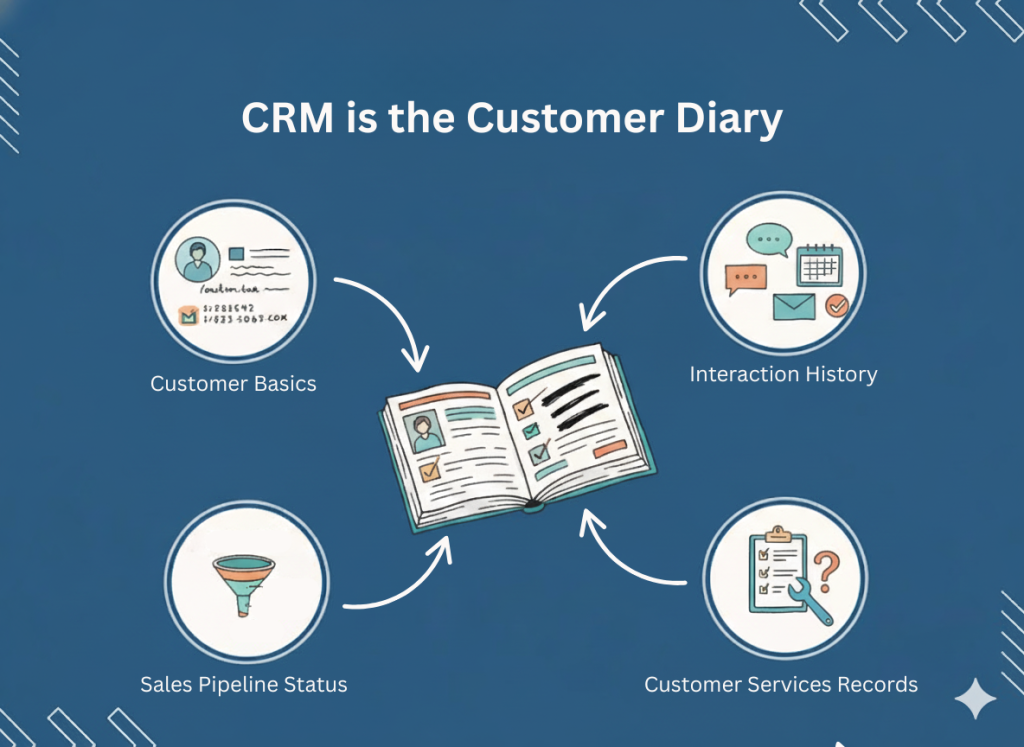
In summary, a CRM’s strength lies in managing relationships. It empowers sales and service teams to collaborate efficiently and provide consistent, personalized service. The ultimate goal is to increase customer satisfaction and loyalty, driving sales and revenue. Understanding this core function is the first step in any effective CDP vs. CRM comparison.
What is a CDP?
A Customer Data Platform (CDP) is a far more comprehensive “central data kitchen.” Its primary mission is to solve one of the biggest challenges facing modern enterprises: data silos. If a CRM focuses on managing relationships, a CDP’s core mission is to unify data from every conceivable source. A powerful CDP + CRM strategy often produces results where the whole is greater than the sum of its parts.
A CDP collects, cleans, and unifies customer data from all online and offline channels, matching it to a single, persistent customer profile. Unlike a CRM, a CDP excels at capturing and integrating anonymous user behavior, creating a true 360-degree customer view. Data sources include:
- Behavioral Data: Which product pages a user viewed, session duration, and items added to a cart but not purchased.
- Transactional Data: Online order details, offline POS purchase records, and return history.
- CRM Data: Known customer names, contact information, and loyalty status.
- Other Sources: Customer service chat logs, social media interactions, and ad platform engagement data.

An Introduction to CDP Types
As the market has evolved, different types of CDPs have emerged to meet specific business needs. Understanding these categories will help you find the right solution when comparing CDP vs. CRM platforms.
Social CDP
A Social CDP specializes in the deep integration of user data from social media platforms. It captures not only public profile information but also interactions like likes, comments, and shares on platforms such as Facebook, Instagram, and LINE, and even conversational data from messenger apps. Its strength lies in creating highly detailed interest-based tags to enrich customer profiles, making it ideal for retail and e-commerce brands that rely heavily on social media marketing.
Infrastructure CDP
An Infrastructure CDP (Infra CDP) is a powerful “data foundation” tool. While it may not come with many pre-built marketing applications, its core advantage is its immense power in data integration, processing, and modeling. Designed for technical teams and data scientists, it allows for the flexible construction of custom data models tailored to specific enterprise needs. For large organizations with robust in-house data teams, an Infra CDP is the ultimate advanced choice.
Suite CDP
A Suite CDP is an “all-in-one” platform that combines powerful data unification capabilities with a built-in suite of marketing automation, analytics, and customer engagement tools. This is the most versatile and popular type of CDP, offering marketers a complete, out-of-the-box solution. Users can perform customer segmentation, design automated marketing journeys, send personalized emails, and analyze campaign performance—all within a single platform. It’s the preferred choice for businesses looking for rapid implementation and a lower technical barrier to entry.
CDP vs. CRM: Key Differences and Use Cases
The most effective way to understand the difference between a CDP and a CRM is to compare their core objectives and primary applications. While both deal with customer data, their design philosophies are fundamentally different. They are not competing platforms; they are complementary.
CDP: Primary Goals and Applications
A CDP’s main objective is to build a unified, persistent, and accessible customer database that can be used by other systems. Its core tasks are data unification and user identification, merging anonymous and known data from disparate channels into a single customer profile.
A CDP is highly versatile and essential for:
- Complex Data Integration: When your customer data is trapped in silos across your website backend, app, and POS systems, a CDP is the best tool to break down those walls.
- Personalized Marketing: When you want to trigger personalized messages or ads based on real-time user behavior, a CDP provides the necessary data infrastructure.
- Omnichannel Marketing: When you need to ensure a consistent and seamless customer experience across all channels, a CDP is the foundational layer to make it happen.
CRM: Primary Goals and Applications
A CRM’s main objective is to manage and optimize direct interactions between the company and its customers. Its core tasks are relationship management and process tracking, ensuring sales and service teams can efficiently follow up with every customer.
A CRM is focused on business models requiring direct human interaction:
- Sales Pipeline Management: For B2B companies or B2C businesses with long sales cycles, a CRM is essential for tracking leads, managing opportunities, and forecasting revenue.
- Customer Service & Support: A CRM records complete communication histories, helping support teams provide fast and context-aware assistance.
- Customer Retention: A CRM helps manage contact preferences, purchase history, and satisfaction levels, which is crucial for customer segmentation and loyalty programs.
In short, a simple way to frame the CDP vs. CRM comparison is: a CDP is responsible for “seeing” the complete picture of every customer, while a CRM is responsible for “talking” and interacting with them. Understanding this core difference is the key to building a successful data strategy.
A Comparison of Leading CDP & CRM Platforms
The market is filled with mature platforms, some starting as CRMs and adding CDP-like features, and others built as CDPs from the ground up. Understanding their strengths can help you make a more informed decision.
Salesforce
As the global leader in the CRM market, Salesforce’s strengths lie in its robust Sales Cloud and Service Cloud functionalities and its extensive AppExchange ecosystem. However, it can be expensive, its native capabilities for unifying anonymous user data are less developed, and implementation can be complex, often requiring specialized technical staff.
Adobe Experience Cloud
This powerful marketing-centric suite features Adobe Real-Time CDP, which excels at real-time data processing and personalization, making it ideal for large retail and media enterprises. Its downsides are a steep learning curve and high licensing costs, which may be prohibitive for businesses that are not marketing-led or have limited budgets.
Microsoft Dynamics 365
The primary advantage of Dynamics 365 is its deep integration with the Microsoft ecosystem (e.g., Office 365, Power BI), offering a unified workflow experience. However, its CRM market share and third-party app ecosystem are smaller compared to Salesforce, which can limit customization options.
How Should Your Business Choose a Platform?
Making the right choice comes down to your core business needs. Ask yourself these key questions:
- What is our primary pain point? Is it a chaotic sales process that needs a CRM for team alignment? Or is it scattered customer data that requires a CDP to enable personalized marketing? Identifying the single biggest problem you need to solve is the first step.
- How complex are our data sources? If your data comes mainly from direct sales interactions, a CRM may be sufficient. But if you need to integrate anonymous website traffic, app behavior, and third-party data, a CDP should be your priority.
- What are our team’s skills and resources? If you don’t have a dedicated IT or data science team, choosing a Suite CDP or a user-friendly CRM is the most practical option. Successful adoption depends as much on your team’s ability to use the tool as it does on the technology itself.
The best platform is the one that solves your most pressing problem today and can scale with you tomorrow.
Master Concept: The Localized CDP Partner for Enterprises in Hong Kong & Taiwan
While global CDP platforms are powerful, businesses in Hong Kong and Taiwan often find they aren’t a perfect fit. Common challenges include poor integration with locally popular communication apps (like WhatsApp and LINE) and a lack of deep understanding of local consumer behavior.
With over 20 years of experience in Hong Kong and Taiwan, Master Concept understands these unique local challenges. Our CDP solutions combine world-class technology with on-the-ground, practical expertise. We know that a successful CDP and CRM integration hinges on its ability to solve the real-world operational pain points of local businesses.
Our advantages include:
- Deep Localization: We seamlessly connect your CDP with the tools you use most in local markets, including payment gateways (PayMe, FPS), e-commerce platforms (HKTVmall), and essential communication apps like WhatsApp.
- Flexible Customization: Our expert team collaborates closely with you to build a data model that fits your business processes perfectly, ensuring the platform solves your most unique challenges.
- Professional Local Support: From strategic consulting and implementation to ongoing optimization, our local teams provide immediate, relevant support to ensure you get the maximum value from your investment.
Master Concept offers a comprehensive and multi-functional CDP platform designed to help enterprises in Hong Kong and Taiwan transform scattered customer data into tangible business growth.
Contact our team of experts today to learn how we can build a custom customer data solution for your business.
Frequently Asked Questions (FAQ)
1. My company already uses a CRM. Do I still need a CDP?
This is a common question. If your goal is to achieve cross-channel personalized marketing, the answer is “yes.” A CRM helps you manage interactions with known customers, but it cannot integrate anonymous user behavior data from your website, app, or other third-party platforms. A CDP fills this gap by unifying all data sources (including your CRM data) to form a complete customer view, making your marketing activities more precise and forward-looking.
2. How does a CDP help businesses achieve “personalized marketing”?
A CDP collects real-time behavioral data from customers across all touchpoints (e.g., which pages they browsed, what items they added to their cart) to build a dynamic, richly tagged customer profile for each user. Marketing teams can leverage this granular data to segment customers and automatically trigger highly personalized messages (such as emails, app push notifications, or ads), delivering content most relevant to the customer at the optimal time.
3. How should I choose between a CDP and a CRM? Which is more suitable for my business?
The key to choosing lies in your current core pain points. If your main challenge is a disorganized sales process or inefficient team collaboration, then a CRM should be your priority. However, if you’re facing “data silos” where customer data is scattered and cannot be unified for analysis and precise marketing, then a CDP will be critical. For many mature enterprises, the optimal strategy isn’t to choose one over the other, but to use a CDP as the data foundation, seamlessly integrated with a CRM, to achieve a synergistic effect where “1+1 > 2.”
4. Is the technical barrier to implementing a CDP system high?
This depends on the type of CDP you choose. The market offers Infra CDPs designed for technical teams, as well as Suite CDP solutions like those provided by Master Concept. A Suite CDP is an “all-in-one” platform with built-in data integration, analytics, and marketing automation tools. It features a user-friendly interface designed to lower the technical barrier, allowing marketing teams to quickly get started and focus on strategy execution rather than technical deployment.
5. Why is choosing a localized CDP partner like Master Concept important?
While international CDP platforms are powerful, they often overlook the unique characteristics of local markets. A local partner deeply understands your operational challenges in Hong Kong and Taiwan, such as consumer reliance on local tools like WhatsApp, LINE, and PayMe. Master Concept not only provides top-tier technology but also ensures the platform integrates seamlessly with your commonly used local tools. Our local expert team offers immediate and relevant strategic consulting and technical support, ensuring your investment truly delivers value and drives business growth.
Turn Customer Data into Business Performance.
DAL (Digital Action Lab) is the specialized growth division of Master Concept. It transforms fragmented customer data into a high-velocity growth engine by architecting modern martech stacks and deploying data-driven strategy. DAL empowers B2B enterprises to accelerate revenue, deepen customer engagement, and increase lifetime value, building the critical capabilities they need to win.


![[Free Webinar] Road to COP17: Unifying Enterprise Data with Planetary-Scale Geospatial AI](https://masterconcept.ai/wp-content/uploads/2026/09/Webinar-261007-Unifying-Enterprise-Data-with-Planetary-Scale-Geospatial-AI-_1280x720px-scaled.png)