

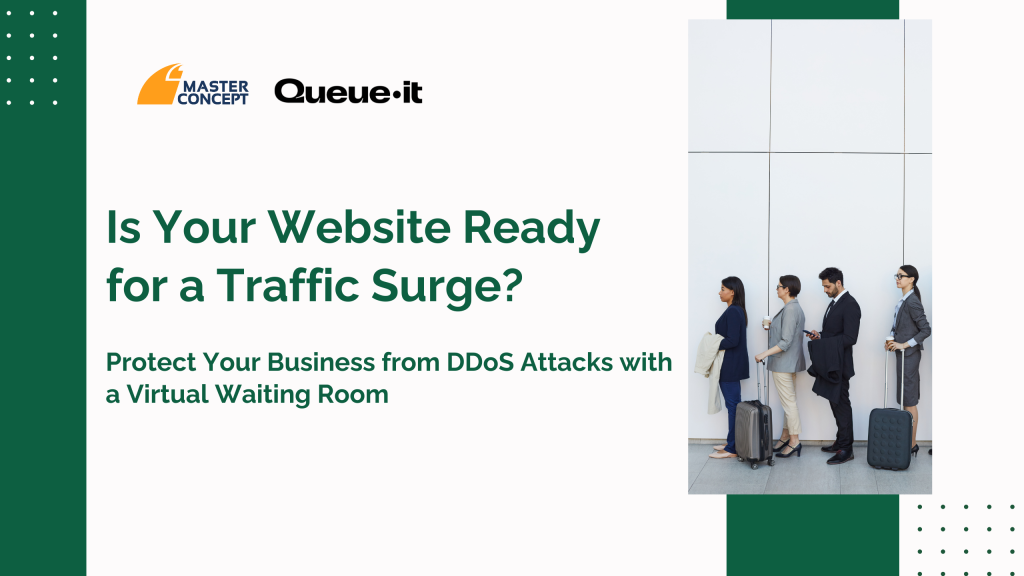
What is DDoS (Distributed Denial of Service) Attack?
A massive influx of internet traffic can be used by hackers to disable websites in what is known as a Distributed Denial of Service (DDoS) attack. Similar to the movie ticket scenario, a DDoS attack floods a website with an overwhelming volume of requests. However, these requests originate from a botnet—a network of compromised devices—rather than actual customers. The botnet simultaneously directs a vast number of requests to the target, intermingling them with legitimate traffic. This onslaught overloads the website’s infrastructure, leading to slowdowns or complete shutdowns and potentially significant financial losses for businesses.
There are three common types of DDoS attacks:
- Volumetric Attacks: These attacks flood a service with an overwhelming volume of fake traffic, essentially blocking the service’s entry points and saturating its bandwidth.
- Protocol Attacks: These attacks exploit weaknesses in network protocols by sending incomplete or malformed requests that exhaust the target server’s resources.
- Application Layer Attacks: This type of attack mimics real user requests to overload a service, making it difficult to distinguish malicious traffic from legitimate users.
DDoS Prevention and Mitigation: A Guide for Businesses
Businesses must adopt a proactive and engaged strategy to defend against DDoS attacks. This involves consistently analyzing potential risks, understanding and continuously monitoring website traffic, and evaluating existing security vulnerabilities to enable a prompt response to any irregularities. Regular software updates are also vital, as utilizing the latest versions can effectively prevent attacks. From a website architecture standpoint, employing a CDN or Load Balancer can prevent malicious traffic from directly impacting the core infrastructure. Furthermore, for anticipated high traffic during promotional events, companies can leverage traffic management services such as Queue-it‘s virtual waiting room.
Should a DDoS attack unfortunately occur, several common and effective solutions can be employed. For large-scale volumetric attacks, a Traffic Scrubbing service is highly effective. This service works by rerouting all incoming traffic to a security service provider’s scrubbing center. Here, specialized equipment and algorithms analyze and filter out malicious traffic, sending only the clean, legitimate traffic back to the company’s servers. To defend against application-layer attacks, implementing a Web Application Firewall (WAF) beforehand is a strong proactive measure. A WAF inspects traffic before it reaches the web server, blocking malicious HTTP/HTTPS requests based on a defined set of rules. Finally, in extreme situations where an attack overwhelms the entire network infrastructure, an internet service provider can utilize Blackhole Routing. This method redirects all traffic intended for a company’s IP address to a null route. While this temporarily takes the service offline, it rapidly cuts losses and prevents the attack from spreading further.
A Virtual Waiting Room: The Key to Preventing Website Crashes
The virtual waiting room system from Queue-it, a partner of Master Concept, is a powerful tool for defending against DDoS attacks. It helps organizations effectively manage sudden surges in online traffic, preventing website servers from crashing due to overload. The Queue-it platform acts as a secure checkpoint for visitors before they reach your main website or app. By controlling the flow of visitors, it ensures that your system remains within a manageable load. Queue-it can also slow down, block, and challenge malicious bots, stripping them of their speed and traffic advantages. It uses a variety of tools, including IP address analysis, Proof-of-Work challenges, CAPTCHA, and 24/7 anomaly detection, to identify and mitigate malicious traffic. By precisely controlling traffic and intelligently filtering out bad requests, Queue-it prevents website slowdowns and crashes caused by extreme loads, ensuring your service runs smoothly even during peak periods.

A great example of this in action is the TaipeiPASS app. Master Concept helped the Taipei City Government implement Queue-it to handle high-traffic events like the distribution of “Bear Voucher (Taipei Digital Stimulus Voucher).” Before the implementation, the app had crashed several times during voucher releases. After Queue-it was introduced in late 2022, the system handled a massive ten-fold traffic increase on the day the winning list was announced—from about 1,000 to over 10,000 users. Queue-it successfully prevented slow page loads and crashes, and as a result, Master Concept and Queue-it received the Smart Taipei Innovation Award that year.

Nowadays, organizations often face the challenge of managing sudden, high-volume traffic during popular online events. From selling concert tickets and limited-edition sneakers to launching new products and hosting flash sales, these events can push a company’s website to its limits. This surge of activity not only tests a website’s infrastructure but can also make it a prime target for malicious actors to launch a DDoS attack. A successful attack that results in a service outage or website crash can lead to significant financial and reputational damage.
For businesses looking for a solution, Queue-it‘s virtual waiting room is an effective way to manage these high-traffic situations. If you’d like to learn more about how this solution can help protect your business, please contact the professional consultants at Master Concept.

![[Free Webinar] Road to COP17: Unifying Enterprise Data with Planetary-Scale Geospatial AI](https://masterconcept.ai/wp-content/uploads/2026/09/Webinar-261007-Unifying-Enterprise-Data-with-Planetary-Scale-Geospatial-AI-_1280x720px-scaled.png)