


Ever feel like you’re overwhelmed with data but still can’t piece together that single customer view? Or maybe you’ve started a Customer Data Platform (CDP) project only to be stumped by messy data, team silos, or a reluctance to adopt new tools. Sound familiar? We’ve got your back! Below, we’ve outlined nine practical steps to provide an overview of successful implementation and point you in the right direction for more efficient, data-driven growth.
(Need help picking the right CDP? Check out our earlier blog, “Ultimate Guide to Choosing the Right Customer Data Platform,” before taking the plunge.)
1. Setting Clear Implementation Goals 🎯
A successful CDP implementation starts with defining what “success” looks like for your organization. Are you aiming for personalized marketing, better customer data management, or improved retention? Get specific and measurable from the start.
Action Steps
- Define Specific, Measurable Objectives: Know exactly what you want your CDP to achieve (e.g., reduce churn by 15%).
- Align CDP Goals with Overall Business Strategies: Make sure your CDP targets fit seamlessly into broader company aims (e.g., boosting ROI or upselling opportunities).
- Establish KPIs to Monitor and Evaluate Success: Track key metrics—like conversion rates or average order value—to measure progress and pivot if needed.

Pro Tip: Balancing ambition with achievability keeps your team motivated and on course.
2. Building a Dedicated Implementation Team 🤝
A Customer Data Platform (CDP) isn’t just a piece of software—it’s a collaborative effort uniting marketing, sales, analytics, and more. Bringing these departments together yields a 360-degree view of real-time customer data, enabling teams to work smarter, not harder.
Action Steps
- Assemble Key Stakeholders: Include IT, marketing, data analytics, and customer service.
- Define Roles & Responsibilities: Clarify who’s in charge of CDP integration, data governance, and training.
- Provide Resources & Empowerment: Offer the budget, tools, and authority needed for each role.
When diverse experts team up, you’ll uncover a 360-degree view of real-time customer data and how best to use it.
Teaming Up with Master Concept 🤝
Rather than juggling each detail solo, we can partner with you at every stage:
- Consultation – Evaluation of how CDP fits in your current tech stack
- Onboarding – Onboarding services to ensure a smooth adoption of new technology
- Implementation – Professional Implementation team to ensure data accuracy
- Managed Service – On-going support to help your team utilize customer data to the fullest
By teaming up with us, you’ll have the dedicated expertise needed to manage your cross-functional CDP rollout—without missing a beat.
3. Selecting the Right Implementation Methodology ⚙️
Your approach can make or break the entire process. Generally, organizations pick Agile, Waterfall, or a Hybrid model.
Key Considerations
- Agile: Short sprints, quick feedback, iterative progress—perfect for teams that thrive on flexibility.
- Waterfall: A linear sequence (plan → build → test → deploy), ideal for companies that want detailed, upfront planning.
- Hybrid: A blend of both, tailored to your project’s needs.
Choose what aligns best with your culture and resources, then set milestones to keep everyone on track.
4. Ensuring Robust Data Integration 🔗
Data integration is the heartbeat of any Customer Data Platform. Combine data from CRMs, social channels, eCommerce, and even offline sources to build a single customer view.
Action Steps
- Identify Data Sources: Catalog all systems holding customer data.
- Assess Compatibility: Evaluate integration challenges and ETL (Extract, Transform, Load) needs.
- Build Secure Pipelines: Work with your vendor to enable real-time data flow.
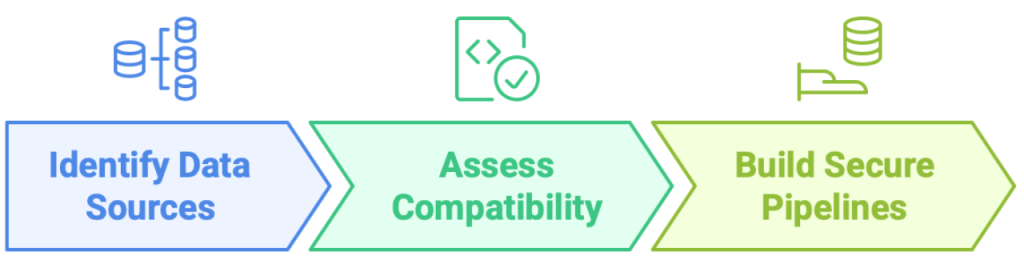
Smooth CDP integration empowers omnichannel customer data—so your marketing can be truly data-driven.
5. Establishing Data Quality Standards 🏆
Even the best CDP solutions can’t fix flawed data by themselves. Low-quality data sabotages customer insights and weakens marketing ROI.
Key Considerations
- Data Governance: Assign specific people to own and maintain different data sets.
- Consistency & Accuracy: Standardize fields and formats (e.g., “Email” vs. “Email Address”).
- Regular Audits: Schedule frequent checks to ensure real-time customer data stays clean.
Great data is like premium fuel for your CDP—everything runs smoother and more efficiently.
6. Customizing the CDP to Fit Business Processes 🛠
One-size-fits-all rarely works. Adapt your CDP to match your existing workflows—whether it’s tying into CRMs or automating eCommerce triggers.
Action Steps
- Configure Dashboards: Customize layouts and alerts for each department’s goals.
- Create Targeted Workflows: Sync CDP marketing features with your sales funnels (e.g., sending recommendations for abandoned carts).
- Integrate Marketing Tools: From email automation to loyalty programs, connecting everything amplifies your insights.
A tailored unified customer data platform boosts adoption and multiplies your CDP benefits.
7. Facilitating Organizational Change and Adoption 🙌
A CDP is both a technological and cultural shift. You need the entire organization on board for it to work its magic.
Key Considerations
- Change Management Plan: Develop strategies to manage the transition.
- Effective Communication: Show how it simplifies tasks like segmentation or consolidating CRM queries.
- Comprehensive Training: Provide hands-on workshops or tutorials to help teams learn.

When teams see how a unified customer data platform makes their day easier, they’ll jump in enthusiastically.
8. Implementing Continuous Monitoring and Feedback Loops 🔄
Launching your CDP is just the start. Ongoing feedback keeps it aligned with your ever-evolving goals.
Action Steps
- Monitor Performance: Track metrics such as uptime, data latency, and user adoption.
- Encourage User Input: Offer channels for reporting issues or suggesting improvements.
- Review & Adjust Regularly: Check if you’re hitting KPIs, then tweak features or processes as needed.
A “set it and forget it” approach leads to stagnation. Keep your data-driven marketing platform fresh and agile.
9. Scaling and Evolving Your CDP Post-Launch 🌱
Business needs change—and your CDP must keep up. Plan for growth and future requirements from the get-go.
Key Considerations
- Assess Scalability: Ensure the system can handle heavier data loads without slowing down.
- Incorporate New Features: Stay alert for cutting-edge tools like AI-driven segmentation or customer profiling software.
- Stay Compliant: Regulations shift, so review and update data governance policies often.
An evolving CDP lets you swiftly adapt to market shifts and stay one step ahead of the competition.
Stay Tuned for More CDP Insights 👀
These nine steps give you a glimpse into crafting a successful CDP implementation strategy, but they’re just the tip of the iceberg. In upcoming posts, we’ll be sharing even more valuable insights, including advanced integrations, data privacy essentials, and even emerging trends to future-proof your business. A robust CDP can be your competitive advantage, so keep an eye out for our next CDP blog!
Looking for Personalized Guidance? 🧭
From defining your CDP objectives and bridging departmental silos to ensuring robust data pipelines and customizing workflows, Master Concept covers all nine steps of the process. We’ll facilitate adoption, monitor performance, and scale the solution as your business evolves. By partnering with us, you can focus on what you do best while we handle the heavy lifting, turning your CDP vision into a powerful reality. We’ve powered success for organizations of all sizes—like how a Renowned Fine Dining Group Leveraged Amplitude to Enhance Customer Insights—and we’d love to do the same for you. Ready to transform your customer data into tangible outcomes? Let’s chat and craft a CDP strategy tailored to your goals!
Want to Know How CDP Can Help?
Growing Business with Digital Marketing
Real Life Use Case on CDP in Hong Kong
Related Solutions:



![[Free Webinar] Road to COP17: Unifying Enterprise Data with Planetary-Scale Geospatial AI](https://masterconcept.ai/wp-content/uploads/2026/09/Webinar-261007-Unifying-Enterprise-Data-with-Planetary-Scale-Geospatial-AI-_1280x720px-scaled.png)