


When companies first dive into fleet digital transformation, they likely come across the term Internet of Vehicles (IoV). But what does IoV actually mean? And how does it differ from traditional telematics systems?
At its core, IoV is an evolved, overarching ecosystem built on top of telematics. It isn’t just about sticking a GPS tracker on a truck to report coordinates back to base. Instead, a robust IoV architecture spans sensors, network, cloud platform, and application layers. This foundation dictates every practical IoV application an enterprise can deploy—from real-time fleet dispatching and driver behavior analysis to predictive maintenance and smart city coordination.
Today, as 5G networks mature and edge AI becomes more powerful, the connected vehicle landscape is shifting rapidly from simple data collection to instant decision-making. In this article, we’ll unpack what the internet of vehicles is, compare IoV vs telematics, break down the key layers of IoV architecture, and look at the real-world applications putting connected vehicle technology to work.
What Is IoV? The Key Differences Between IoV and Telematics
To truly grasp what the Internet of Vehicles is, we first need to clear up a very common misconception: confusing telematics with IoV. While these terms are often used interchangeably, they operate on completely different levels.
From Simple Trackers to Smart Ecosystems
Traditional telematics focuses primarily on point-to-point communication between a single vehicle and a central server. It tracks location, reads engine diagnostic codes, monitors fuel burn, and logs driver habits. Essentially, it answers two core questions: Where is my vehicle, and how is it performing?
The Internet of Vehicles, on the other hand, takes that solid data foundation and expands it into a fully connected ecosystem. When comparing IoV vs telematics, think of telematics as the underlying data engine, while IoV is the entire hyper-connected network interacting with everything around the vehicle—other cars, road sensors, traffic lights, pedestrians, and cloud networks.
What Makes a Connected Vehicle Truly “Smart”?
A connected vehicle in an IoV network isn’t just a car with a Wi-Fi hotspot. Within modern frameworks, the internet of vehicles creates a multi-directional network spanning Vehicle-to-Human (V2H/V2P), Vehicle-to-Vehicle (V2V), Vehicle-to-Infrastructure (V2I), and Vehicle-to-Cloud (V2C) communications.
Think of it this way: every vehicle becomes a mobile IoT node. As it drives daily routes, it operates like a high-precision sensor on wheels, constantly exchanging data to link traffic flows, street signals, pedestrians, and cloud platforms into one connected web.
For fleet managers, this changes everything. Operations no longer revolve around a single basic question: “Did Truck A arrive on time?” Instead, with a strong telematics data engine driving your IoV application, you can optimize total fleet efficiency, elevate supply chain visibility, and deploy proactive safety strategies across your entire operation.

💡Expert Take: When evaluating fleet technology, prioritize deep data access and platform openness. Choosing low-cost, closed GPS trackers creates data silos, making future AI video upgrades or enterprise ERP integrations nearly impossible.
Under the Hood: Breaking Down IoV Architecture
A reliable and scalable smart transport platform relies on a well-designed blueprint. Industry experts generally divide IoV architecture into four distinct, interconnected layers:
1. The Perception Layer (Sensors & Inputs)
This is the “eyes and ears” of the IoV architecture. Rather than relying solely on basic GPS, modern perception devices tap directly into a vehicle’s CAN bus. Hardware like the Geotab GO9 device extracts high-fidelity metrics like engine temperature, oil pressure, and brake health in real time.
AI dashcams like the GO Focus Plus take this a step further by using Edge AI to monitor driver fatigue, distraction, and tailgating right inside the cabin.
2. The Network Layer (Data Highways)
Once data is collected, it needs a fast, secure path to the cloud. High-speed 4G LTE and 5G cellular networks form the backbone here. For closed operational areas like logistics hubs or ports, Wi-Fi provides a cost-effective backup. Looking ahead, C-V2X (Cellular Vehicle-to-Everything) technology is unlocking direct communication between cars and street infrastructure.
3. The Platform Layer (Cloud Processing & APIs)
Raw vehicle data is useless if you can’t read it. The platform layer cleanses, aggregates, and transforms chaotic data into actionable insights. Powerful fleet management cloud platforms like MyGeotab process billions of data points daily into clear safety scorecards, maintenance alerts, and carbon emission reports. Open RESTful APIs allow IT teams to sync this intelligence directly into ERP or WMS platforms.
4. The Application Layer (Business Value)
This is where fleet managers experience the actual ROI. The application layer translates cloud intelligence into operational tools—whether that means optimizing delivery routes, evaluating driver performance, or automating fleet maintenance schedules.
Real-World Applications: How IoV Drives Fleet Value
Understanding the concept of IoV is great, but where does the actual business value come in? Here are the primary IoV application scenarios delivering measurable results:
Smart Fleet Operations & AI Dash Cams
For commercial logistics and transport fleets, proactive fleet management is a lifeline. Integrating an IoV application across your vehicles links multiple smart sensors together into an active, real-time management system:
- Dynamic Route Optimization (GPS & Traffic Feeds): Move away from rigid, static scheduling. The system adapts routes on the fly using live traffic, weather, and road conditions, drastically cutting fuel burn and idle time.
- Real-Time Driver Coaching (AI Dashcams): In-cab AI cameras issue instant voice alerts the moment a driver looks down at a phone or shows signs of fatigue, preventing accidents before they occur.
- Precision Cold Chain Monitoring (IoT Sensors): Track refrigerated cargo temperatures in real time, alerting dispatchers immediately if cooling levels drop.
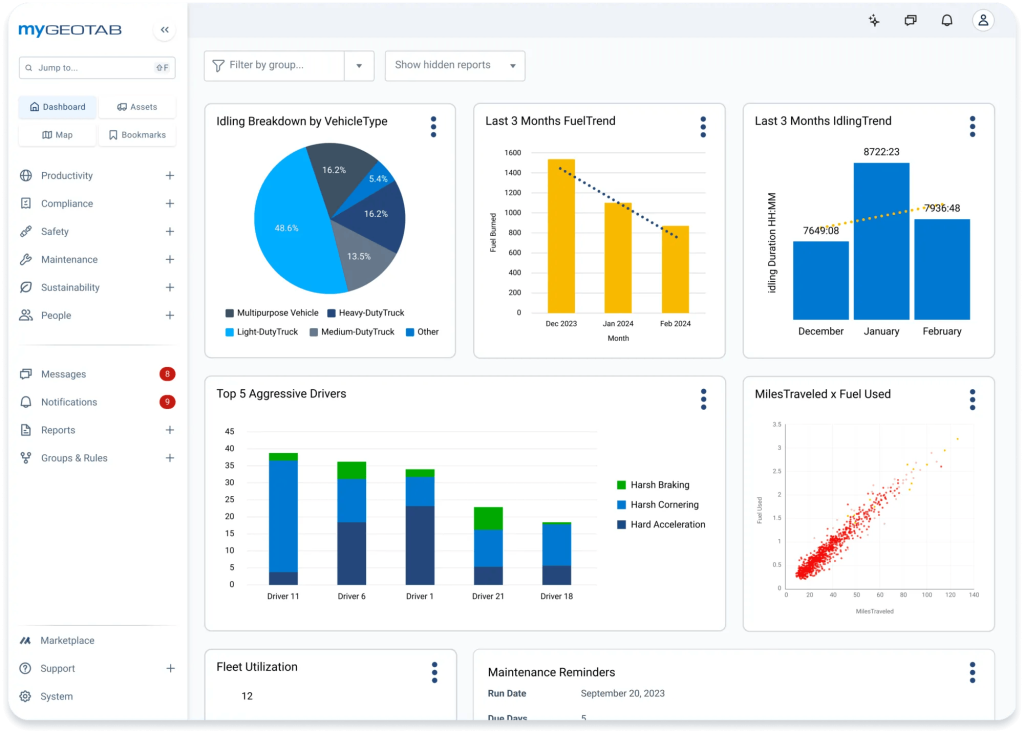
🛠️ Solution Spotlight: Many companies hit a wall with IoV because their baseline fleet data is too fragmented. Geotab solves this with deep engine decoding and a completely open API architecture. By capturing real-time CAN bus metrics—like engine fault codes, fuel burn, and crash data—and streaming them to the cloud, Geotab turns raw vehicle signals into a reliable digital foundation for your enterprise IoV ecosystem.
Predictive Maintenance
Instead of waiting for a vehicle to break down on the highway, IoV continuously reads factory fault codes. If a truck’s battery voltage drops unexpectedly during startup, system algorithms flag the issue weeks in advance, allowing you to schedule maintenance before costly operational downtime occurs.
Usage-Based Insurance (UBI)
Traditional commercial vehicle insurance relies on static metrics like vehicle age and driver demographics. IoV powered by accurate connected vehicle data enables Usage-Based Insurance. Premiums are calculated based on actual driving behavior—harsh braking, cornering speeds, and overall safety scores—rewarding safe fleets with significantly lower premiums.
Smart City Infrastructure Synergy
When thousands of vehicles on the road function as connected nodes, they feed valuable, anonymized data back to municipal traffic planners. Cities can pinpoint harsh braking hotspots to fix poorly designed intersections, optimize signal timings, and build safer roads.
3 Trends Shaping the Future of the Connected Vehicle
As you build out your long-term fleet strategy, three major shifts are defining the next era of the internet of vehicles:
- 5G-Enabled Hazard Warnings: Near-zero network latency allows a connected vehicle to receive blind-spot alerts and hazard warnings in milliseconds, turning active collision avoidance into a reality.
- Edge AI Reducing Bandwidth Costs: Instead of streaming continuous high-definition video to the cloud, Edge AI processes computer vision models locally on onboard chips. Video clips are uploaded only when critical safety events occur, saving massive cellular data costs.
- Data Sovereignty & Open API Architecture: Today’s CIOs are rejecting closed, proprietary hardware. Modern fleet leaders demand full ownership of their operational data along with open APIs, allowing them to feed fleet insights directly into enterprise BI tools and ESG compliance platforms.
Key Criteria for Evaluating an IoV Platform
Whether you are evaluating a full IoV ecosystem or a specialized fleet telematics solution, use these four evaluation criteria:
- Open API & SDK Support: Can the platform easily stream data into your existing ERP, CRM, or custom software without expensive custom builds?
- Mixed Fleet & EV Compatibility: Does the platform support ICE, Hybrid, and Electric Vehicles uniformly, including EV battery State of Health (SOH) tracking?
- Security & Regulatory Compliance: Is the software ISO 27001 certified and fully compliant with international privacy standards like GDPR?
- Ecosystem Marketplace: Does the platform offer plug-and-play add-ons for cold chain sensors, tire pressure monitoring systems (TPMS), or bluetooth asset tracking?
Power Your Smart Fleet Strategy with Geotab
Moving from traditional fleet tracking to a full Internet of Vehicles (IoV) ecosystem is the key to unlocking true operational value. It’s no longer just about tracking where your vehicles are—it’s about turning real-time connected data into smarter routing, safer driving, and lower operating costs.
As a global leader in connected vehicle technology, Geotab provides the robust data engine needed to power your entire IoV strategy. When paired with AI-driven tools like the GO Focus Plus AI dashcam, you gain complete visibility—combining deep engine diagnostics with proactive driver coaching to protect your fleet on every route.
Ready to transform your fleet strategy? Contact our team today to discover how we can help you build a smarter, safer, and more efficient fleet operation with Geotab.
Frequently Asked Questions (FAQ)
No, you don’t. Leading telematics platforms like Geotab connect directly to standard diagnostic ports (like OBD-II) for simple plug-and-play installation on both internal combustion and electric vehicles. Furthermore, open platforms can often ingest data from your existing sensors or third-party hardware via open APIs, helping you avoid costly full-fleet hardware replacements.
Telematics focuses on capturing core vehicle data—such as GPS location, engine diagnostics, fuel burn, and driver behavior—and sending it to a central platform. The Internet of Vehicles (IoV) expands on this telematics foundation by connecting the vehicle multi-directionally to surrounding infrastructure, cloud networks, and enterprise systems to enable real-time decision-making and automation.
An IoV application connects your vehicles directly to smart energy grids, traffic management systems, and enterprise supply chain platforms. It enables real-time EV smart-charging orchestration to draw power during peak renewable energy hours, dynamically re-routes vehicles around high-emission congestion zones, and automatically feeds verified, audit-ready carbon data straight into your corporate ESG reporting software.




![[Free Webinar] Road to COP17: Unifying Enterprise Data with Planetary-Scale Geospatial AI](https://masterconcept.ai/wp-content/uploads/2026/09/Webinar-261007-Unifying-Enterprise-Data-with-Planetary-Scale-Geospatial-AI-_1280x720px-scaled.png)