
Whether you operate a fleet of delivery vans, cold chain trucks, ride-hailing cars, or field service vehicles, your fleet is one of your company’s most valuable assets. But without proper management, it quickly becomes one of your biggest financial drains.
If you manage commercial vehicles, you’ve likely run into these everyday headaches:
- Fuel costs keep adding up, but you can’t pin down the exact cause of fuel waste.
- Lack of visibility on drivers, making it hard to curb risky driving habits like speeding or harsh braking.
- Maintenance gets missed, forcing you to rely on memory or manual spreadsheets for vehicle maintenance.
- Dispatch relies on experience, leading to potentially overlapping routes or delayed deliveries.
How can you regain control and fix these headaches? This article breaks down what fleet management actually involves, and how modern fleet management software helps streamline operations, safeguard assets, and significantly reduce overhead.
Table of Contents
- What Is Fleet Management?
- How Does Fleet Management Work?
- Key Benefits of A Modern Fleet Management System
- How To Choose Your Fleet Management Solution? (with Industry Use Cases)
- Streamlining Dispatch with AI Route Optimization
- Ready to Build a Smarter, More Efficient Fleet?
- Frequently Asked Questions (FAQ)
What Is Fleet Management?
Fleet management is the process of overseeing, coordinating, and maintaining a company’s commercial vehicles throughout their entire lifecycle.
It spans everything from routine maintenance and fuel monitoring to driver safety training and route optimization. The goal is simple: maximize fleet productivity and driver safety while keeping operating costs as low as possible.
How Does Fleet Management Work?
Relying on paper logs or Excel spreadsheets is slow, prone to human error, and leaves managers blind to real-time events on the road. A modern fleet management system works by using vehicle hardware to transmit real-time data directly into centralized software.
The 4 Core Pillars of Commercial Fleet Oversight
A comprehensive fleet management solution focuses on four primary operational areas:
- Asset & Maintenance Management: Track mileage, vehicle health, and automated service reminders to prevent unexpected breakdowns and downtime.
- Driver Safety & Behavior Monitoring: Detect harsh braking, rapid acceleration, speeding, and excessive idling to protect drivers and lower accident risks.
- Dispatch & Route Optimization: Match vehicles to customer orders and build efficient routes based on real-time traffic data.
- Fuel & Cost Control: Monitor fuel consumption per vehicle to catch anomalies, unauthorized usage, or wasteful idling.
Key Benefits of A Modern Fleet Management System
A modern fleet management system leverages advanced telematics—integrating GPS tracking and IoT sensors—to make vehicle operations fully transparent. Implementing this technology delivers immediate, measurable advantages:
1. Slash Fuel Consumption & Operating Expenses
Fuel often accounts for over 30% of total fleet operational costs. By tracking real-time fuel usage, modern systems quickly flag wasteful behaviors like excessive engine idling or speeding. In fact, eliminating unnecessary idling alone can save companies 10% to 15% on monthly fuel bills. [1]
2. Improve Driver Safety & Reduce Wear and Tear
Accidents endanger lives, destroy cargo, and increase liability. Telematics technology detects risky driving habits in real time, alerting drivers via in-cab audio warnings before mistakes turn into accidents. Over time, smoother driving habits also reduce premature wear on tires and brake pads.
3. Boost Dispatch Efficiency & Customer Experience
When customers ask, “Where is my order?“, managers no longer need to call drivers for manual updates. Live GPS tracking provides exact vehicle locations and accurate ETAs, dramatically improving client satisfaction and trust.
4. Automated Reports & Data-Driven Asset Protection
Instead of spending hours manually compiling logs, modern systems automatically aggregate mileage, fuel metrics, and driver scores into visual dashboards. This transparent data helps protect vehicle resale value and ensures maintenance happens before major mechanical failures occur.
Traditional Manual Tracking vs. Modern Fleet Management Solution
| Approach | Traditional Manual Tracking | Modern Fleet Management Solution |
|---|---|---|
| Real-Time Tracking | Blind spots on vehicle locations; requires phone calls to drivers | Live GPS tracking and historical route playback with precise ETAs |
| Fuel Monitoring | Post-dated paper receipts with no visibility into fuel waste | Real-time fuel & idling tracking to spot waste and prevent fuel theft |
| Driver Safety | Violations or accidents are only discovered after the fact | In-cab real-time driver alerts and automated safety scorecards |
| Vehicle Maintenance | Manual logs that are easy to lose or forget | Automated mileage tracking with preventive maintenance alerts |
| Dispatch & Routing | Manual guesswork that causes overlapping routes | Optimized routing that adjusts dynamically to road conditions |
How To Choose Your Fleet Management Solution? (with Industry Use Cases)
Not all fleets face the same challenges. When evaluating telematics and fleet management software, companies should choose solutions that scale seamlessly across different vehicle types and operational needs.
Industry leaders like Geotab provide commercial telematics through intuitive plug-and-play OBD-II devices. By capturing rich, native engine diagnostics, Geotab delivers high-precision data management whether you manage 5 vans or 5,000 heavy-duty trucks.
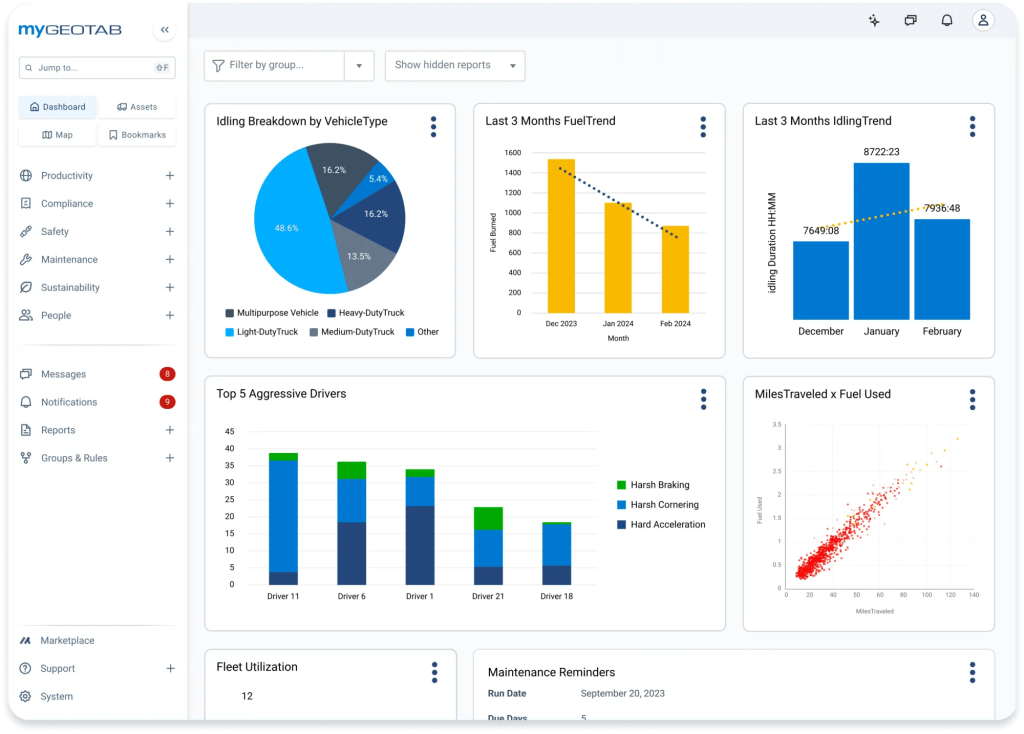
Here is how advanced telematics supports different commercial industries:
Cold Chain & Delivery Logistics
Connects with cargo temperature sensors to maintain strict climate controls while tracking live location to prevent spoilage from prolonged idling or delays.
Passenger & Ride-Hailing Services
Tracks driving patterns like harsh cornering or speeding, enabling managers to reward safe drivers, coach high-risk operators, and lower insurance premiums.
Field Service & Engineering Fleets
Tracks engine hours and site arrival times for mobile technicians, allowing dispatchers to quickly locate and deploy the nearest available unit for urgent jobs.
Electric Vehicle (EV) Fleets
Offers dedicated EV data—such as State of Charge (SoC), battery health (SoH) monitoring, and optimal charging schedules—helping companies transition to green fleets with confidence.
Streamlining Dispatch with AI Route Optimization
Once you have accurate vehicle telematics, the next operational challenge is pre-trip planning.
Logistics teams handling dozens or hundreds of delivery stops every day face a complex puzzle. Relying on manual route planning leads to excessive mileage, unbalanced driver workloads, and missed delivery windows—costly inefficiencies that often go unnoticed by management.
To solve this, Master Concept offers Master Planner, an AI-powered route optimization solution designed for enterprise fleets.
How Master Planner Solves Complex Routing Challenges
- One-Click Route Optimization: Import multiple delivery stops, and the algorithm calculates the most efficient sequence and route for each vehicle in seconds, avoiding traffic bottlenecks.
- Multi-Constraint Calculations: Automatically considers vehicle weight limits, driver working hours, and tight customer time windows to generate realistic multi-stop schedules.
- Reduced Mileage & Carbon Footprint: Optimized routing reduces total fleet mileage by an average of 15% to 20%, saving fuel while helping businesses achieve their ESG sustainability goals.
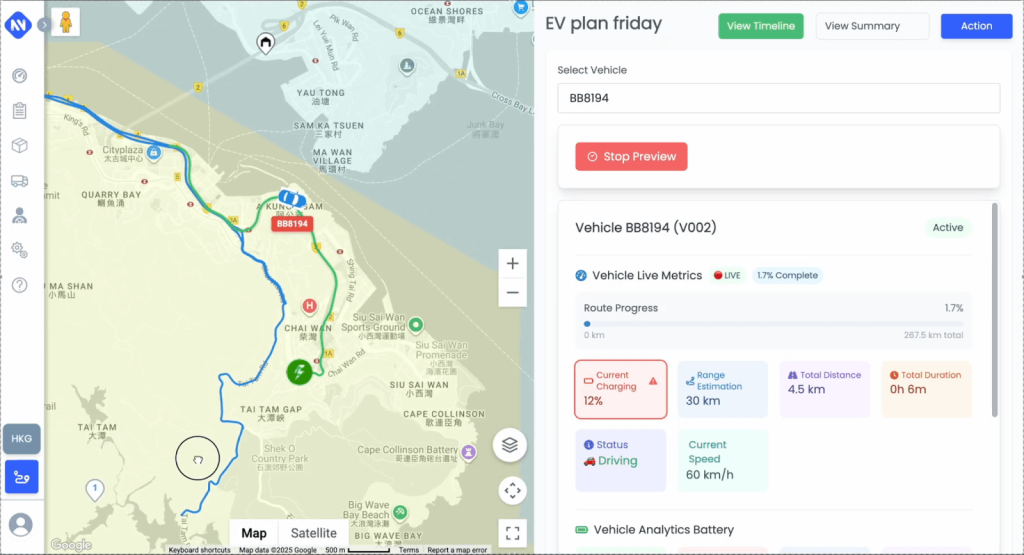
By pairing Geotab telematics with Master Planner route optimization, companies create a complete, end-to-end fleet operational loop—from pre-trip planning to post-trip data analysis.
Ready to Build a Smarter, More Efficient Fleet?
In an era of rising fuel costs and tight margins, relying on outdated manual tracking methods puts your business at a distinct disadvantage. Upgrading to a modern fleet management system helps eliminate fuel waste, reduce accident risks, and keep your vehicle assets in peak operational condition.
By combining Geotab telematics with Master Planner, your business can eliminate blind spots, optimize delivery schedules, and deliver a better experience to your customers. Contact our experts at Master Concept today to explore how our tailored fleet management solutions can meet your business’s unique operational needs!
Frequently Asked Questions (FAQ)
Why is fleet management important?
Fleet management helps businesses cut fuel waste, prevent costly vehicle breakdowns, and keep drivers safe on the road. Without a system in place, fuel bills and maintenance costs can quickly eat up a company’s profits.
What can a fleet management system do?
A modern system tracks vehicle locations in real time, monitors fuel and engine health, flags bad driving habits (like speeding or idling), sends maintenance alerts, and automates route planning to save time.
How is a fleet management solution different from traditional GPS tracking?
Basic GPS tracking only shows a blue dot on a map. A complete fleet management solution connects directly to the vehicle’s engine (via telematics) to track fuel burn, battery health, driver behavior, and dispatch schedules.
Do small fleets (5–10 vehicles) need software to manage?
Yes. Small fleets are actually more vulnerable to unexpected expenses. A single major breakdown or excessive fuel leak can wipe out monthly profit margins. Affordable cloud software gives small businesses enterprise-level efficiency at a low entry cost.
What fleet management systems are recommended?
A top-rated combination is pairing Geotab (for real-time vehicle telematics and driver safety scores) with Master Planner (for AI-powered route planning). Together, they handle everything from pre-trip dispatch to post-trip data analysis.
- Geotab: Provides plug-and-play OBD/J1939 hardware, supports both ICE and EV fleets, offers integrated AI dashcams, and scales effortlessly from small businesses to enterprise fleets.
- Master Planner: Handles pre-trip route optimization, factoring in multiple criteria—including vehicle availability, load constraints, and customer time windows—to cut driving mileage and operating costs.
References
- U.S. Department of Transportation (DOT) – Fleet Safety and Fuel Economy Guidelines (https://www.transportation.gov)