

Why Traditional Location Analysis Fails?
In today’s hyper-competitive retail, F&B, and service landscape, “address” isn’t just a street number—it’s a strategic weapon that can make or break your brand. Traditionally, businesses chose locations based on site visits, rental rates, foot traffic observations, and competitor mapping.
But the problems? Data sources are scattered, updates are slow, and they rarely capture real-time consumer behavior or market dynamics.
For example: You might know the foot traffic volume in an area, but do you know if those people are commuters, tourists, or local office workers? You might know where competitors are, but can you tell which of their branches actually attract the most customers? Or perhaps you have internal POS data but lack the geographic context to make sense of it all.
That’s exactly why Google Maps Platform’s newest feature, Places Insights in BigQuery exists—to transform “real-world location data” into “queryable, visualizable, and predictable” market intelligence, empowering businesses to understand markets, simulate potential, and forecast outcomes at unprecedented speed.
What Happens When Google Maps Places Insights Meets BigQuery?
Places Insights in BigQuery is Google Maps Platform’s integrated data solution that enables developers and analysts to directly query, analyze, and cross-reference Google Maps location data within BigQuery.
This is far more than simple POIs (Point of Interest)—it’s a higher-level spatial intelligence platform that includes:
- Place Types & Attributes: Categories (e.g., restaurants, supermarkets, pharmacies, gyms, educational institutions) plus operational details (e.g., store hours, ratings, price levels, popular times).
- Regional Density: Analysis of concentration of similar place types, competitor proximity, and distribution of adjacent business categories.
- Time-Based Location Trends: Tracking which areas are rapidly opening new stores or experiencing industry shrinkage.
Through BigQuery integration, businesses can directly use SQL to cross-analyze this data with their internal sales, customer, or transaction records to achieve true “Geo-Business Intelligence”.
Three Major Breakthroughs of Places Insights in BigQuery
1. From Place Lists to Market Models
Traditional POI data only tells you “where stores are located”, but Google Maps Places Insights helps you understand “why stores are located there”.
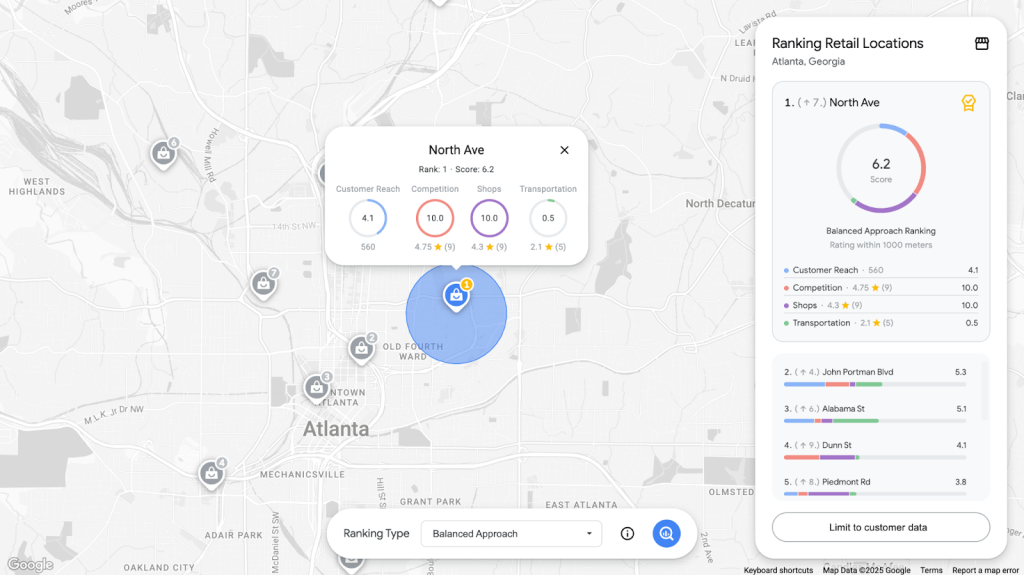
By quantifying place density, business category concentration, and areas of interest (i.e., hotspot), businesses can build rich market location models. For example:
- Taipei’s Xinyi District: The data moves far beyond “lots of restaurants” to reveal insights like “concentration of 4.5+ star Italian restaurants within a 1 km radius”, “areas experiencing peak late-night activities”, and “the number of non-locals crowding the district on weekends”.
- Bangkok Downtown: You can observe the symbiotic relationship between convenience stores and financial services—a reliable market indicator for international chain brands looking for actionable expansion signals.
This kind of “market fingerprint” analysis, based on deep spatial characteristics, helps businesses move decisively from single-point decisions to regional strategic thinking.
2. Merging with Internal Data to Unlock True O2O Insights
When Places Insights data enters BigQuery, businesses can combine it with their internal sales and customer data. For instance:
| Data Source | Questions Answered |
| Google Maps Places Insights | Which areas have the highest density? What related services are nearby? |
| Internal sales data | Which areas currently have the fastest sales growth? |
| CRM / Customer data | Which customer segments are concentrated in specific markets? |
Through this multi-dimensional integration, you can answer questions that would previously be impossible, such as: “Which markets have high growth potential where we haven’t yet reached our core customers?” For chain brands, this not only guides new store development but optimizes existing location operations—adjusting hours, promotional timing, and service offerings.
3. From Static Maps to Dynamic Decision-Making
Traditional map or location data provides a mostly static “current state description” of the world. Places Insights in BigQuery enhances this by adding a crucial time dimension, allowing businesses to track location opening/closing trends, popular times, and rating changes to predict market dynamics.
For example:
- Post-pandemic: Rapid rebounds in coffee shop numbers in specific areas signal commercial activity recovery.
- Newly developed districts: Growth in residential buildings and schools indicates population influx, providing reliable signals for future retail planning.
These insights go beyond simple changes; they reveal market opportunities in real-time. This enables businesses to adjust resource allocation and expansion pace with unprecedented responsiveness.
How Places Insights in BigQuery Accelerates Every Industry?
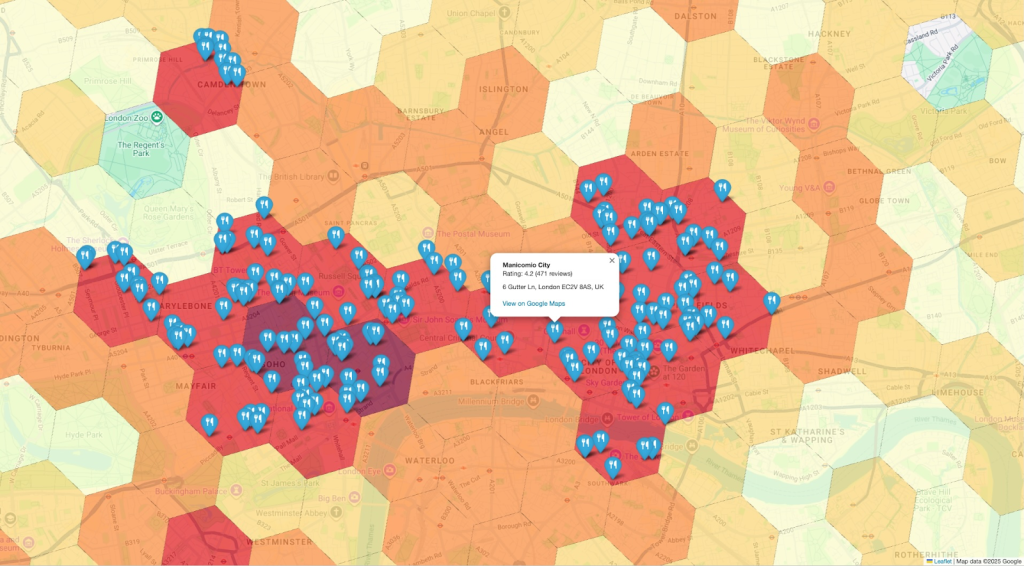
➡️ Retail & F&B Service: Smart Site Selection and Market Optimization
Identify high-potential areas based on location density, popularity, and foot traffic characteristics, then combine with their own operational data to predict new store ROI.
➡️ Travel & Hospitality: Understanding of Customer Dynamics
Analyze tourist attractions and surrounding service activity in different cities to optimize advertising strategies and amenity planning.
➡️ Retail & Advertising: Focused on Location Intent
Target specific areas or demographics that exhibit high purchase intent (based on place types and search popularity) to execute far more precise local marketing campaigns.
➡️ Government & Real Estate: Spatial Economic Decision Support
Build “industry activity maps” that identify emerging commercial districts, residential growth areas, and critical population concentration trends.
Why Places Insights in BigQuery: Achieving Data-Driven Location Intelligence
Operating in the BigQuery environment allows businesses to rapidly process and visualize Google Maps location data using standard SQL. By leveraging existing data pipelines and BI tools (e.g., Looker Studio, Tableau), teams can instantly build dynamic dashboards.
This means businesses can:
- Eliminate the time and cost associated with developing and maintaining separate map API integration programs.
- Enable data analysts to work with location information instantly in their familiar, native environment.
- Easily link geographic dimensions directly to internal business KPIs (e.g., conversion rates, revenue, and retention rates).
Three Trends in 2025: The Future of Location-Driven Strategy with Places Insights
As a Google Maps Platform partner, we’ve helped numerous retail and real estate companies implement Places Insights in BigQuery, and we’ve observed three significant market shifts:
- Temporal Behavior is the Priority
It’s no longer just about whether a place “exists”—businesses are now observing “when it’s visited” and “when it’s most active” to understand real consumer behavior. - Incorporating Location Data into AI Model Training
Location data is now routinely incorporated into corporate AI models for predicting market sales growth rates, delivery demand volume, and potential rent increases. - Explosion of Cross-Departmental Use Cases
Maps used to belong to transport or logistics teams; now marketing, sales, operations, and even finance departments are incorporating geographic insights into reports and decision-making.
Conclusion: Key to Site Selection and Store Performance—The Story Behind the Location
With Google Maps Places Insights in BigQuery, businesses can solve the three major pain points in location and market analysis: scattered data, lack of geographic context, and slow decision-making. The tool helps you capture not just the “position” of a location, but the “movement” around the world.
From static maps to dynamic insights, and from place lists to market models, Google Maps Places Insights in BigQuery is fundamentally transforming how businesses understand markets. This shift is a whole new revolution where location analysis is no longer about finding answers, but about uncovering potential.
As GIS advisors, we’re committed to helping businesses transform location data into tangible decision-making advantages. Whether you’re planning to develop new markets, reassess location strategies, or use AI to predict market dynamics, Google Maps Places Insights in BigQuery will be your essential first building block toward the era of geo-business intelligence.

![[Free Webinar] Road to COP17: Unifying Enterprise Data with Planetary-Scale Geospatial AI](https://masterconcept.ai/wp-content/uploads/2026/09/Webinar-261007-Unifying-Enterprise-Data-with-Planetary-Scale-Geospatial-AI-_1280x720px-scaled.png)