


Keeping drivers safe and alert on long hauls is one of the toughest challenges fleet managers face. Studies show that driver fatigue contributes to 15% to 20% of all global road accidents—and in regions like Southeast Asia, where nations such as the Philippines face major sleep-deprivation trends, drowsy driving poses an even greater daily risk.
The problem? You can’t fix exhaustion through self-discipline alone. Most drivers don’t realize just how tired they are until it’s too late.
That’s why driver fatigue detection systems have become a game-changer for safety-focused fleets. By pairing smart AI camera sensors with vehicle diagnostic data, driver fatigue detection systems catch early warning signs of exhaustion before a close call turns into a serious crash. In this guide, we’ll explain how driver fatigue detection works, compare standalone cameras against integrated telematics, and show how AI is transforming fleet safety.
The Hidden Cost of Fatigue Behind the Wheel
Many fleet operators don’t realize the true financial and operational damage of fatigued driving until a major accident occurs. To build a resilient fleet, you have to look beyond basic shift schedules and address the underlying risks.
High-Risk Drowsy Driving and Asset Loss
In heavy transport and long-haul logistics, safety is the non-negotiable bottom line. Commercial vehicles—like multi-axle trailers, cement mixers, and passenger coaches—carry immense momentum. When a driver nods off or loses focus, even for a few seconds, the resulting rear-end collision can be catastrophic.
Beyond the immediate physical danger, a single drowsy driving crash brings staggering repair bills, lost cargo, legal liabilities, spike in insurance premiums, and massive operational downtime.
Strict HOS Regulations and Driver Burnout
Across global logistics hubs and Southeast Asian transport corridors, regulatory bodies are tightening enforcement around commercial hours-of-service (HOS) rules, driver shift limits, and mandatory rest breaks. Relying on paper logbooks or supervisor sign-offs is no longer enough to satisfy modern safety audits.
What makes fatigue so tricky is that circadian rhythms and endurance vary wildly from person to person. A driver might be fully compliant on paper with their shift limit, yet still experience severe drowsiness due to poor sleep, medication, or highway hypnosis after hours on a monotonous stretch of road. Relying solely on a driver’s willpower puts high-value assets and lives at risk.
How Does Driver Fatigue Detection Work?
Modern safety technology catches fatigue through three primary approaches—evaluating facial cues, monitoring steering patterns, or measuring physiological signals.
1. Computer Vision & In-Cab Optical Sensors
This is the most effective and widely adopted technology on the market today. A dedicated driver monitoring camera uses infrared illumination to track facial expressions and eye movements without distracting the driver—even in pitch-black conditions or when wearing sunglasses.
Key metrics measured by an in-cab camera include:
- PERCLOS (Percentage of Eye Closure): Measures how long a driver’s eyes stay closed over a set time window, triggering an alert when eyelid droops cross a fatigue threshold while filtering out normal, natural blinks.
- Facial Landmark Tracking: Algorithms track dozens of micro-points across the face to detect frequent yawning, head nodding (micro-sleeps), or gaze distraction away from the windshield.
The main advantage of an optical driver monitoring system is immediate intervention. It catches early signs of drowsiness in real time, issuing immediate audio alerts right inside the cab.
2. Vehicle Dynamics & Steering Behavior Analysis
This approach focuses on vehicle motion rather than optical tracking. When alert, drivers make subtle and frequent micro-adjustments to keep the vehicle centered in a lane. As fatigue sets in, steering adjustments slow down, followed by sudden corrections when the vehicle drifts toward lane markings.
By reading steering angles and throttle pedal inputs via the vehicle’s CAN bus, systems infer driver fatigue. While this method completely protects driver visual privacy, its main drawback is latency—by the time a truck is weaving across lane markers, the driver is already dangerously exhausted.
3. Physiological Signal Sensing
This method tracks real-time biological markers, such as heart rate variability (HRV), skin conductance, and brainwave activity. Because autonomic nervous system activity changes as exhaustion sets in—such as a drop in heart rate variability or shifts in skin response—wearable sensors can flag drowsiness at a deep biological level.
While highly accurate in controlled clinical environments, real-world deployment faces significant operational hurdles. Requiring drivers to wear smart wristbands, chest straps, or specialized caps every day often triggers pushback over invasion of privacy and discomfort. For fleet managers, enforcing daily compliance creates unnecessary administrative friction.
Types of Driver Fatigue Detection Systems
When evaluating driver fatigue detection solutions in the market, architectures generally fall into three main categories:
1. Standalone Dashcams
A standalone driver monitoring camera is an isolated piece of hardware. It processes visual data internally and emits a loud “beep” or voice prompt inside the cab when a driver nods off or loses focus.
- Pros: Easy to install, low upfront hardware costs.
- Cons: Operates as an isolated island of data. Fleet managers have little to no visibility into what happened, making post-incident driver coaching difficult.
2. Integrated Telematics Platforms
This is the gold standard for commercial fleets. It bridges the in-cab camera with your central telematics and tracking software.
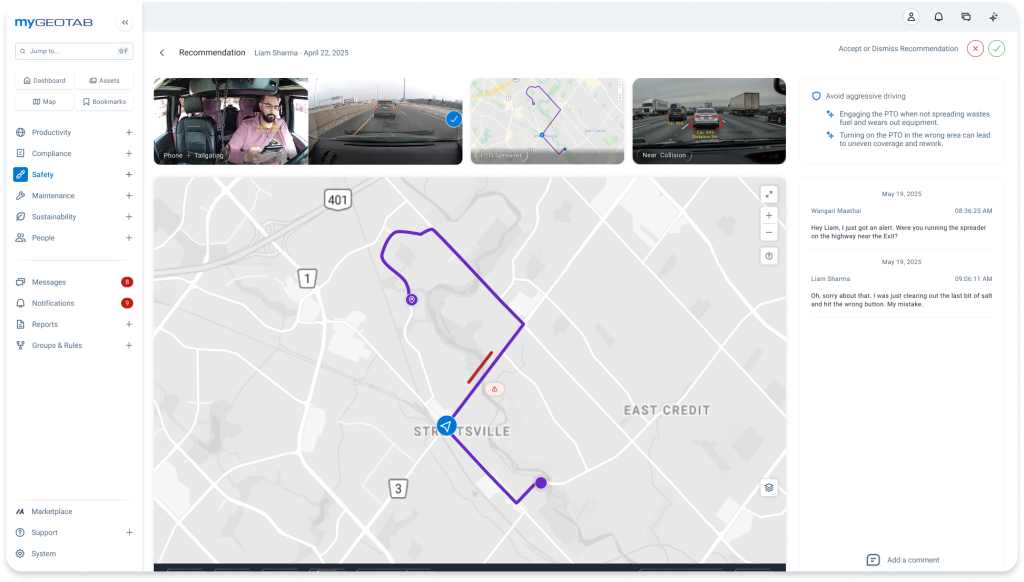
- Pros: When the camera detects a drowsy driving event, it instantly triggers an in-cab alert and streams critical event metadata (GPS location, speed, time, HD video clip) straight to your cloud dispatch console. Fleet managers can intervene immediately or track long-term driver safety scores.
- Cons: Higher initial deployment and monthly software subscription costs compared to offline cameras.
3. Cloud-Only AI Video Processing
With this approach, raw dashcam footage is continuously uploaded to a cloud server to run complex deep-learning models.
- Pros: Access to immense cloud processing power for deep behavioral analytics across large datasets.
- Cons: High cellular data costs and noticeable latency. If a driver falls asleep on a highway, waiting 30 seconds for cloud server processing is simply too late.
To help you quickly compare the options, here’s how the top fatigue detection approaches stack up:
| Type | Key Pros | Key Cons | Best For |
|---|---|---|---|
| Standalone Dashcams | Easy installation; minimal upfront cost. | Isolated data; no real-time visibility for dispatchers. | Tight budgets or micro-fleets. |
| Integrated Telematics Platforms | Instant in-cab warnings; live cloud visibility; enables targeted driver coaching. | Higher initial investment and ongoing subscription fees. | Mid-to-large logistics fleets prioritizing safety compliance. |
| Cloud-Only AI Video Processing | Powerful cloud processing for deep behavioral trends. | High latency; fails to deliver live, on-the-spot warnings. | Teams focused solely on post-trip performance audits. |
Next-Gen Safety: AI and Multi-Sensor Fusion
Fleet safety technology is evolving rapidly beyond simple single-camera detection. Modern systems combine artificial intelligence with multi-sensor data to build proactive, highly accurate safety networks.
Multimodal Fusion: Eliminating False Alarms
Older camera systems often struggled with false alarms. If a driver had naturally small eyes or wore reflective sunglasses, the camera might incorrectly flag them as asleep.
Modern driver fatigue detection systems solve this with multi-sensor fusion. By combining visual data from a driver monitoring camera with steering input from the CAN bus and motion data from telemetry sensors, the AI verifies the true context. If a driver blinks for a second while steering smoothly in the center of a lane, the system ignores it. But if eye closure coincides with lane drifting, it escalates the warning immediately.
Edge AI: Instant Local Decisions
Edge AI chipsets process video models directly inside the camera unit. Driver fatigue detection processing happens 100% locally in real time without relying on cloud connectivity or cellular signals. Even if a truck passes through a remote mountain tunnel or dead zone, the safety system works without interruption.
Merging In-Cab DMS with External ADAS
Complete safety requires connecting internal driver monitoring with external road sensing. Pairing a Driver Monitoring System (DMS) with an Advanced Driver Assistance System (ADAS) provides true 360-degree protection:
- In-Cab DMS: Looks inward at driver attention, fatigue, phone distraction, eating or drinking while driving, and seatbelt compliance.
- External ADAS: Looks outward at forward collision risks, tailgating distances, and lane departures.
When these technologies work together, safety intelligence multiplies. For example, if ADAS detects that traffic ahead is slowing down while DMS spots the driver looking down at their phone, the system instantly triggers a maximum-level emergency warning to prevent a collision.
From Detection to Action: Why Platform Integration Matters
Detecting fatigue in the cab is only half the battle. To actually reduce fleet risk, safety events can’t live in isolation—they need to be tied directly to your broader operational data. You need to know who triggered a fatigue warning, where it happened, how fast they were going, and how long they had been behind the wheel.
By pairing AI dashcams directly with a full-suite telematics platform, driver fatigue transforms from a temporary alarm into actionable intelligence. Integrations allow you to cross-reference drowsiness alerts with route patterns, shift hours, and long-term driving behavior—giving you the full context needed to prevent accidents rather than just react to them.
The Geotab Advantage: Turning Safety Data into Results
As the world’s leading fleet telematics platform, Geotab excels at bringing all safety metrics into one place. Its open architecture seamlessly connects fatigue detection data with GPS tracking, vehicle diagnostics, and driver scorecards, giving you complete visibility across your operations.
Within the Geotab ecosystem, drowsy driving isn’t just a fleeting warning; it translates into highly visible management metrics:
- Driver Safety Scorecards: The system automatically logs fatigue and distraction events per 100 kilometers, factoring them into overall driver ratings. This helps fleet managers quickly spot high-risk drivers and step in with personalized coaching.
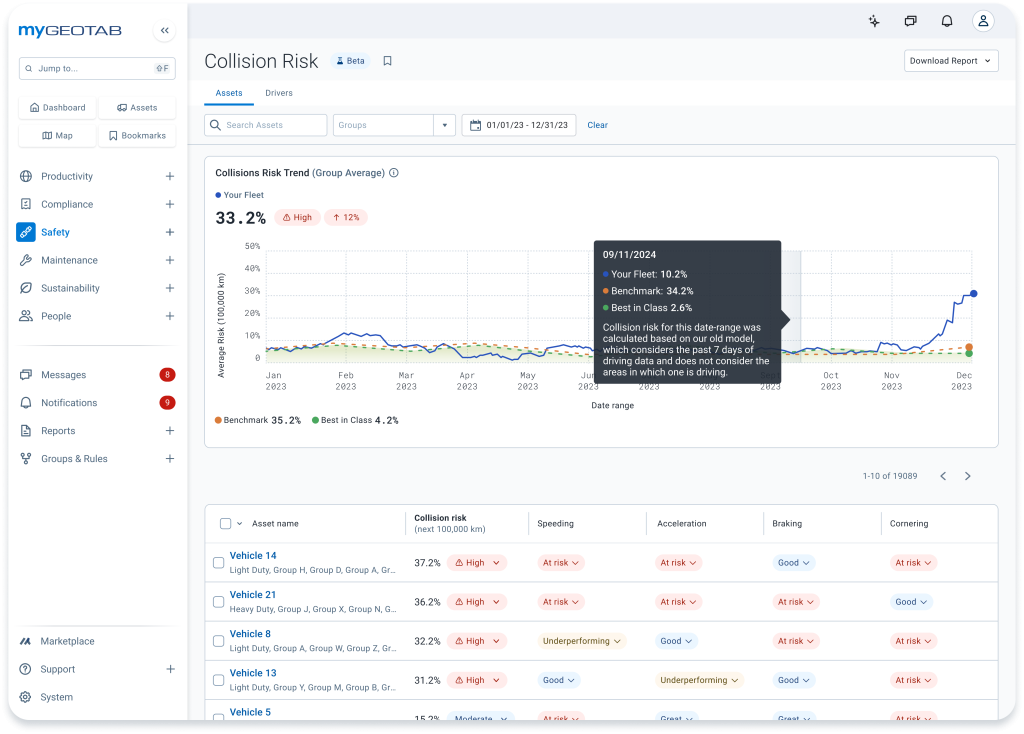
- Collision Risk Analysis: Geotab cross-references fatigue data with harsh braking and speeding incidents to calculate real collision probabilities. By visualizing risk trends (e.g., “High,” “At Risk”) and comparing them against industry benchmarks, dispatchers can adjust schedules and prevent crashes before they happen.
GO Focus Plus AI Dashcam: Your Digital Safety Coach
The Geotab GO Focus Plus is an enterprise-grade, dual-facing AI dashcam that combines outward-facing ADAS with inward-facing DMS.
Key features include:
- Precision Edge Processing: Powered by an advanced onboard AI chip, it tracks subtle micro-expressions, eye closure rates, and yawning in any lighting condition—whether driving on pitch-black rural highways or exiting bright tunnels—triggering immediate in-cab voice alerts.
- Proactive Distraction Control: Beyond fatigue, the AI flags and curbs risky behaviors in real time, including texting, smoking, eating behind the wheel, and driving unbuckled.
- Instant Cloud Syncing: When a critical event occurs—like severe drowsiness or a near-miss collision—the camera automatically uploads a HD video clip to your cloud portal. This provides clear material for driver debriefs and undeniable video evidence if an incident occurs.
- Privacy-First Design: Video processing is handled locally on the device with end-to-end encryption. Unless configured otherwise, footage is only uploaded to the cloud when a safety event is triggered—giving fleet operators complete risk visibility while respecting driver privacy.
Build a Zero-Incident Fleet with Geotab
Driver fatigue may be hard to catch with the naked eye, but modern AI telematics makes it completely manageable. Moving away from isolated hardware to a fully integrated edge-to-cloud platform is the single best step you can take to keep your drivers safe and your fleet running efficiently.
Pairing the GO Focus Plus AI dashcam with the Geotab platform gives your drivers a real-time safety coach in the cab while giving your managers the data they need to build a safer fleet.
Ready to eliminate drowsy driving and safeguard your fleet? Contact our experts today for a fleet safety evaluation or a Geotab demo!
Frequently Asked Questions (FAQ)
You can track fatigue using modern Driver Monitoring Systems (DMS) equipped with AI cameras. These systems monitor driver facial cues—such as eye closure duration (PERCLOS), yawning frequency, and head droops—and instantly sound an in-cab alert when fatigue is detected while uploading event clips to your fleet management dashboard.
Most modern systems combine Edge AI computer vision (inward-facing cameras tracking eyes and facial movements) with vehicle telemetry (CAN bus data tracking steering patterns, speed, and lane alignment). Advanced setups also use multi-sensor fusion to combine camera data with G-force sensors to verify driver behavior in real time.
It depends. A standalone camera only sounds an in-cab alert. But when an AI dashcam like the GO Focus Plus integrates into a telematics platform like MyGeotab, the camera syncs with GPS location, vehicle diagnostics, and safety scorecards—turning isolated alerts into complete fleet risk management.
Yes, it works everywhere. Because processing happens locally on the camera unit (Edge AI), in-cab warnings trigger instantly even in rural dead zones, mountain passes, or tunnels without cell service. Video clips are saved locally and automatically sync to the cloud once cellular connectivity is restored.
Older, camera-only systems suffered from false alarms, but modern platforms solve this with multi-sensor fusion. By cross-checking visual cues with steering wheel adjustments and vehicle speed, the AI can tell the difference between a natural blink and a drowsy eye droop, suppressing unnecessary alerts.
No, when configured correctly. Enterprise systems like the GO Focus Plus operate on an event-triggered privacy model. Video processing happens locally, and footage is encrypted on the device. Only short clips surrounding critical safety events (such as severe fatigue alerts or hard braking) are uploaded to the cloud for review and coaching.
A DMS looks inward at the driver to detect tiredness, phone usage, and missing seatbelts, whereas ADAS looks outward at the road to monitor lane departures, forward collision warnings, and tailgating distances. Top commercial fleets integrate both for complete safety coverage and visibility.
Geotab GO Focus Plus goes way beyond driver fatigue monitoring. It detects a full range of distracted behaviors in real time—including phone usage, smoking, driving unbuckled, and eating or drinking behind the wheel. When these risky habits occur, the system immediately issues in-cab voice alerts to help drivers self-correct and build safer long-term habits.




![[Free Webinar] Road to COP17: Unifying Enterprise Data with Planetary-Scale Geospatial AI](https://masterconcept.ai/wp-content/uploads/2026/09/Webinar-261007-Unifying-Enterprise-Data-with-Planetary-Scale-Geospatial-AI-_1280x720px-scaled.png)