

Why High Availability Architecture Matters in Singapore’s Digital Economy
In Singapore, many enterprises operate latency-sensitive digital services across Southeast Asia and Greater China. For these organizations, application performance is not only about speed. It directly impacts transactions, user trust, and regulatory compliance. As traffic volumes grow and applications become more distributed, traditional single-layer CDN and WAF architectures are no longer sufficient to ensure consistent availability.
The Limitations of Single Layer CDN and WAF Architectures
Many organizations initially rely on a primary CDN and WAF provider supported by on premises infrastructure. However, as digital services scale, several challenges emerge:
- Performance degradation during peak traffic periods
- Increased risk of service disruption from single provider dependency
- Complex failover processes requiring manual intervention
- Rising infrastructure and operational costs
In environments where milliseconds can affect transaction outcomes, these limitations introduce measurable business risk.
A Practical Approach to Resilient Architecture
To address these challenges, enterprises are introducing a secondary layer using Cloudflare to complement existing infrastructure.
Instead of replacing the primary provider, this approach creates a multi layer architecture focused on resilience and performance.
Architecture Overview
The model integrates:
- Primary CDN and WAF handling baseline traffic
- Cloudflare as a secondary CDN and WAF layer
- Global Server Load Balancing for traffic distribution
- Health checks and monitoring for real-time visibility
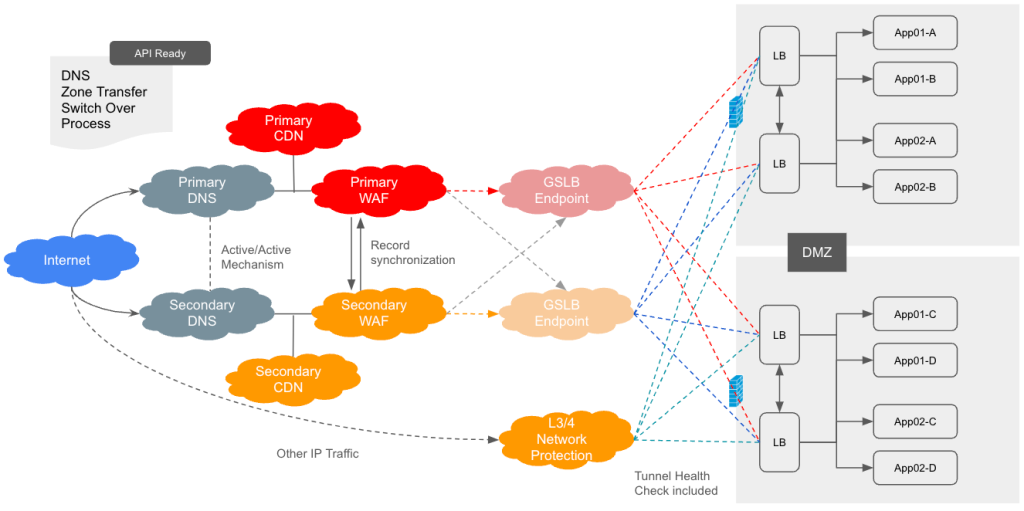
This design allows traffic to shift dynamically between layers without service disruption.
How Automated Failover Ensures Business Continuity
A key requirement for high-availability systems is the ability to respond instantly to failures.
In this architecture, failover is automated through DNS and orchestration tools.
- Continuous health checks monitor application endpoints
- Traffic conditions are evaluated in real time
- DNS updates are triggered automatically when anomalies are detected
- Traffic is redirected to the secondary layer within seconds
This minimizes downtime and ensures service continuity even during outages.
Key Benefits of a Secondary WAF and GSLB Strategy
This architecture provides both technical and business advantages.
| Area | Traditional Architecture | With Secondary Layer |
| Availability | Single point of failure risk | Multi-layer failover across regions |
| Performance | Static routing | Dynamic traffic optimization |
| Security | Single WAF protection | Additional inspection and threat mitigation |
| Operations | Manual response | Automated monitoring and failover |
| Cost Structure | High infrastructure overhead | Reduced dependency on on-premises systems |
For organizations running mission-critical applications, these improvements directly translate into operational stability.
Meeting Compliance and Data Routing Requirements
Enterprises in Singapore often operate under strict regulatory frameworks such as MAS guidelines and PDPA requirements.
These regulations require careful handling of data flows and visibility into traffic behavior.
With Cloudflare’s global network and routing capabilities, organizations can:
- Direct traffic based on geographic policies
- Maintain visibility across regions
- Align network design with compliance requirements
This enables organizations to balance performance with regulatory obligations.
A Common Architecture Pattern in High Throughput Environments
This approach is increasingly adopted by organizations that handle high-volume transactions and real-time data delivery. In these environments:
- Traffic spikes are unpredictable
- Downtime has immediate financial impact
- Latency directly affects user experience
By introducing a secondary WAF and global load balancing layer, these organizations are able to maintain consistent service levels even under extreme conditions.
From Infrastructure Design to Resilience Strategy
Modern network architecture is no longer defined by infrastructure alone. It is defined by how effectively systems can respond to change, failure, and growth. A secondary WAF and GSLB strategy allows enterprises to:
- Reduce dependency on a single provider
- Improve incident response time
- Maintain consistent performance across regions
- Simplify operational complexity
Conclusion
For organizations evaluating how to improve availability and reduce dependency on a single provider, introducing a secondary WAF and global load balancing layer is often a practical first step. A structured architecture review can help identify where performance bottlenecks, failover risks, and security gaps exist, and define a roadmap for a more resilient design. Review your architecture today!
FAQ
What is a secondary WAF architecture?
A secondary WAF architecture adds an additional security layer to improve redundancy, resilience, and protection against application-level attacks.
What is GSLB and how does it work?
Global Server Load Balancing distributes traffic across multiple regions based on availability, latency, and health checks.
Why do enterprises use a multi-CDN architecture?
Multi-CDN architecture reduces dependency on a single provider and improves performance, resilience, and availability.
How does Cloudflare support failover?
Cloudflare uses DNS-based routing, health checks, and traffic steering to automatically redirect traffic during outages.
When should organizations consider this architecture?
Organizations should consider this approach when uptime, latency, and service continuity directly impact business performance.





![[Free Webinar] Road to COP17: Unifying Enterprise Data with Planetary-Scale Geospatial AI](https://masterconcept.ai/wp-content/uploads/2026/09/Webinar-261007-Unifying-Enterprise-Data-with-Planetary-Scale-Geospatial-AI-_1280x720px-scaled.png)