

Why MPLS Is No Longer Enough for Modern Enterprise Networks
For many enterprises operating in Singapore, MPLS has traditionally been the backbone of corporate connectivity across offices, data centers, and regional operations.
However, Singapore’s role as a regional hub for multinational companies has significantly changed network demands. Traffic is no longer centralized. Applications are no longer hosted in a single environment. Users are no longer confined to one location.
With the rise of SaaS platforms, cloud workloads, and real-time collaboration tools such as video conferencing, network usage has become more distributed and unpredictable.
In this environment, MPLS often becomes a constraint rather than a solution.
The Real Challenge Behind MPLS: Cost, Performance, and Rigidity
Enterprises evaluating MPLS replacement are not only reacting to cost pressures.
The underlying issue is structural.
Bandwidth must be provisioned in advance, making it difficult to adapt to sudden increases in traffic demand. Latency becomes more noticeable as traffic is forced through fixed routes instead of optimized paths.
At the same time, traditional security architectures depend heavily on internal firewalls and appliances, increasing both operational complexity and ongoing maintenance costs. This creates a gap between what the network was designed for and how it is actually used today.
A Shift Toward Cloud-Delivered WAN Architecture
To address these limitations, enterprises are adopting a different approach to network design. Instead of relying on private circuits, connectivity is delivered through a global network platform.
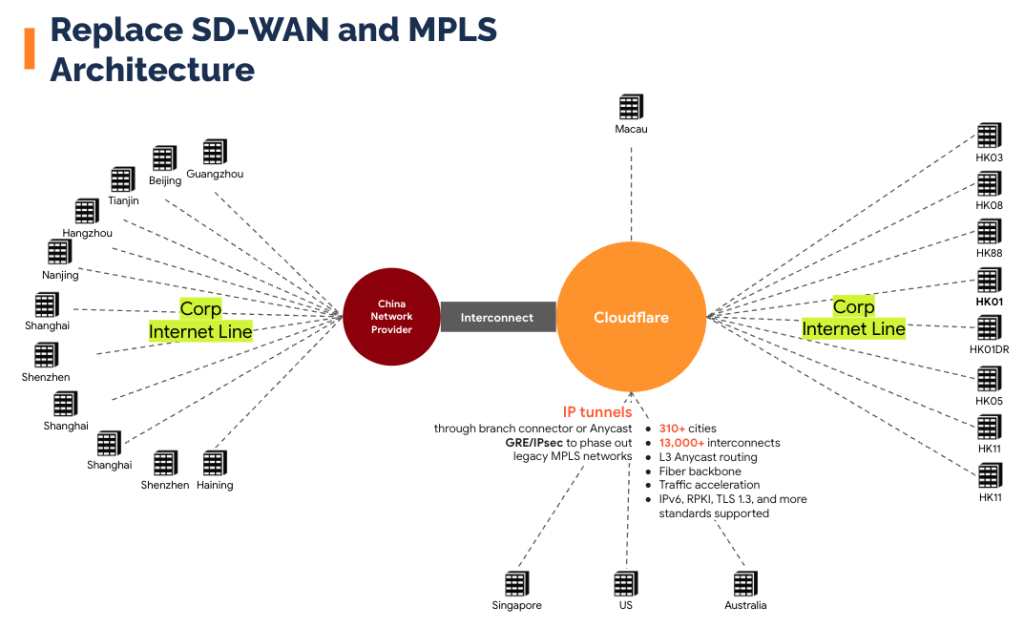
Cloudflare provides this model by acting as a distributed network layer that connects offices, cloud environments, and users through its global backbone. According to the deployment architecture, traffic can be routed across regions through Cloudflare’s interconnection model, reducing dependency on traditional MPLS routing paths. This approach enables a more flexible and scalable network without increasing infrastructure complexity.
What MPLS Replacement Looks Like in Practice
The transition is not simply a replacement of connectivity, but a redesign of how the network operates. Each branch location connects directly to Cloudflare, instead of routing traffic through a central hub. This model resembles a shared infrastructure approach, where each location gains direct access to a global network rather than relying on a fixed internal path.
| Area | Traditional MPLS Model | Cloudflare WAN Architecture |
| Connectivity | Private circuits between sites | Direct connection to global backbone |
| Traffic flow | Routed through centralized hubs | Routed dynamically across edge locations |
| Branch setup | Dependent on HQ network | Independent and scalable per site |
| Expansion | Requires provisioning and lead time | Rapid deployment with minimal setup |
| Cost model | High fixed cost | More flexible and usage aligned |
This architectural shift allows enterprises to reduce complexity while improving performance.
Integrating Network and Security into One Platform
In traditional environments, networking and security are handled separately. This leads to fragmented visibility and increased operational overhead.
Cloudflare integrates these layers. With capabilities such as Magic WAN and Magic Firewall, enterprises can centralize traffic inspection, enforce policies consistently, and reduce dependency on on-premises hardware. Instead of managing multiple tools, organizations operate on a unified platform that combines connectivity and protection.
Moving from Network-Based Access to Identity-Based Control
Another important change is how access is managed.
Traditional models rely on network location, often enforced through VPNs and internal routing. Modern architectures shift access control to the edge. Traffic is inspected and controlled based on identity, device posture, and application context. This reduces pressure on internal infrastructure while improving security for distributed teams. For enterprises in Singapore managing regional operations, this approach provides a more scalable and secure access model.
Business Impact: From Infrastructure Constraint to Scalable Platform
The impact of MPLS replacement is best understood through operational outcomes.
| Dimension | Before | After |
| Cost structure | Fixed MPLS and hardware investment | Optimized and flexible cost model |
| Performance | Limited by circuit capacity | Improved through dynamic routing |
| Operations | Multiple vendors and systems | Unified platform management |
| Security | Layered and fragmented | Integrated and consistently enforced |
| Scalability | Slow expansion cycles | Fast and demand-driven scaling |
This shift enables enterprises to align network capabilities with business growth.
When MPLS Replacement Becomes Relevant
Not all organizations need to replace MPLS immediately.
However, the transition becomes increasingly relevant when:
- Cloud and SaaS usage continue to grow
- Video and real-time applications impact network performance
- MPLS cost increases without proportional value
- Operational complexity becomes difficult to manage
In Singapore’s fast-moving digital environment, these conditions are becoming more common.
From Network Upgrade to Strategic Transformation
Replacing MPLS is not only about reducing cost or improving performance.
It represents a broader shift toward a cloud-delivered network model that integrates connectivity, security, and scalability. For enterprises in Singapore, this transition supports regional expansion, improves user experience, and simplifies operations.
Organizations evaluating this shift often begin with a structured assessment of current network architecture, traffic patterns, and security requirements to identify the most effective transformation path. Contact us to learn more!
Frequently Asked Questions
What is MPLS replacement and why are enterprises moving away from it?
MPLS replacement refers to transitioning from private network circuits to cloud-delivered network architectures. Enterprises are moving away from MPLS due to high costs, limited scalability, and performance constraints in cloud and SaaS environments.
How does Cloudflare replace MPLS networks?
Cloudflare replaces MPLS by providing a global backbone where branch offices connect directly to the nearest edge location. Traffic is then routed dynamically across Cloudflare’s network instead of fixed private circuits.
What is Cloudflare Magic WAN?
Cloudflare Magic WAN is a network-as-a-service solution that enables enterprises to connect locations, users, and cloud environments through Cloudflare’s global infrastructure without relying on traditional MPLS or SD WAN.
Is Cloudflare a replacement for SD-WAN or MPLS?
Cloudflare can replace both MPLS and SD-WAN by combining connectivity, traffic routing, and security into a single platform, reducing the need for multiple network layers.
When should an enterprise consider MPLS replacement?
Enterprises should consider MPLS replacement when network costs continue to increase, performance becomes inconsistent, or cloud and SaaS usage requires more flexible and scalable connectivity.





![[Free Webinar] Road to COP17: Unifying Enterprise Data with Planetary-Scale Geospatial AI](https://masterconcept.ai/wp-content/uploads/2026/09/Webinar-261007-Unifying-Enterprise-Data-with-Planetary-Scale-Geospatial-AI-_1280x720px-scaled.png)